2012 - Sin Tax Law Enacted (RA 10351)
Congress restructured excise taxes on alcohol and tobacco, earmarking a portion of the funds (Sin Tax Collections) for universal healthcare and subsidies to PhilHealth.
2019 - Universal Health Care Act Enacted (RA 11223)
The UHCA was enacted, establishing the National Health Insurance Program (NHIP) with automatic coverage for all Filipinos and defining the specialized "reserve funds" of PhilHealth, mandating that "No portion of the reserve fund or income thereof shall accrue to the general fund of the National Government."
President Submits Budget to Congress
President Marcos, Jr. submitted the Budget of Expenditures and Sources of Financing (BESF) and the National Expenditure Program (NEP) for Fiscal Year (FY) 2024.
President Certifies GAA as Urgent
President Marcos, Jr. certified House Bill No. 8980 (the General Appropriations Bill) as urgent to maintain continuous government operations, dispensing with the three-day printing requirement.
Bicameral Committee Report Approved
The Bicameral Conference Committee (BCC) Report was approved by both Houses, inserting Special Provision 1(d) under the Unprogrammed Appropriations, which mandated the return of the "fund balance" of GOCCs (defined as the remainder after reducing their "reserve funds" to a reasonable level) to the National Treasury.
2024 GAA Signed into Law (RA 11975)
President Marcos, Jr. signed the General Appropriations Act of 2024, including Special Provision 1(d).
2024 GAA Takes Effect
The General Appropriations Act (GAA) of 2024 took effect.
DOF Circular No. 003-2024 Issued
The Department of Finance (DOF) issued the circular implementing Special Provision 1(d), requiring GOCCs like PhilHealth to remit their "fund balance" to the National Treasury.
DOF Orders PhilHealth Remittance
DOF Secretary Ralph Recto instructed PhilHealth to remit its fund balance of PHP 89.9 billion (representing unutilized government subsidies for indirect members from 2021-2023) to the National Treasury.
First Tranche Remitted (PHP 20 Billion)
PhilHealth made the first tranche transfer of PHP 20 billion to the National Treasury.
Second Tranche Remitted (PHP 10 Billion)
PhilHealth made the second tranche transfer of PHP 10 billion.
Third Tranche Remitted (PHP 30 Billion)
PhilHealth made the third tranche transfer of PHP 30 billion, bringing the total remitted amount to PHP 60 billion.
Cases Consolidated; TRO Issued
The Supreme Court consolidated the three petitions (G.R. No. 274778, G.R. No. 275405, and G.R. No. 276233) challenging the constitutionality of the fund transfer.
The Supreme Court issued a Temporary Restraining Order (TRO) against the transfer of the remaining PHP 29.9 billion fund balance.
February 4 & 25, March 4, and April 2 & 3, 2025 - Oral Arguments Held
The Supreme Court consolidated the three petitions (G.R. No. 274778, G.R. No. 275405, and G.R. No. 276233) challenging the constitutionality of the fund transfer.
OSG Submits Motion on Mootness
The Office of the Solicitor General (OSG) submitted a motion to dismiss the petitions for mootness, citing President Marcos, Jr.'s public announcement that the PHP 60 billion remitted would be returned to PhilHealth.
Supreme Court Decision Promulgated
The Supreme Court (En Banc) PARTLY GRANTED the petitions, ruling that:
-
The President's certification of urgency for the 2024 GAA was NOT UNCONSTITUTIONAL.
-
Special Provision 1(d), DOF Circular No. 003-2024, and the PHP 60 billion fund transfer were declared VOID for violating constitutional provisions, including the prohibition on riders and the use of special funds for a purpose other than their creation.
-
The TRO on the remaining PHP 29.9 billion was MADE PERMANENT.
-
The Executive and Legislative branches were ORDERED to include PHP 60 billion as a specific item in the 2026 GAA to be returned to PhilHealth, in addition to its regular budget.
Aquilino Pimentel III, et al. v. House of Representatives, et al. (G.R. No. 274778); Neri Colmenares, et al. v. Executive Secretary Lucas P. Bersamin, et al. (G.R. No. 275405); 1Sambayan Coalition, et al. v. House of Representatives, et al. (G.R. No. 276233)
December 3, 2025
EN BANC
Lazaro-Javier, J.
DOCTRINE:
Special provisions in the General Appropriations Act (GAA) that effect the repeal or amendment of substantive laws, particularly those governing special funds like the Philippine Health Insurance Corporation’s (PhilHealth) “reserve funds,” are void for being unconstitutional riders and for violating the constitutional prohibition against transferring special funds to purposes other than those for which they were created, thereby infringing upon the people’s fundamental right to health and accessible public healthcare.
FACTS:
In 2019, Republic Act No. 11223, or the Universal Health Care Act (UHCA), was enacted, mandating the automatic coverage of every Filipino citizen in the National Health Insurance Program (NHIP) and listing sin tax collections as a primary source of appropriations for its implementation. Section 11 of the UHCA specifically created PhilHealth’s “reserve funds” from accumulated revenues, set an actuarially estimated ceiling for it (two years’ projected expenditures), and strictly prohibited any portion of the reserve fund or its income from accruing to the general fund of the National Government. Furthermore, any excess in these reserves was mandated to be used only to increase benefits and decrease member contributions.
The General Appropriations Act of 2024 (2024 GAA), enacted in December 2023, contained Special Provision 1(d) under Chapter XLIII (Unprogrammed Appropriations). This provision mandated the return to the National Treasury of the “fund balance” of Government-Owned and Controlled Corporations (GOCCs), defined as the remainder resulting from the review and reduction of their “reserve funds” to reasonable levels. By virtue of this provision, the Department of Finance (DOF) issued Circular No. 003-2024, which instructed GOCCs, including PhilHealth, to remit their fund balance. The DOF then directed PhilHealth to remit PHP 89.9 billion, which it labeled as unutilized government subsidies for indirect contributors from 2021 to 2023. PhilHealth, despite having negative total members’ equity when accounting for the Provision for Insurance Contract Liabilities (ICL), remitted PHP 60 billion of this amount in three tranches.
Various petitioners and intervenors, including lawmakers, labor groups, and former government officials, filed petitions for Certiorari and Prohibition assailing the constitutionality of Special Provision 1(d) and DOF Circular No. 003-2024. They argued, among others, that the special provision was an unconstitutional rider, violated the prohibition against transferring special funds, constituted an invalid delegation of augmentation power, and infringed the people’s constitutional right to health. The Office of the Solicitor General (OSG) defended the provisions, arguing that the PhilHealth “fund balance” was distinct from the legally protected “reserve funds,” that the remittance was justified by PhilHealth’s “idle funds,” and that the issues were non-justiciable.
ISSUE(S):
Are the requisites for a valid exercise of the expanded power of judicial review present?
Is the 2024 GAA unconstitutional for bearing the certification of urgency by the President despite the alleged absence of a public calamity or emergency?
Is Special Provision No. 1(d), as implemented by DOF Circular No. 003-2024, an unconstitutional rider or an inappropriate provision in the 2024 GAA?
Does the transfer of PhilHealth funds to the National Treasury violate the people’s right to health, Section 11 of the UHCA, the Sin Tax Laws, and Article VI, Section 29(3) of the Constitution?
Is the DOF authorized to direct the transfer of savings of GOCCs back to the National Treasury under Article VI, Section 25 of the Constitution?
Does DOF Circular No. 003-2024 violate Section 70 of the 2023 GAA insofar as it orders the transfer of PhilHealth funds the National Treasury before December 30, 2024?
May alleged culpability for technical malversation and/or plunder in the so-called illegal transfer of PhilHealth funds be adjudged in the present cases?
May petitioners properly seek guidelines from the Court on how and when the President may exercise his or her power to certify a bill for immediate enactment?
Assuming that Special Provision 1(d) and DOF Circular No. 003-2024 are declared unconstitutional, may the Court order the return of the PHP 60 billion PhilHealth funds that have already been transferred to the National Treasury in 2024?
RULING:
1. Are the requisites for a valid exercise of the expanded power of judicial review present?
YES. The Court holds that the four requisites for the exercise of its expanded power of judicial review are all present here.
One. An actual case or controversy exists when there is a conflict of legal rights or an assertion of opposite legal claims between the parties that is susceptible or ripe for judicial resolution. The contrariety of legal rights was satisfied in these cases by the antagonistic or conflicting reasoned positions of the parties vis-à-vis the constitutionality of Special Provision 1(d) and DOF Circular No. 003-2024. The cases are also ripe for adjudication. As of date, PHP 60 billion of public funds was already remitted to the National Treasury allegedly contrary to the Constitution and other laws. There is therefore a prima facie demonstration of grave abuse of discretion given the reasoned allegations of petitioners that the remittance of these funds is unconstitutional or illegal. The exigencies of the matter at hand render ordinary remedies inadequate.
Two. Locus standi or legal standing is defined as a personal and substantial interest in the case such that the party has sustained or will sustain direct injury as a result of the governmental act that is being challenged. We affirm petitioners’ locus standi. As direct contributors who have consistently paid their premiums to PhilHealth, petitioners stand to be directly and materially injured by the assailed governmental acts which undisputedly affect and involve PhilHealth funds. As beneficiaries of the NHIP, they possess a legal interest in the effective management and utilization of these funds. In any event, the Court may allow suits even if the petitioner fails to show direct injury as the rule on standing is a matter of procedure which can be relaxed when public interest so requires, such as when the matter is of transcendental importance, overarching significance to society, or paramount public interest.
Three. The question of constitutionality was raised at the earliest possible opportunity. In these cases, the constitutionality of the assailed issuances was raised at the earliest opportunity during the lifetime of the 2024 GAA and DOF Circular No. 003-2024 and immediately before their implementation. Thus, the relevant constitutional issues here were raised as soon as the constitutional objections became apparent.
Four. The issue of constitutionality is the very lis mota of the cases. Here, the constitutionality of the contents of, and the procedure for the enactment of, Special Provision 1(d) and the issuance of DOF Circular No. 003-2024 is at issue. The allegations and competing assertions of the parties show that the validity of the assailed issuances cannot be disposed of in any other way except through the constitutional assessment by the Court.
2. Is the 2024 GAA unconstitutional for bearing the certification of urgency by the President despite the alleged absence of a public calamity or emergency?
NO. The president’s act of certifying House Bill No. 8980 and the factual circumstances that caused him to do so do not involve an exercise of judicial, quasi-judicial, or ministerial functions that are ordinarily reviewable under Rule 65. Rather, the President’s decision to certify the bill is a matter of policy which he alone may determine as the chief executive. When the president exercises his or her prerogative under Article VI, Section 26(2) of the Constitution and certifies the immediate enactment of a bill, he or she exercise his or her full and binding discretionary power. For House Bill No. 8980, the president issued the assailed certification because he recognized the importance of the timely passage of the 2024 GAA to sufficiently address the government’s priorities, goals, and needs for the 2024 fiscal year. Between their unsubstantiated claim and the cogent ratiocination posited by the OSG, the latter must prevail. In any event, the only appropriate judge of whether a certification of urgency is proper is the Congress. No one else. Not even the Court, absent any proof that it is tainted with grave abuse of discretion.
We emphasize anew that the Court cannot overrule the wisdom of the president and the wisdom of the Congress and substitute its own. On whether the presidential certification violated the constitutional requirement that printed copies of a bill shall be distributed to members of the Congress in advance before it is subjected to a vote for approval, Tolentino v. Secretary of Finance has long settled that a presidential certification for immediate enactment of a bill dispenses not only with the requirement of reading on three separate days but also the requirement of printing and distribution of printed copies in advance. The phrase “except when the President certifies to the necessity of its immediate enactment, etc.” in Art. VI, § 26(2) qualifies the two stated conditions before a bill can become a law: (i) the bill has passed three readings on separate days and (ii) it has been printed in its final form and distributed three days before it is finally approved. There is, therefore, no merit in the contention that presidential certification dispenses only with the requirement for the printing of the bill and its distribution three days before its passage but not with the requirement of three readings on separate days, also.
3. Is Special Provision No. 1(d), as implemented by DOF Circular No. 003-2024, an unconstitutional rider or an inappropriate provision in the 2024 GAA?
YES. To curb abuses that may be concealed through the voluminous items in an appropriations bill, Article VI, Section 25(2) of the Constitution commands that all provisions of a general appropriations bill must be germane to the purpose of the law. A provision in a general appropriations bill complies with the test of germaneness if it is particular, unambiguous, and appropriate. While it satisfied the requirement of particularity, Special Provision 1(d) is ambiguous. The ambiguity of the subject provision can be gleaned from its introduction of the concept of “fund balance.” First, what is the composition of the so-called “fund balance”? Second, what does “reasonable levels” mean? The existence of these questions suggests a clear conclusion: Special Provision 1(d) is ambiguous. To hit the nail on the head, the DOF was in fact required to issue guidelines to supply the details for the implementation of this provision. Where the law itself is vague, reliance on IRRs to operationalize it is tantamount to an undue delegation of legislative power, as here.
On this score alone, We are already constrained to rule that Special Provision 1(d) is an unconstitutional rider to the 2024 GAA. Still, assuming arguendo that Special Provision 1(d) satisfied the requirement of germaneness, Philippine Constitution Association v. Enriquez identifies which provisions in a general appropriations bill are “inappropriate,” thus, must be struck down: provisions which are intended to amend other laws, because clearly these kinds of laws have no place in an appropriations bill. In Gov. Mandanas v. Hon. Romulo, We emphasized that the Congress is not allowed to amend statutes through a general appropriations law but must enact a separate law for such amendment. Here, We find that Special Provision 1(d) is equally infirm because it amended the provisions of the UHCA and the Sin Tax Laws.
4. Does the transfer of PhilHealth funds to the National Treasury violate the people’s right to health, Section 11 of the UHCA, the Sin Tax Laws, and Article VI, Section 29(3) of the Constitution?
YES. As set forth in the first paragraph of Section 11 of the UHCA, PhilHealth derives its “reserve funds” from a portion of PhilHealth’s accumulated revenues less their current year expenditures. The total “reserve funds” includes the contributions of both direct and indirect members, government subsidies, and the income arising from investing unused portions of the “reserve funds.” Section 11 of the UHCA, in no equivocal terms, further commands that “no portion of the reserve fund or income thereof shall accrue to the general fund of the National Government or to any of its agencies or instrumentalities, including GOCCs.” This restriction is based on sound public policy. The “reserve funds” of PhilHealth is a restricted fund earmarked for two purposes vital to the existence and viable and sustainable operations of PhilHealth as a public health insurer: first, to answer for the urgent yet unexpected obligations of PhilHealth and NHIP as they fall due, ensuring that PhilHealth as a public health insurer continues as a going concern; and second, to generate sufficient funds to expand and elevate the goods and services, inclusive of premium contributions, that PhilHealth can viably provide to our people. Special Provision 1(d) invariably refers to the GOCC’s “reserve funds” when deriving the “fund balance.” In his interpellation, Justice Caguioa was able to confirm from the solicitor general that the “fund balance” was obtained by DOF from the PHP 183.1 billion difference between the PHP 464.26 billion “reserve funds” and the DOF-imposed ceiling of PHP 280.1 billion. In other words, the PHP 89.9 billion “unutilized” government subsidies of PhilHealth for years 2021 to 2023 formed part of its surplus or net income, which PhilHealth, in turn, transferred at the end of every fiscal year to form part of its “reserve funds” for the following year. This surplus or net income has long assumed the nature of restricted funds of PhilHealth as “reserve funds” under Section 11 of the UHCA prior to the implementation of Special Provision 1(d). The incompatibility between Special Provision 1(d) and its implementing DOF Circular No. 003-2024, on one hand, and Section 11 of the UHCA, on the other, rendered them irreconcilable and incapable of simultaneous compliance.
First. The DOF used an averaging method in place of the actuarial computation required by Section 11 of the UHCA when the DOF computed and imposed the PHP 280.6 billion ceiling. By doing so, Special Provision 1(d), as implemented by DOF Circular No. 003-2024, completely covers the subject of Section 11 of the UHCA and substituted or repealed, or at the very least, amended this provision by disregarding the other factors relevant to PhilHealth’s current and future operations when it simplistically limited the computation of the ceiling to the past and, possibly, already obsolete historical financial data of PhilHealth.
Second. Assuming for the sake of argument that the PHP 280.6 billion ceiling imposed by the DOF was correct and the “reserve funds” of PhilHealth in 2023 amounted to PHP 464.28 billion, the balance of PHP 183.1 billion is still the difference between the “reserve funds” and the ceiling for the “reserve funds,” which then makes this balance the excess “reserve funds” of PhilHealth. Under Section 11 of the UHCA, when the “reserve funds” exceeds the ceiling, as in the computation provided by the OSG and the DOF, the excess “reserve funds” shall be devoted only to two specific purposes and no other: one, to increase the benefits under the NHIP; and two, to decrease the contributions of members. Therefore, when Special Provision 1(d) diverted the use of these excess “reserve funds” to fund the projects and programs under the Unprogrammed Appropriations of the 2024 GAA, Special Provision 1(d) set aside or substituted or repealed or, at the very least, amended Section 11 of the UHCA by: 1. directly replacing the purposes under Section 11 to which the excess “reserve funds” of PhilHealth is mandatorily devoted; and 2. directly putting in place a mechanism that recharacterizes the “reserve funds” as unrestricted “fund balance,” which can then be literally taken out of PhilHealth and the NHIP and away from their mandatory intended purposes – both contrary to Section 11.
Third. The Sin Tax Laws are intended not only to curb excessive consumption of substances or goods that are detrimental to the health of people, but also to raise revenue for the implementation of the UHCA. The relevant percentages of sin tax collections as set forth in the amended Section 288-A of the NIRC “shall be allocated and used exclusively” for, among others, the implementation of the UHCA. It is beyond question, therefore, that sin tax collections, subsequently remitted to PhilHealth in the form of premiums of indirect contributors, are special funds allotted for a specific purpose. Article VI, Section 29(3) of the Constitution is unequivocal: “All money collected on any tax levied for a special purpose shall be treated as a special fund and paid out for such purpose only.” Article VI, Section 29 (3) of the Constitution admits of only one exception for the transfer of special funds to the general fund of the National Government, i.e., if the purpose for which a special fund was created has been fulfilled or abandoned. The constitutional mandate is clear. As long as the legislative purpose endures, so too must the integrity and exclusivity of the funds committed to it persist chronically. Hence, when Special Provision 1(d) diverted the use of the PhilHealth “reserve funds” that were sourced from these earmarked excise taxes to fund instead the programs and projects under the Unprogrammed Appropriations of the 2024 GAA, Special Provision 1(d) clearly and convincingly repealed the categorical mandatum of the Sin Tax Laws to limit the use of the excise tax percentages for funding the UHCA and directly contravened the prohibition enshrined in Article VI, Section 29(3) of the Constitution.
Fourth. This financial misalignment is not merely a budgeting error—it is a breach of our constitutionally guaranteed right to health. The diversion of PhilHealth resources undermines the UHCA’s legal architecture and violates the constitutional obligation to strive toward equitable, affordable, and sustainable health services for all. The transfer of funds from PhilHealth is “fundamentally disruptive to the UHCA’s framework,” undermining the mechanism by which the State meets its healthcare obligations and threatening the universal healthcare system. The government does not have the prerogative to rank national projects at the cost of undermining a constitutionally guaranteed right, especially when the prioritization of these other projects rests on false invocations of “urgency” and lack of funding. In this context, Special Provision 1(d) and DOF Circular No. 003-2024, insofar as they mandated the transfer of PhilHealth’s “reserve funds” to the National Treasury, constitute a direct and indefensible breach of the right to health.
5. Is the DOF authorized to direct the transfer of savings of GOCCs back to the National Treasury under Article VI, Section 25 of the Constitution?
NO. Article VI, Section 25(5) of the Constitution defines the power of augmentation: “No law shall be passed authorizing any transfer of appropriations; however, the President, the President of the Senate, the Speaker of the House of Representatives, the Chief Justice of the Supreme Court, and the heads of Constitutional Commissions may, by law, be authorized to augment any item in the general appropriations law for their respective offices from savings in other items of their respective appropriations.”
The power to transfer savings under Article VI, Section 25(5) of the Constitution pertains to the president, the president of the senate, the speaker of the House of Representatives, the chief justice of the Supreme Court, and the heads of Constitutional Commissions—the list is exclusive and signifies no other. As held in Philippine Constitution Association v. Enriquez, while Article VI, Section 25(5) of the Constitution allows as an exception to the realignment of savings to augment items in the general appropriations law for the executive branch, this power must and can be exercised only by the President alone, pursuant to a specific law. In fine, the secretary of finance cannot, in any capacity whether as alter ego of the president or as head of department, exercise the power of augmentation under the Constitution. The funds transferred were not “savings” generated from the appropriations for the Office of the President.
In Araullo v. Aquino, the Court stressed that “savings” must come from the appropriations of the augmenting office itself. Neither is the “fund balance” from the appropriations of the Office of the President, having been derived from the “reserve funds” of PhilHealth. The transfer here was not made to augment an item in the general appropriations law for the Office of the President. The funds were not also intended for PhilHealth to augment its own appropriations. What cannot be done directly cannot be done indirectly. While the form may differ from direct augmentation under Article VI, Section 25(5) of the Constitution, the result is the same: funds appropriated to PhilHealth are redirected and repurposed for the use of other budget items, here, Unprogrammed Appropriations. This set-up attempts to side-step but brazenly infringes the prohibition against the cross-border transfer of funds—that is, moving funds across institutional boundaries—and violates the proscription on the realignment of funds that have already been specifically appropriated.
6. Does DOF Circular No. 003-2024 violate Section 70 of the 2023 GAA insofar as it orders the transfer of PhilHealth funds the National Treasury before December 30, 2024?
NO. While the remittance of excess funds may have been in line with the cash budgeting system that discourages accumulation of unused obligations or idle funds for efficient cash management, the nature of the funds of PhilHealth precludes the application of the cash budgeting system. As exhaustively discussed, the funds of PhilHealth are special funds created for a special purpose contemplated under Article VI, Section 29(3) of the Constitution. Hence, the cash budgeting system finds no application to the remittance of PhilHealth funds as there can be no instance that its funds will remain unobligated. While its funds may be unspent at a given time, there will still be no unobligated funds to speak of, as they are exclusively appropriated for the people’s right to health.
7. May alleged culpability for technical malversation and/or plunder in the so-called illegal transfer of PhilHealth funds be adjudged in the present cases?
NO. A petition for certiorari and prohibition—a special civil action limited to a determination of grave abuse of discretion—is not the proper remedy to adjudge criminal liability or innocence for technical malversation or plunder. The only issue to be adjudicated here is the constitutionality of the assailed issuances and whether they were tainted with grave abuse of discretion amounting to lack or excess of jurisdiction.
8. May petitioners properly seek guidelines from the Court on how and when the President may exercise his or her power to certify a bill for immediate enactment?
NO. The Court declines to heed the prayer of Atty. Colmenares et al. to issue guidelines on the president’s exercise of his or her privilege to certify to the immediate enactment of a bill under Article VI, Section 26(2) of the Constitution. The desired guidelines are superfluous, if not inappropriate. The Constitution is clear on when and why this certification is issued by the president. Too, the Congress is the sole judge of the sufficiency and propriety of the urgency certification by the president.
9. Assuming that Special Provision 1(d) and DOF Circular No. 003-2024 are declared unconstitutional, may the Court order the return of the PHP 60 billion PhilHealth funds that have already been transferred to the National Treasury in 2024?
YES. As a consequence of the unconstitutional transfer of the subject PhilHealth funds to the National Treasury pursuant to Special Provision 1(d) of the 2024 GAA and DOF Circular 003-2024, the remitted funds amounting to PHP 60 billion to PhilHealth must be returned to the coffers of PhilHealth. The operative fact doctrine is a rule of equity. As such, it must be applied as an exception to the general rule that an unconstitutional law produces no effects. It can never be invoked to validate as constitutional an unconstitutional act. Here, the nature of the funds taken from PhilHealth warrants the application of the general rule. What is at stake is the cost of protecting the lives and health of the people. It diminished the resources that were exclusively reserved for the implementation of the UHCA—crippling the State’s capability to deliver preventive, promotive, curative, rehabilitative, and palliative care for medical, dental, mental and emergency health services. To rule otherwise would have far more detrimental and far-reaching consequences. It cannot be emphasized enough that this involves no less than the right to health of the people. Depriving the people of these funds when the implementation of the universal healthcare is still in its critical early stages is tantamount to the abandonment by the State of its duty to uphold this inviolable right. The retention of the special fund constitutes a continuing violation of the people’s right to health. Thus, the return of the PHP 60 billion funds to PhilHealth is proper.

Republic of the Philippines
Supreme Court
Manila
EN BANC
AQUILINO PIMENTEL III; ERNESTO OFRACIO; JANICE LIRZA D. MELGAR; MARIA CIELO MAGNO; MA. DOMINGA CECILIA B. PADILLA; DANTE M. GATMAYTAN; IBARRA B. GUTIERREZ; SENTRO NG MGA NAGKAKAISA AT PROGRESIBONG MANGGAGAWA; PUBLIC SERVICES LABOR INDEPENDENT CONFEDERATION FOUNDATION, INC.; and PHILIPPINE MEDICAL ASSOCIATION, Petitioners,
ATTY. JOSE SONNY MATULA, President of the Federation of Free Workers (FFW-NAGKAISA LABOR COALITION); DANIEL EDRALIN, Secretary General, National Union of Workers in Hotel Restaurant and Allied Industries (NUWHRAIN-NAGKAISA); RENATO MAGTUBO, Chairperson, Partido Manggagawa (PM-NAGKAISA); JULIUS A. CAINGLET, Co-Convenor, CHURCH-LABOR CONFERENCE, GRACE ESTRADA, President, Pinay Careworkers Transnational (PIN@Y); ALFREDO MARANAN, FFW National Treasurer; JUN RAMIREZ MENDOZA, Union President, Vishay Employees Philippines Union-FFW and National Vice President, FFW; JUDY ANN CHAN MIRANDA, Chairperson, Nagkaisa Women Committee and General Secretary, PM-NAGKAISA; VILMA G. REYES, Union President, Dela Salle Medical and Health Sciences Institute Employees Union-FFW, National Board Member, FFW; RENE L. CAPITO, National President, Alliance of Filipino Workers (AFW); ELIJA R. SAN FERNANDO, National Vice President, National Federation of Labor (NFL); RENE DE MESA TADLE, President of the Council of Teachers and Staff of Colleges and Universities of the Philippines (CoTeSCUP); EMERITO C. GONZALES, Union President UST Faculty Union (USTFU); DENNIES GUTIERREZ, Union President, Interphil Laboratories Employees Union-FFW (ILEU-FFW); ROLANDO LIBROJO, Convenor, Kilusang Artikulo 13 (A.13); and ATTY. DANILO C. ISIDERIO, FFW Legal Center, Petitioners-in-Intervention,
v.
HOUSE OF REPRESENTATIVES represented by the Speaker Ferdinand Martin Romualdez; SENATE OF THE REPUBLIC OF THE PHILIPPINES, represented by SENATE PRESIDENT FRANCIS ESCUDERO; DEPARTMENT OF FINANCE SECRETARY RALPH RECTO; EXECUTIVE SECRETARY LUCAS BERSAMIN; and PHILIPPINE HEALTH INSURANCE CORPORATION represented by its President, Emmanuel R. Ledesma, Jr.
[ G.R. No. 274778, December 3, 2025]
BAYAN MUNA CHAIRMAN NERI COLMENARES, BAYAN MUNA VICE CHAIRMAN TEODORO A. CASIÑO, BAYAN MUNA EXECUTIVE VICE PRESIDENT CARLOS ISAGANI T. ZARATE, and FORMER BAYAN MUNA REPRESENTATIVE FERDINAND R. GAITE
v.
EXECUTIVE SECRETARY LUCAS P. BERSAMIN, SENATE OF THE PHILIPPINES and THE HOUSE OF REPRESENTATIVES
[ G.R. No. 275405]
1SAMBAYAN COALITION; MEMBERS OF U.P. LAW CLASS 1975 namely: JOSE P.O. ALILING IV, AUGUSTO H. BACULIO, EDGARDO R. BALBIN, MOISES B. BOQUIA, ANTONIO T. CARPIO, MANUEL C. CASES, JR., RICHARD J. GORDON, OSCAR L. KARAAN, BENJAMIN L. KALAW, LUCAS C. LICERIO, TOMAS N. PRADO, ELIZER A. ODULIO, OSCAR M. ORBOS, AURORA A. SANTIAGO, EMILY SIBULO-HAYUDINI, CONRAD D. SORIANO, and JOSE B. TOMIMBANG; FORMER OMBUDSMAN CONCHITA CARPIO MORALES; SENIOR FOR SENIORS ASSOCIATION, INC., represented by MS. CAROL BLANCO BENAVIDES; KIDNEY FOUNDATION OF THE PHILIPPINES, represented by ATTY. VICENTE GREGORIO; and ATTY. CHRISTOPHER JOHN P. LAO
v.
HOUSE OF REPRESENTATIVES represented by the speaker, FERDINAND MARTIN ROMUALDEZ; THE SENATE OF THE REPUBLIC OF THE PHILIPPINES represented by the Senate President FRANCIS JOSEPH ESCUDERO; DEPARTMENT OF FINANCE SECRETARY RALPH RECTO; EXECUTIVE SECRETARY LUCAS BERSAMIN; and PHILIPPINE HEALTH INSURANCE CORPORATION, represented by its President, EMANNUEL R. LEDESMA, JR.
[ G.R. No. 276233]
DECISION
LAZARO-JAVIER, J.:
PREFATORY
Health is wealth, but wealth is also health.
In the Philippines, the age-old adage health is wealth is not just wisdom—it is a warning. When 42.7% of healthcare expenses are paid directly out of pocket by Filipino families,1 a painful truth emerges: wealth is health. And for too many, this truth decides whether life proceeds with dignity or spirals into debt, despair, and suffering.
Consider a story recently aired on national television:2 A father—working-class and devoted—suffered a stroke worsened by diabetes. His leg was amputated. The hospital bill reached PHP 400,000.00. Even after discounts, his family was short by PHP 65,000.00. They borrowed money to be able to pay, and debt began its cruel descent. But the costs did not end at discharge. Medications, therapy, and home adjustments followed. Unable to cope, they rationed his prescriptions. Not out of neglect, but necessity. Their budget left no other option.
This is not an isolated tragedy. It echoes across thousands of Filipino households—unheard, unseen, but no less real. It forces us to confront a chilling contradiction: What good is a constitutionally guaranteed right to life when the right to health remains financially unreachable?
A deafening silence looms between law and lived reality.
The right to health is not abstract philosophy. It is the heartbeat of the right to life—the foundation on which all other freedoms stand. It is primus inter pares—first among equals—in the constellation of rights that uphold human dignity.
Illness does not strike in isolation. It devours entire families. It robs children of opportunity, breadwinners of strength, and communities of resilience. Without health, our capacity to work, learn, vote, protest, parent, or even survive erodes. And with it, so does our ability to claim the other rights we hold dear.
This is why the right to health is not merely important. It is enabling, elevating, empowering. A government that protects this right affirms the value of every human life. It anchors dignity in policy. It puts compassion into practice.
But rights need resources. We fund our courts to defend liberty. We support education to unlock potential. We invest in national defense to preserve peace. Yet health is persistently underfunded—a paradox given how foundational it is. Why does the most immediate right remain the most neglected?
To remain silent is to remain complicit.
Those who are sick may not storm the halls of power, but their struggles must command equal urgency. Their pain is enduring. Their care must be treated as a core pillar of justice. Their quiet suffering demands loud, unwavering advocacy.
The Judiciary has a constitutional mandate: To protect not only the abstract right to health, but the concrete right to accessible, affordable, and sustainable public healthcare. The Universal Health Care Act (UHCA) is a landmark step. It speaks of inclusion, protection, and equity. But laws are only as strong as the commitment behind them. And commitment needs funding, structure, empathy, and vigilance.
We must demand a system that heals—then supports, prevents, and uplifts. Because when health becomes a privilege, life itself becomes a commodity. And in any society worthy of justice, neither should it ever be for sale.
Health is never abstract or theoretical. It is intimate. Immediate. Non-negotiable. It must be safeguarded—not eventually, not someday, not 10 years after, but today.
A healthy population is not just the bedrock of national development; it is the highest expression of our shared humanity. When our people are protected by a just and reliable health system, we do more than survive. We thrive. We dream. We hope.
The Cases
These three consolidated Petitions for Certiorari and Prohibition3 and Petition-in-Intervention4 assail for being unconstitutional Special Provision 1(d), Chapter XLIII of Republic Act No. 11975 [Special Provision 1(d)] or the General Appropriations Act of 2024 (2024 GAA) and Department of Finance (DOF) Circular No. 003-2024 (DOF Circular No. 003-2024) which mandated the transfer to the National Treasury of PHP 89.9 billion representing the “fund balance” of the Philippine Health Insurance Corporation (PhilHealth).
Antecedents
In 2012, Congress enacted Republic Act No. 103515 which restructured the excise tax on alcohol and tobacco products. It earmarked funds for universal healthcare and covered the subsidies of the National Government to the premium contributions of indigents or indirect contributors under the National Health Insurance Program (NHIP). Subsequently, Republic Act No. 10351 was amended to include excise tax on heated tobacco and vapor products.6 These taxes have since become the primary component of the government subsidy received by PhilHealth annually pursuant to Section 87 of Republic Act No. 10351, as amended.
In 2019, Republic Act No. 11223 or the UHCA8 was enacted, expanding the country’s social health insurance.9 Consistent with Republic Act No. 10351 as amended, Section 37 of the UHCA listed total incremental sin tax collections as one of the sources of appropriations for the implementation of the NHIP:
Section 37. Appropriations. The amount necessary to implement this Act shall be sourced from the following:
(a) Total incremental sin tax collections as provided for in Republic Act No. 10351, otherwise known as the “Sin Tax Reform Law:” Provided, That the mandated earmarks as provided for in Republic Act Nos. 7171 and 8240 shall be retained;
(b) Fifty percent (50%) of the National Government share from the income of the Philippine Amusement and Gaming Corporation as provided for in Presidential Decree No. 1869, as amended: Provided, That the funds raised for this purpose shall be transferred to PhilHealth at the end of each quarter subject to the usual budgeting, accounting and auditing rules and regulations; Provided, further, That the funds shall be used by PhilHealth to improve its benefit packages;
(c) Forty percent (40%) of the Charity Fund, net of Documentary Stamp Tax Payments, and mandatory contributions of the Philippine Charity Sweepstakes Office (PCSO) as provided for in Republic Act No. 1169, as amended: Provided, That the funds raised for this purpose shall be transferred to PhilHealth at the end of each quarter subject to the usual budgeting, accounting, and auditing rules and regulations; Provided, further, That the funds shall be used by PhilHealth to improve its benefit packages;
(d) Premium contributions of members;
(e) Annual appropriations of the Department of Health (DOH) included in the GAA; and
(f) National Government subsidy to PhilHealth included in the GAA.
The amount necessary to implement the provisions of this Act shall be included in the GAA and shall be appropriated under the DOH and National Government subsidy to PhilHealth, the DOH, in coordination with PhilHealth, may request Congress to appropriate supplemental funding to meet targeted milestones of this Act. (Emphasis supplied)
The UHCA also provided a 10-year implementation period.10 Section 5 ordained the automatic coverage of every Filipino citizen in the NHIP while Section 6 enumerated the health care services that must be granted to every Filipino citizen, thus:
Section 5. Population Coverage. Every Filipino citizen shall be automatically included into the NHIP, hereinafter referred to as the Program.
Section 6. Service Coverage. –
(a) Every Filipino shall be granted immediate eligibility and access to preventive, promotive, curative, rehabilitative, and palliative care for medical, dental, mental and emergency health services, delivered either as population-based or individual-based health services: Provided, That the goods and services to be included shall be determined through a fair and transparent [Health Technology Assessment (HTA)] process;
(b) Within two (2) years from the effectivity of this Act, PhilHealth shall implement a comprehensive outpatient benefit, including outpatient drug benefit and emergency medical services in accordance with the recommendations of the Health Technology Assessment Council (HTAC) created under Section 34 hereof;
(c) The DOH and the local government units (LGUs) shall endeavor to provide a health care delivery system that will afford every Filipino a primary care provider that would act as the navigator, coordinator, and initial and continuing point of contact in the health care delivery system; Provided, That except in emergency or serious cases and when proximity is a concern, access to higher levels of care shall be coordinated by the primary care provider; and
(d) Every Filipino shall register with a public or private primary care provider of choice. The DOH shall promulgate the guidelines on the licensing of primary care providers and the registration of every Filipino to a primary care provider.
In 2020, Section 14 of Republic Act No. 1134611 further inserted a new provision, Section 288-A, under Chapter II, Title XI of the National Internal Revenue Code (NIRC), which reserved a portion of the revenues from excise tax on sugar-sweetened beverages, alcohol products, tobacco products and heated tobacco and vapor products (sin tax) for the implementation of the UHCA.
Finally, Section 9 of Republic Act No. 1146712 amended Section 288-A of the NIRC, increasing the portion of the excise or sin taxes reserved for the implementation of the UHCA.
On August 2, 2023, President Ferdinand R. Marcos, Jr. (President Marcos, Jr.) submitted to the Congress the following documents relating to the national budget for the fiscal year 2024: (a) Budget Message;13 (b) Budget of Expenditures and Sources of Financing (BESF);14 (c) National Expenditure Program (NEP);15 and (d) Staffing Summary.16
On August 30, 2023, members of the House of Representatives filed House Bill No. 8980 titled “An Act Appropriating Funds for the Operation of the Government of the Republic of the Philippines from January One to December Thirty-One, Two Thousand and Twenty-Four.”$^{17}$
House Bill No. 8980 adopted the PHP 5.7676 trillion budget, with PHP 4.0198 trillion programmed appropriations, PHP 1.7478 trillion automatic appropriations, and PHP 281.9 billion unprogrammed appropriations, as recommended by President Marcos, Jr. in his budget submissions.
On September 4, 2023, House Bill No. 8980 was tackled on First Reading in the House of Representatives. By Letter dated September 20, 2023 addressed to Speaker Ferdinand Martin G. Romualdez of the House of Representatives (Speaker Romualdez), President Marcos, Jr. certified as urgent House Bill No. 8980.
On September 27, 2023, House Bill No. 8980 was approved by the House of Representatives on Second and Third Readings. The approved version of House Bill No. 8980 was transmitted to the Senate for its concurrence on November 4, 2023,$^{18}$ and tackled on First Reading in the Senate on November 6, 2023.
On November 28, 2023, the Senate approved House Bill No. 8980 on Second Reading with amendments and, on the same day, House Bill No. 8980 was approved by the Senate on Third Reading.19
The Senate and the House of Representatives thereafter designated their conferees to the Bicameral Conference Committee (BCC) to tackle specific provisions of House Bill No. 8980 on which the Houses of Congress did not agree. The BCC held two meetings for this purpose, first on November 28, 2023, and second on December 6, 2023.20
On December 11, 2023, the BCC submitted its Report to both the House of Representatives and the Senate, recommending the approval of House Bill No. 8980 which: first, reflected an increase in the amount of unprogrammed appropriations from PHP 281.9 billion to PHP 731.4 billion; and second, inserted Special Provision 1(d) under Chapter XLIII on unprogrammed appropriations, ordaining the return to the National Treasury of “the fund balance of government-owned and controlled corporations (GOCCs) from any remainder resulting from the review and reduction of their ‘reserve funds’ to reasonable levels taking into account the disbursement from prior years.”
On the same day, the Report was approved by both Houses of Congress.21
On December 20, 2023, the President signed House Bill No. 8980 into law, now known as Republic Act No. 11975 or the 2024 GAA.22 It took effect on January 1, 2024.23 Special Provision 1(d) thereof under Chapter XLIII on unprogrammed appropriations authorized the return of the “fund balance” or the excess “reserve funds” of GOCCs to the National Treasury to fund unprogrammed appropriations under the 2024 GAA, viz.:24
Special Provision(s)
1. Availment of the Unprogrammed Appropriations. The amounts authorized herein for Purpose Nos. 1, 3-5, and 7-51 may be used when any of the following exists:
…….
(d) Fund balance of the Government-Owned or -Controlled Corporation (GOCCs) from any remainder resulting from the review and reduction of their reserve funds to a reasonable levels taking into account disbursement from prior years.
The Department of Finance shall issue the guidelines to implement this provision within fifteen (15) days from effectivity of this Act. (Emphasis supplied)
By virtue of this provision, the DOF issued DOF Circular No. 003-2024 on February 27, 2024, requiring GOCCs such as PhilHealth to remit their fund balance to the National Treasury, thus:25
Section 5. PROCEDURE FOR THE COLLECTION AND REMITTANCE OF FUND BALANCE
1. The DOF shall notify in writing the GOCC regarding the Fund Balance to be remitted to the Bureau of the Treasury (BTr). The date of the electronic transmission shall be considered as the date of receipt.
2. The GOCC shall remit to the BTr the Fund Balance within fifteen (15) calendar days from the receipt of such notice. Upon remittance, the GOCC shall inform the DOF of such remittance including the proof thereof.
3. Upon remittance, the BTr shall issue to the Department of Budget and Management (DBM) a certification stating the amount of the Fund Balance remitted to the BTr by the GOCC in accordance with these Guidelines and copy furnishing DOF. The certification shall become the basis of the DBM in the release of funds chargeable against unprogrammed appropriations under Republic Act No. 11975, subject to applicable budgeting, accounting and auditing rules and regulations.
4. Any remitted Fund Balance shall not be considered as a payment of any dividend arrears or advance dividend payment for the succeeding dividend years pursuant to Republic Act No. 7656, entitled as “An Act Requiring Government-Owned Or-Controlled Corporations To Declare Dividends Under Certain Conditions To The National Government, And For Other Purposes.” (Emphasis supplied)
Under Letter26 dated April 24, 2024, Secretary Ralph G. Recto (Secretary Recto) of the DOF instructed PhilHealth to remit to the National Treasury its fund balance of PHP 89 billion, later clarified to be PHP 89.9 billion. These funds were supposedly the excess “reserve funds” of PhilHealth coming from the government subsidy contributions or premiums for indigents or indirect contributors which it received for the years 2021, 2022, and 2023.27
In compliance, the PhilHealth Board of Directors approved the transfer of the subject funds, and remitted PHP 20 billion to the National Treasury for the first tranche on May 10, 2024;$^{28}$ PHP 10 billion on August 21, 2024 for the second tranche;$^{29}$ and PHP 30 billion on October 16, 2024 for the third tranche.29
On September 20, 2025, President Marcos, Jr. announced that the PHP 60 billion fund balance of PhilHealth remitted to the National Treasury will be returned to the PhilHealth.30
The Present Petitions
G.R. No. 274778
Petitioners Senator Aquilino Pimentel III, Ernesto Ofracio, Junice Lirza D. Melgar, Maria Cielo Magno, Ma. Dominga Cecilia B. Padilla, Dante B. Gatmaytan, Sentro ng mga Nagkakaisa at Progresibong Manggagawa, Inc. (SENTRO), Public Services Labor Independent Confederation Foundation, Inc. (PSLINK), and Philippine Medical Association (PMA) (collectively, Pimentel III, et al.) filed the Petition for Certiorari and Prohibition (with Application for Status Quo Ante Order, Temporary Restraining Order (TRO), and/or Writ of Preliminary Injunction)31 against respondents House of Representatives, Senate of the Philippines, Secretary Recto, Executive Secretary Lucas P. Bersamin (Executive Secretary Bersamin) (collectively, respondents), and PhilHealth. They seek to declare as unconstitutional Special Provision 1(d) and DOF Circular No. 003-2024 on the following grounds:
First, Special Provision 1(d) is a prohibited rider violative of Article VI, Section 25(2) of the Constitution because it is not germane to the 2024 GAA. Specifically, it does not meet the requirements for germaneness, i.e., the provision or clause must be particular, unambiguous, and appropriate. Special Provision 1(d) is inappropriate insofar as it amends the UHCA and Section 8 of Republic Act No. 10351, as amended by Section 14 of Republic Act No. 11346 and Section 9 of Republic Act No. 11467 (the Sin Tax Laws), by diverting funds for the exclusive use of PhilHealth to the National Treasury. It is also ambiguous because its implementation requires reference to previous budget and non-budget legislation.32
Second, the insertion of Special Provision 1(d) exceeds the power of the Congress to appropriate funds under the Constitution as it effectively diverts, for further appropriation by the Executive, the “reserve funds” of PhilHealth earmarked for the implementation of the UHCA.33
Third, for the same reason, DOF Circular No. 003-2024 violates Article VI, Section 29(3) of the Constitution, prohibiting the transfer of special funds to purposes other than for which those funds have been created.34
Fourth, DOF Circular No. 003-2024 further violates Section 70 of Republic Act No. 11936 or the GAA of 2023 (2023 GAA) since even before the end of Fiscal Year December 31, 2024, it already ordered the return to the National Treasury of supposed unused or excess funds of GOCCs like PhilHealth.35
Finally, Special Provision 1(d) and DOF Circular No. 003-2024 violate the people’s constitutional right to health by effectively depriving the Filipino people of funds that could increase their access to quality and affordable health care goods and services.36
Petition-in-Intervention
Intervenors Atty. Jose Sonny Matula, President, Federation of Free Workers (FFW-NAGKAISA Labor Coalition); Daniel Edralin, Secretary General, National Union of Workers in Hotel Restaurant and Allied Industries; Renato Magtubo, Chairperson, Partido Manggagawa (PM-NAGKAISA); Julius Cainglet, Co-Convenor, Church-Labor Conference; Grace A. Estrada, President, Pinay Careworkers Transnational; Alfredo Maranan, FFW National Treasurer; Jun Ramirez Mendoza, Union President, Vishay Employees Philippines Union-FFW and National Vice President, FFW; Judy Ann Chan Miranda, Chairperson, Nagkaisa Women Committee and General Secretary, PM-NAGKAISA; Vilma G. Reyes, Union President, De La Salle Medical and Health Sciences Institute Employees Union-FFW and National Board Member, FFW; Rene L. Capito, National President, Alliance of Filipino Workers (AFW); Elija R. San Fernando, National Vice President, National Federation of Labor (NFL); Rene De Mesa Tadle, President, Council of Teachers and Staff of Colleges and Universities of the Philippines; Emerito C. Gonzales, Union President, University of Santo Tomas (UST) Faculty Union; Dennis Gutierrez, Union President, Interphil Laboratories Employees Union-FFW; Rolando Librojo, Convenor, Kilusang Artikulo 13; and Atty. Danilo C. Isiderio, FFW Legal Center (collectively, Atty. Matula et. al) moved to intervene in G.R. No. 274778.37
They did so in their respective capacities as national officers and representatives of the NAGKAISA Labor Coalition and in their individual capacities as citizens, taxpayers, and members of PhilHealth.38 They claim to possess vested interests in protecting the funds entrusted to PhilHealth because they will be adversely affected by Special Provision 1(d) and DOF Circular No. 003-2024, which reduced the “reserve funds” of PhilHealth intended for the expansion of the basic health benefits and services under the NHIP.39
Atty. Matula et al. join the arguments of Pimentel III et al.,⁴⁰ and in addition, submit that:
First, under the Constitution, it is the President, not the Congress, who may be authorized by law to augment an item in the general appropriations law from savings coming from another item.⁴¹ Special Provision 1(d) and DOF Circular 003-2024 thus unduly delegated to the Secretary of Finance the power to transfer the savings of GOCCs to the National Treasury.
Second, the transfer of idle or unused funds from PhilHealth to the National Treasury constitutes technical malversation of public funds and plunder. The PHP 89.9 billion fund balance belongs to PhilHealth members and is not intended to augment the funds in the National Treasury.42
G.R. No. 275405
Petitioners BAYAN MUNA Chairman Neri J. Colmenares, BAYAN MUNA Vice Chairman Teodoro A. Casiño, BAYAN MUNA Executive Vice President Carlos Isagani T. Zarate, and Former BAYAN MUNA Representative Ferdinand R. Gaite (collectively, Atty. Colmenares et al.) filed the Petition for Certiorari and Prohibition⁴³ against respondents President Marcos, Jr., Executive Secretary Bersamin, the Senate of the Philippines, and the House of Representatives.
Procedurally, Atty. Colmenares et al. argue that their direct resort to the Court is proper since their Petition raises pure questions of law and important constitutional issues.Too, as citizen-taxpayers, they have legal standing to assail the use of public funds through the subject provision of the 2024 GAA. Further, their Petition was filed at the earliest opportunity, i.e., during the lifetime of the 2024 GAA. Finally, the constitutionality of the actions of President Marcos, Jr. and both Houses of Congress is the very lis mota of the case.44
As for the substantive issues, Atty. Colmenares et al. aver that:
First, the President committed grave abuse of discretion in certifying as urgent House Bill No. 8980 sans any public calamity or emergency in violation of Section 26(2), Article VI of the Constitution. The President certified as urgent House Bill No. 8980 “in order to address the need to maintain continuous government operations following the end of the current fiscal year.” This reason, however, did not justify the certification of urgency because no public calamity or emergency existed at that time.
Another, the presidential certification infringes on the constitutional power and duty of the Congress to deliberate on a bill in three readings on separate days before voting thereon. The presidential certification does not excuse compliance with the constitutional requirement that printed copies of a bill be distributed to members of the Congress before it is subjected to a vote for approval.⁴⁶ By virtue of such unconstitutional certification, the Congress undertook a short-cut method in enacting the 2024 GAA.
There was no point in rushing the passage of the 2024 GAA as early as September 2023 as it would not be taking effect until January 1, 2024. At any rate, Article VI, Section 25(7) of the Constitution governs in the event the Congress fails to pass a general appropriations bill for the ensuing fiscal year, i.e., the general appropriations law for the preceding fiscal year shall be deemed re-enacted and remain in force until the corresponding general appropriations bill is passed by the Congress.⁴⁷
Second, the constitutional prohibition against increasing the appropriations recommended by the President was violated. The Report of the BCC inserted a total of PHP 449.5 billion under unprogrammed appropriations resulting in the increase thereof from PHP 289.1 billion to PHP 731.4 billion, which is void for being substantially different from the amount contained in the NEP submitted by the President to the Congress.⁴⁸
Third, increasing the unprogrammed appropriations and inserting the subject provision as a new item not found in the version of House Bill No. 8980 approved by both Houses of Congress are unconstitutional since the BCC is not a third house of the Congress; it is not empowered to perform legislative functions. If anything, the power of the BCC is only to harmonize the differences between the bills passed by each Chamber of Congress. Thus, when there is no discrepancy, there is nothing to harmonize in the bill, as here.49
Finally, Atty. Colmenares et al. pray that the Court issue guidelines on the exercise of the President’s power to certify a bill as urgent.⁵⁰ They also seek the issuance of parameters for the creation, practice, and process of a bicameral conference committee in accordance with the Constitution.50
G.R. No. 276233
Petitioners 1Sambayan Coalition; Members of U.P. Law Class 1975 namely, Jose P.O. Aliling IV, Augusto H. Baculio, Edgardo R. Balbin, Antonio T. Carpio, Jr., Richard J. Gordon, Oscar L. Karaan, Benjamin L. Kalaw, Lucas C. Licerio, Tomas N. Prado, Elizer A. Odulio, Aurora A. Santiago, Emily Sibulo-Hayudini, Conrad D. Soriano, Mercy Pine, Prudencio B. Jalandoni, Nonette C. Mina, and Jose B. Tomimbang; Former Ombudsman Conchita Caprio-Morales; Senior For Seniors Association, Inc., represented by Ms. Carol Blanco Benavides; Kidney Foundation of the Philippines, represented by Jose Rafael Hernandez; Atty. Christopher John P. Lao; the San Beda College Alabang-Human Rights Center namely, Gloriette Marie Abundo, Elvie Amiscosa, Isabel Francesca Anunciacion, Aramaine Balon, Charmae Ann Maravilla, and Rhiana Isabelle Navarro (collectively, 1Sambayan Coalition et al.) filed the Petition for Certiorari and Prohibition (with Urgent Prayer for the Issuance of a TRO, Writ of Preliminary Injunction and/or Other Injunctive Remedies)51 dated October 16, 2024 against the same respondents.
1Sambayan Coalition et al. argue that the subject provision is an invalid delegation of authority as the power to transfer savings is only vested upon those enumerated in the exhaustive list under Article VI, Section 25(5) of the Constitution, of which the Congress is not a part.⁵² Nonetheless, even if the transfer was authorized by the President himself, it would still constitute a transfer of special funds raised for a specific purpose, violative of Article VI, Section 26(3) of the Constitution.⁵³
Too, 1Sambayan Coalition et al. argue that in issuing DOF Circular No. 003-2024, the Secretary of Finance arrogated unto himself the authority belonging to the President under Article VI, Section 25(5) of the Constitution.⁵⁴ They also urge the Court to find the DOF Secretary liable for malversation and/or plunder for issuing the directive to transfer PhilHealth funds to the National Treasury.
Comments on the Petitions
The Office of the Solicitor General (OSG),⁵⁵ on behalf of respondents House of Representatives, the DOF, Secretary Recto, and Executive Secretary Bersamin pray for the dismissal of the Petitions allegedly because:
First, the requisites for the exercise of judicial review are absent.
Second, there was violation of the doctrine of exhaustion of administrative remedies which include the filing of a case before the DOF itself.
Third, the President was improperly impleaded and must be dropped as a respondent by virtue of his presidential immunity from suit.⁵⁶
Fourth, Special Provision 1(d) is not a rider because it has a reasonable relation to the 2024 GAA where sources of funds for unprogrammed appropriations are necessarily included. It does not amend or repeal any provision of the UHCA and the Sin Tax Laws because: (1) the concept of “fund balance” under Special Provision 1(d) is different from the concept of “reserve funds” under the UHCA; (2) the concept of “reserve funds” remains the same even after the 2024 GAA containing the special provision took effect; (3) it does not revoke the mandate of PhilHealth under the UHCA; (3) the special provision does not authorize the withdrawal of the Investment Reserve Fund of PhilHealth; (4) the prohibition against the transfer of PhilHealth’s reserve fund to the general fund remains in place; and (5) the subject matter of the Sin Tax Laws is different from the subject matter of the special provision.
Fifth, fund balance is not the same as savings which, in the context of Section 25(5), Article VI of the Constitution, pertains to “money originally appropriated for one purpose [but] remain unspent after that purpose has been fulfilled or otherwise terminated.”⁵⁷ Thus, Special Provision 1(d) and DOF Circular No. 003-2024, as well the DOF Secretary’s directive to transfer the fund balance to the National Treasury did not emanate from the power of the President to transfer savings under Article VI, Section 25(5) of the Constitution. There is therefore no undue delegation of power to the DOF.⁵⁸
Sixth, there is no violation of the right to health.⁵⁹ The out-of-pocket expenditure of the people for healthcare has no relation to the remittance of PhilHealth funds to the National Treasury.⁵⁹ The remittance will not necessarily hamper or disable the implementation of the UHCA.⁵⁹ Besides, the issue on the benefit packages of PhilHealth is a question of policy beyond the jurisdiction of the Court.
Seventh, the fund balance defined under DOF Circular No. 003-2024 does not include the special fund from sin tax collections as the fund balance can only include “unrestricted funds,” hence, there is no occasion by which Article VI, Section 29(1) of the Constitution could have been violated.
Eighth, there is no violation of the cash-budgeting system under Section 70 of the 2023 GAA. The cash-budgeting system only requires that unutilized amounts remaining at the end of the fiscal year must be returned to the National Treasury. It does not require the reversion of the unexpended balances of appropriation to be made only at the end of the fiscal year.⁶⁰
Ninth, the transfer of funds from PhilHealth to the National Treasury does not constitute technical malversation or plunder. One element of technical malversation is the application of the subject funds to a purpose different from that for which they were originally appropriated by law. The fund balance of PhilHealth, however, was not appropriated by law for a specific purpose, hence, is not a special fund. Rather, it comprises the “unexpended” or “unutilized” subsidy contributions of the National Government to PhilHealth. On the other hand, the gravamen of plunder is the accumulation of ill-gotten wealth through a combination or series of criminal acts. Here, the fund balance of PhilHealth was clearly remitted to the National Treasury, thus, there was no acquisition of ill-gotten wealth to speak of either.62
Tenth, the President’s certification of House Bill No. 8980 is in accordance with Article VI, Section 26(2) of the Constitution.⁶⁴ A general appropriations law is not different from any ordinary statute and must be passed promptly. The timely passage of a general appropriations law ensures that the National Government’s planned programs and projects within a particular fiscal year are realized;⁶⁴ and provides a degree of stability and predictability essential to the nation’s economic growth and development.62
Recognizing the importance of the timely passage of the 2024 GAA, the President certified as urgent House Bill No. 8980. If the 2024 GAA were not passed by December 31, 2023, the 2023 GAA would have been deemed re-enacted. This would have resulted in the government’s inability to address its specific priorities, goals, and needs for the 2024 Fiscal Year. Notably, the Congress itself did not question the President’s certification of House Bill No. 8980, hence, the same must be given due deference as a valid exercise of wisdom by the Chief Executive.63
Regarding the required distribution of printed copies of House Bill No. 8980 in advance, Tolentino v. Secretary of Finance⁶⁵ has long settled that the President’s certification for immediate enactment of a bill dispenses not only with the required reading on three separate days but also the required printing and distribution of printed copies in advance; otherwise, the time saved would be so negligible as to be of any use in ensuring the immediate enactment of the “urgent” bill.⁶⁶
Eleventh, What Article VII, Section 22 of the Constitution prohibits is the increase in the President’s proposed budget or the BESF;⁶⁷ and not the increase in the unprogrammed appropriations which is in accordance with Article VI, Section 25(1) of the Constitution.
It is customary that the President submits to the Congress the following budget documents: (1) Budget Message; (2) BESF; (3) NEP; and (4) Staffing Summary. Of these documents, the BESF is the constitutionally and statutorily mandated document bearing the President’s proposed budget for the ensuing fiscal year. Notably, unprogrammed appropriations are not part of the National Government Expenditures in the BESF. On the other hand, the NEP, which contains unprogrammed appropriations, does not reflect the sources of financing mandated by Article VII, Section 22 of the Constitution.⁶⁷ Therefore, since Congress did not increase the budget proposed by President Marcos, Jr. in the BESF, there is no violation of Article VI, Section 25(1) of the Constitution.⁶⁷
Twelfth, the BCC has the power to modify and add provisions to a bill under its review.⁶⁸ The rules of both Houses of Congress in fact recognize this power. Further, Tolentino confirmed the BCC’s power to propose amendments and even include an entirely new provision that is not found either in the House bill or in the Senate bill.⁶⁸
Lastly, the Court may not make any finding of criminal liability for technical malversation and/or plunder against the DOF Secretary in a petition for certiorari and prohibition.⁶⁹
For its part, PhilHealth, through the Office of the Government Corporate Counsel (OGCC) headed by Government Corporate Counsel Solomon M. Hermosura, asserts that DOF Circular No. 003-2024 complied with the guidelines set by the 2024 GAA. The enforcement of the national budget is vested upon the executive branch and the DOF is primarily responsible for the efficient management and financial resources of the government. It also echoes the OSG’s argument that the fund balance does not include special funds under Article VI, Section 29(3) of the Constitution since it only covers unrestricted funds. Assuming arguendo that the fund balance is considered a special fund, the purpose for which it was created had already been fulfilled or abandoned.⁷⁰
PhilHealth likewise argues that Special Provision 1(d) is not a rider and is germane to the purpose of the GAA, which is the allocation of funds for the operation and activities of the government. It simply bears the mechanism by which a source of funding for unprogrammed appropriations under the GAA is created.
Finally, PhilHealth states that the cash-budgeting system under Section 70 of the 2023 GAA does not require the government subsidy to be utilized in full by December 31, 2024. There is also no prohibition against reversion of the unutilized funds prior to December 31, 2024.
Consolidation of cases and Preliminary Conference
By Resolution71 dated September 9, 2024, the Court ordered the consolidation of G.R. No. 275405 with G.R. No. 274778 and set the consolidated cases for oral arguments on January 14, 2025. Meanwhile, under Resolution72 dated October 8, 2024, the Court granted the Motion for Intervention with Leave of Court73 filed by Atty. Matula, et al.; and under Resolution74 dated October 29, 2025, the Court ordered the consolidation of G.R. No. 276233 with G.R. Nos. 274778 and 275405.
The Court thereafter held a preliminary conference on the consolidated cases on October 9, 2024, during which, petitioners were directed to file their respective compliances with the Court’s directive to submit proofs of their respective legal standing and/or authorization to file the Petitions;⁷⁷ their responses to the queries of the Court;75 the specific documents pertaining to the fiscal operations of PhilHealth;76 and the names and curriculum vitae of their proposed amici curiae.77
TRO and Compliances
Under Resolution78 dated October 29, 2025, the Court issued a TRO against the transfer to the National Treasury of the remaining PHP 29.9 billion PhilHealth funds; and the further implementation of Special Provision 1(d) and DOF Circular No. 003-2024.
The parties also submitted their responses to the clarifications sought by the Court on several matters. Petitioners maintain79 that the DOF mistakenly deducted the benefit claims of indirect members from their premium contributions and labeled the difference as “excess funds,” which may be transferred to the National Treasury. They argue that this difference still makes up the premiums of members that may not be taken by the DOF. Thus, allowing the transfer of this balance breaches the nature of PhilHealth as a public insurer that pools member contributions in order to insure against risks. These pooled contributions are held by PhilHealth in trust for its members to be used in the future should any of the insured risks, i.e., illnesses and other health-related concerns, occur.80
Petitioners reiterate their prayer for the issuance of a status quo ante order, emphasizing that though the Court may later on order the return of the transferred amount, the huge amount to be paid back to PhilHealth would require appropriations by Congress in future national appropriations statutes. Meantime, people suffer opportunity cost for this delay because PhilHealth would be giving up the value of foregone benefits that it could have otherwise immediately provided to all its members.81
Petitioners emphasize that as of December 31, 2024, the balance sheet of PhilHealth reflected PHP 1.25 trillion as total liabilities, which significantly exceeds its total assets of PHP 588.5 billion, meaning, PhilHealth was already incurring a total negative equity position of PHP 663.7 billion. Petitioners argue that this negative income and negative capital of PhilHealth is inconsistent with the assertion of the DOF that PhilHealth has excess funds82 as PhilHealth is balance sheet insolvent. Petitioners predict that if PhilHealth would not adjust its policies or if the government were to cease appropriating funds to address PhilHealth’s reserve gaps, PhilHealth’s insolvency would lead to bankruptcy.83 Petitioners assert that the DOF did not consider the Provision for Insurance Contract Liabilities (ICL) in computing the fund balance of PhilHealth.84
Petitioners state as well that based on the financial statements of PhilHealth in previous years, all unused portions of its income were transferred and considered “reserve funds,” which could not be utilized for purposes other than those under Section 11 of the UHCA.85
Atty. Matula et al. submit that if PhilHealth does not have enough assets to cover the Provision for ICL, PhilHealth would be unable to fund the claims of both direct and indirect contributors, let alone, sustain their insurance operations. They further note that as of March 31, 2024, PhilHealth had PHP 1.251 trillion contingent liabilities including pending hospital claims.86
PhilHealth, for its part clarifies that: (1) the PHP 89.9 billion fund balance of PhilHealth was intended to be remitted to the National Treasury in four tranches, viz.:88
Particulars Amount Date of Remittance 1st Tranche 20.0 B May 10, 2024 2nd Tranche 10.0 B August 21, 2024 3rd Tranche 30.0 B October 16, 2024 4th Tranche 29.9 B November 20, 2024 Total 89.9 B
(2) PhilHealth is an attached agency of the DOH; (3) all Filipinos are automatically included in the NHIP; (4) PhilHealth Board Resolution No. 2899, Series of 2024, already increased the NHIP benefit package by 30%; (5) the sources of PhilHealth funds include those enumerated under Sections 11 and 37 of the UHCA; (6) the premium subsidy for indirect contributors is included annually in the GAA; (7) PhilHealth adopts the “one fund concept”, i.e., a general fund that is generally available to carry out all functions and activities of PhilHealth, regardless of source; and (8) premium contributions from direct contributors are recognized under “Members’ Contributions – Direct Contributor” while premium contributions of indirect contributions in the form of government subsidies are recognized under “Members’ Contribution – Indirect Contribution.”⁸⁹
PhilHealth admits that some of their notable liabilities are Financial Liabilities, 95% of which pertains to Accrued Benefit Payables (i.e., claims in process at a given period), and Provision for Health Benefits (i.e., benefit claims already incurred but still in the possession of the health facilities and have yet to be submitted to PhilHealth). PhilHealth explains that the insufficiency of assets to cover the Provision for ICL means that the current contribution scheme of PhilHealth is insufficient to sustain the benefits and administration of the benefits availment of members in the future.⁹⁰
Even then, PhilHealth maintains that the fund balance transfer is not part of the “reserve funds” referred to under Section 11 of the UHCA.⁹¹ None of its “reserve funds” or unused portion thereof is currently invested. It employs a laddering strategy in the investment of the National Health Insurance Fund (NHIF) to ensure that there are steady maturities occurring over a period of time. The cash flow streams from its investments are the main source of PhilHealth funding. After deducting its daily funding requirements, the remaining net investible funds are reinvested by PhilHealth. For 2023, PhilHealth’s investment portfolio stood at PHP 498.3 billion and earned PHP 20.7 billion. As of June 30, 2024, its investment portfolio was valued at PHP 504 billion with PHP 12.9 billion earnings.⁹²
The OSG, on the other hand, explains93 that PhilHealth is an attached agency of the DOH. PhilHealth delivers individual-based health services, while the DOH is responsible for population-based health services under Sections 17 and 18 of the UHCA,⁹⁴ but no portion of the budget appropriated to the DOH is directed towards the programs of PhilHealth.⁹⁵
The OSG further informs the Court that the fund balance transfer shall be used to fund certain projects and programs under the unprogrammed appropriations of the 2024 GAA, such as:⁹⁶
(1) maintenance, repair, and rehabilitation of infrastructure facilities (routine maintenance of national roads);
(2) the Panay-Guimaras-Negros (PGN) Island Bridges Project;
(3) government counterpart of foreign-assisted projects;
(4) payment of right-of-way;
(5) strengthening assistance for government infrastructure and social programs;
(6) public health emergency benefits and allowance for health care and non-healthcare workers;
(7) management and supervision of peace process;
(8) payment of personnel benefits;
(9) priority social programs for health, social welfare and development, higher education, and technical and vocational education;
(10) revised Armed Forces of the Philippines modernization program;
(11) pension and gratuity fund; and
(12) financial subsidy for purchase of photovoltaic mainstreaming (solar home system) for rural electrification.
The OSG also clarifies that the PhilHealth fund balance, in particular, was computed by deducting the average two-year actual expenditure of PhilHealth in the amount of PHP 280.6 billion from PhilHealth’s accumulated net income of PHP 463.7 billion, leading to the difference of PHP 183.1 billion. The entire sum of PHP 183.1 billion, theoretically, may be transferred to the National Treasury but the DOF exercised prudence by directing PhilHealth to simply return the smaller amount of PHP 89.9 billion, which represents the unutilized government subsidies to PhilHealth from 2021 to 2023:97
In PHP Billions FY 2021 FY 2022 FY 2023 TOTAL Premium for indirect contributors 80.1 80.2 78.8 239.1 Less: Benefit claims for indirect contributors 53.1 56.1 40.0 149.2 Net Flow-Fund Balance 27.1 24.0 38.8 89.9
Here is the cleaned-up text with all footnote markers (e.g., 40^{40}40) converted into plain-number superscripts using proper formatting:
On PhilHealth’s liabilities, the OSG expounds that the Provision for ICL is the difference between the Present Value of Future Outflows (i.e., benefit payments plus administrative expenses) and the Present Value of Future Inflows (i.e., premium collections plus interest earnings). It is not an actual obligation incurred by PhilHealth but an accounting construct to provide an estimate of potential obligations of PhilHealth in the future.
Thus, the Provision for ICL was not considered by PhilHealth and the DOF in computing the fund balance of PhilHealth, albeit this accounting construct represents PhilHealth’s contingent liabilities. In any case, the OSG posits that there is no tangible operational or financial implication for PhilHealth if it does not have enough assets to cover the Provision for ICL.98
The OSG points to the inordinately high levels of the Investment in Time Deposits (PHP 134 billion) and Investment Securities at Amortized Costs (PHP 336 billion) in the 2023 financial statements of PhilHealth, as sources of its “idle funds.” The existence of these “idle funds” allegedly justified the transfer of PhilHealth’s PHP 89.9 billion fund balance to the National Treasury.99
Oral Arguments, Memoranda of the Parties, and Amici Curiae
By Resolution100 dated November 12, 2024, the Court reset the oral arguments to February 4, 2025. Meanwhile, under its Revised Advisory101 dated December 13, 2024, the Court appointed the following as amici curiae: (1) Former Secretary of Finance Mr. Margarito Teves (Secretary Teves), nominated by respondents; (2) Dr. Orville Jose C. Solon, Ph.D. (Dr. Solon), nominated by PhilHealth; (3) Mr. Sonny Africa (Mr. Africa), nominated by Atty. Colmenares et al.; (4) Dr. Beverly Lorraine C. Ho, M.D. (Dr. Ho), nominated by Pimentel III et al.; and (5) Ms. Zy-za Nadine N. Suzara (Ms. Suzara), selected motu proprio by the Court.
The Court held the first oral arguments on February 4, 2025, during which each party was given an opportunity to present their arguments. Interpellations by Members of the Court took place on February 4 and 25, 2025, March 4, 2025, and April 2 and 3, 2025. On the last day of the oral arguments, the Court directed the parties to submit their respective memoranda within a nonextendible period of 30 days therefrom.102
In compliance, the parties filed their respective memoranda,103 essentially reiterating the arguments in their earlier pleadings.
In its memorandum, the OSG notably prays that should the Court strike down Special Provision 1(d) and DOF Circular No. 003-2024 as unconstitutional, the doctrine of operative fact be applied considering that the PHP 60 billion remitted by PhilHealth to the National Treasury was already utilized in good faith by the National Government for various health-related projects which can no longer be undone.104 The OSG also submits that ordering the return of this amount would add fiscal pressure to the national deficit and would prevent the country from achieving its coveted credit rating upgrade.105
On the other hand, the amici curiae filed their respective memoranda, as follows:
Secretary Teves106 emphasizes the need for a reasonable amount of unprogrammed appropriations to cover unforeseen events, given that the national budget is prepared one year in advance. Accordingly, unprogrammed appropriations allow projects to be potentially funded in the future, instead of being removed outright from the GAA. As such, the use of unprogrammed funds gives the national budget the flexibility to fund projects without resorting to additional borrowing.
He concludes that the secretary of finance complied with Special Provision 1(d) in issuing DOF Circular No. 003-2024 since it was done in close coordination with the relevant GOCCs to determine a reasonable amount called the “fund balance” that can be remitted to the National Treasury without jeopardizing the latter’s operations.
In the case of PhilHealth, he believes that PHP 183.1 billion falls under the definition of a “fund balance,” which represents the difference between PhilHealth’s accumulated revenue of PHP 464.3 billion and its estimated two-year average projected expenditures of PHP 280.6 billion as determined by the PhilHealth Board. More, the remittance followed proper procedure as the PHP 89.9 billion was only remitted by PhilHealth after securing a favorable opinion from the OGCC, Governance Commission for GOCCs, and the Commission on Audit (COA).
On the economic and social justification, he posits that the PHP 89.9 billion was taken from the unutilized government subsidy in previous years and not from the members’ contributions. Nonetheless, despite the decision to return PHP 89.9 billion to the National Government, PhilHealth recorded PHP 443.5 billion in accumulated revenues in 2024, which will be sufficient to cover the benefit packages to be given to the contributing members and indigents over several years. Therefore, on balance, the remittance of PhilHealth’s funds was beneficial as it will enable some of the health-related and growth enhancement projects in the unprogrammed appropriations to be funded without having to resort to borrowing, which increases projected deficits and debt to the gross domestic product ratios. Indeed, of the first PHP 60 billion remitted by PhilHealth, 75% was spent on health-related needs and projects such as the public health emergency benefits, and allowances for health care and non-healthcare workers, while the balance of PHP 15 billion was used as counterpart funds for foreign-assisted projects.
He also points out that the Provision on the ICL amounting to PHP 1.1 trillion and PHP 266.9 billion for 2022 and 2023, respectively, are only part of the requirements of the Philippine Financial Reporting Standards (PFRS) and were based on a 40 to 50-year projections. In other words, the ICL does not represent the actual debts or liabilities of PhilHealth and is only used to reflect the worst-case scenario, which has never, and will never happen, since PhilHealth has never even incurred a loss.
He explains that the assailed government actions are being implemented to maximize the use of unutilized or idle funds to support the country’s fiscal needs and have historical precedents from the time of the administration of then President Fidel V. Ramos (President Ramos)107 and carried over to the administrations of former Presidents Gloria Macapagal-Arroyo (President Macapagal-Arroyo)108 and Rodrigo Roa Duterte (President Duterte).109 This system of fund management directs national agencies to operate with the understanding that they must fully use their budgets in accordance with their respective mandates. This management understanding allows the National Government to restore or even increase subsidies for PhilHealth in the future provided PhilHealth can demonstrate improved absorptive capacity to implement more generous benefits for the members.
Dr. Ho110 explains that uncertainty in the health system before the advent of the UHCA, particularly the lack of transparency and predictable financing, prevents the full realization of universal health care in the country. The UHCA was enacted precisely to address this challenge of uncertainty by explicitly prescribing (1) benefits to every Filipino, (2) payment mechanisms for healthcare providers, and (3) identified and stable sources of financing.
She summarizes the 25 years’ worth of benefit expansion of PhilHealth, as follows:
(1) on the average, only 40% of the total hospital expenses is covered by PhilHealth albeit covered inpatient diseases are broad. Of the 9,000 case rate packages, only 17 have been upgraded to Z benefits;111
(2) covered outpatient diagnostic tests are only at 13 tests or around 7% of the 183 tests considered by the World Health Organization (WHO) as essential;
(3) covered outpatient drugs total to only 21 molecules or around 11% of the 189 drugs in the Philippines’ Primary Care Formulary;
(4) covered primary care benefit package is limited;¹¹²
(5) covered outpatient specialist care is also limited to certain conditions;¹¹³ and
(6) emergency services were only recently covered in 2024.
She opines that a stable source of financing is critical in reducing the uncertainty of benefit expansion or timely payout. The UHCA enabled PhilHealth to accumulate resources for aggressive benefit expansions, but to do so, PhilHealth must disavow any inaccurate and unfair claim of “savings” until its mandate shall have been accomplished. The opportunity to have a healthcare system that Filipinos can be proud of must be seized with urgency and decisiveness.
Mr. Africa, executive director of IBON Foundation, emphasizes¹¹⁴ that under the International Covenant on Economic, Social, and Cultural Rights of 1996 (ICESCR), the Philippines as a State Party has the duty to use all its available resources for the progressive realization of the people’s right to health.¹¹⁵
Under General Comment No. 14 (The Right to the Highest Attainable Standard of Health), a State which is unwilling to use the maximum of its available resources for the realization of the right to health violates its obligations under the covenant. Too, there is a violation of the right to health when the State adopts “legislation or policies which are manifestly incompatible with pre-existing domestic or international legal obligations in relation to the right to health… violations of the obligation to fulfill occur through the failure of the States parties to take all the necessary steps to ensure the realization of the right to health by individuals or groups, particularly the vulnerable or marginalized.”
He explains why PhilHealth must retain the PHP 89.9 billion to increase its benefits and programs under the UHCA:
First, privatization has made health care more expensive, along with the rising cost of confinement in public facilities, the alarming trajectory of rising health care costs, and the worsening poverty in the country. In all, the share of household spending for health has dramatically increased since the enactment of the UHCA.
Second, reducing PhilHealth funds has made it more difficult to achieve its already unmet targets under the UHCA. Rather than limiting its resources, the problem on PhilHealth’s absorptive capacity should be addressed directly.
Third, the resources of PhilHealth have been greatly diminished not only by the transfer of the PHP 89.9 billion, but also by the allocation of only PHP 61.5 billion under the 2024 GAA, the smallest amount appropriated for PhilHealth since 2018. Worse, the BCC struck out the proposed subsidy of PHP 74.4 billion for PhilHealth in the 2025 GAA.
Fourth, the drastic budget cuts for PhilHealth and the depletion of PhilHealth’s “reserve funds” prove the growing trend in the GAA of decreasing budgetary priority for health services and social services. It is unconscionable to prioritize infrastructure projects and divert scarce government resources away from socially critical spending, especially amid growing poverty and hunger in the country.
Fifth, the use of fund balances of GOCCs arose from the substantial increases made by Congress to the amounts allocated for unprogrammed appropriations in the budget. From 2016 through to 2021, the allocations for unprogrammed appropriations reflected the amounts submitted to Congress through the NEPs. The Congress, however, recently increased by leaps and bounds this amount for unprogrammed appropriations by PHP 10 billion in 2022, PHP 219 billion in 2023 and PHP 449.5 billion in 2024. This trend raises the suspicion that allocations for programmed appropriations are purportedly transferred to unprogrammed appropriations to create fiscal space in the programmed appropriations for projects identified by legislators during the budget process and in whose implementation the legislators may be allegedly directly or indirectly involved.
Unprogrammed Appropriations are part of the “budget” mentioned in Article VI, Section 25(1) of the Constitution whose appropriations Congress may not increase. This view is supported by Chapter 3, Sections 11 to 14 and Chapter 4, Section 24 of the Administrative Code of 1987.
Finally, the principle of rights-based budgeting should be institutionalized. The budget process is flawed since it is “unable to systematically uphold the interests of the poor and low-income majority of Filipinos while, it is strongly suspected, open to abuse by narrow and self-serving interests.“¹¹⁶
Dr. Solon states¹¹⁷ that the amount to be transferred from PhilHealth to the National Treasury under the 2024 GAA and DOF Circular No. 003-2024 is not substantial enough to significantly affect the ability of PhilHealth to implement and improve the NHIP because: one, the amount is equivalent to only a small part of the total national health care spending; two, the amount represents excess revenues accumulated during the period 2021 to 2023, which remains unused; and three, PhilHealth is unlikely to spend this amount in 2025, given its sizeable reserves and especially when a medium-term benefit development plan is still in the works.¹¹⁸
Dr. Solon notes that the accumulation of funds in PhilHealth can be attributed to PhilHealth’s higher estimates of reserve ceilings than the previous years’ average benefit spending while claim payments and operating expenses have marginal increases compared to accumulated reserves.¹¹⁹ He thus submits that it may not be prudent to set reserve ceilings significantly more than the previous years average benefit spending.¹²⁰ In his view, huge reserves reflect lost opportunities to deliver social risk protection or provide for public investments.¹²¹
As regards PhilHealth’s declared Provision for ICL, Dr. Solon states that this amount is typically part of reserves for insurance.¹²² Based on standard practice, the Provision for ICL is the present value of future cash outflows (benefits and expenses) less the present value of future cash inflows (premiums),¹²³ which is based on assumptions on certain factors, such as, mortality and morbidity rates, relevant beneficiary behavior, asset default, expenses and inflation.¹²⁴
However, Dr. Solon observes that PhilHealth apparently based its Provision for ICL on the aspirations of the UHCA, i.e., the cost of covering all services for all members thus setting its ICL approximately equal to the total national health expenditures. He posits that this target is absurd given that PhilHealth’s share in the total national health spending is only about 11%.¹²⁵ Too, PhilHealth may have underestimated its future cash inflow considering its sovereign guarantee and provisions for financing under the UHCA. The Provision for ICL, based on PhilHealth’s estimation, should not be used as an excuse to prevent benefits improvement or the accumulation of reserves.¹²⁶ Excluding its Provision for ICL, Dr. Solon states that PhilHealth, even without any additional premium collection, can sustain its operations for at least another 3.6 years based on the average claims for the last three years and its operating expenses.¹²⁷
Dr. Solon likewise underscores that while the NHIP has failed to become a major payor of health care in the country,¹²⁸ PhilHealth continues to accumulate excess and unutilized funds.¹²⁹ The accumulation of unused funds can be attributed to the following causes, among others: (i) gaps in PhilHealth’s administrative capacity since its infrastructure is inadequate for it to undertake its roles as beneficiary representative and bulk payor of health services;¹³⁰ (ii) lack of alignment between incentives and benefit delivery since PhilHealth’s operating budget is not linked to benefit delivery but is pegged to premium collections;¹³¹ (iii) operational challenges in the implementation of the UHCA given that not all Filipinos are able to fully utilize the services under the NHIP albeit being covered because health care providers are inaccessible or unavailable;¹³² and (iv) gaps and bottlenecks in the Philippine health care delivery system, which remains highly fragmented.¹³³
The persistence of excess funds, i.e., accumulated revenues less reserve funds, should serve as a strong indicator that PhilHealth is “unable to provide the best level of protection against the financial burden of health care services.”¹³⁴ Ultimately, underspending on public subsidies at the expense of benefit delivery, as in the case of PhilHealth, “represents missed opportunities in paying for health services and in providing financial risk protection, especially for the poor and vulnerable.” The transfer of unused funds from PhilHealth to the National Treasury should send a signal to relevant government agencies to effectively spend public subsidies for their intended purpose.¹³⁵
Should these funds be retained by PhilHealth, the retention of these funds should be conditioned on structural reforms, otherwise excess funds would just continue to persist. Conversely, should the transfer of funds be allowed, said funds should nonetheless be utilized to address supply-side constraints in the healthcare delivery system.¹³⁶ Dr. Solon brings to the fore the following three reform actions: (i) the creation of a competent and technically equipped actuarial department in PhilHealth; (ii) linkage of its corporate budget to benefit delivery; and (iii) the channeling of the excess funds to support the establishment of health care providers in remote areas and the enhancement of their capacities.¹³⁷
In her Brief, Ms. Suzara discusses in detail the Philippine budget process. She explains that the technical process of formulating budget commences prior to the Budget Call issued by the DBM. Before the Budget Call, the Development Budget Coordinating Committee (DBCC)¹³⁸ formulates the medium-term fiscal program of the government and approves the annual fiscal program to support the Budget. The fiscal program consists of the aggregate level of revenues from both tax and non-tax revenues, disbursements (or expenditures), and financing level that is needed to plug the budget deficit. Based on the fiscal program, the DBCC advises the President on the appropriate level of the government’s expenditure program; and recommends to the President a proper allocation of expenditures for each development initiative. The approved fiscal program by the DBCC becomes the framework on how the NEP will be formulated.¹³⁹
At the start of the fiscal year or in the last quarter of the previous fiscal year, the Budget Call is issued by the DBM through the National Budget Memorandum (NBM), as well as a separate NBM outlining the Budget Priorities Framework. These two issuances set the parameters, procedures, and timeline to guide the National Government agencies and departments in preparing their respective budget proposals. Also, a Budget Forum is conducted by the DBM to brief agencies about the fiscal program. Departments and agencies of the National Government will then formulate their budget proposals, ensuring alignment to the development priorities of the President, and national plans and programs based on their respective mandates. Thereafter, these budget proposals are submitted to the DBM through an online facility.¹⁴⁰
Once the DBM receives all budget proposals from departments and agencies of the National Government, the DBM will conduct two levels of technical budget hearings: first, an agency will present its budget proposal to the DBM technical bureau in charge of its budget; and second, the DBM technical bureaus will present their recommendation to the DBM secretary and senior officials.¹⁴¹
The budget preparation spans around six months from the Budget Call to the consolidation by the DBM of the proposed Budget, until its presentation by the DBCC to the President and the members of the Cabinet for discussion and approval.¹⁴²
When the President approves the Budget, the respective agency budgets are confirmed by the heads of the agencies and departments of the National Government. These confirmed agency budgets will be consolidated into the NEP and the BESF. The NEP and the BESF will then be submitted by the President to Congress.¹⁴³
Our budget process may be visually summarized, as follows:¹⁴⁴
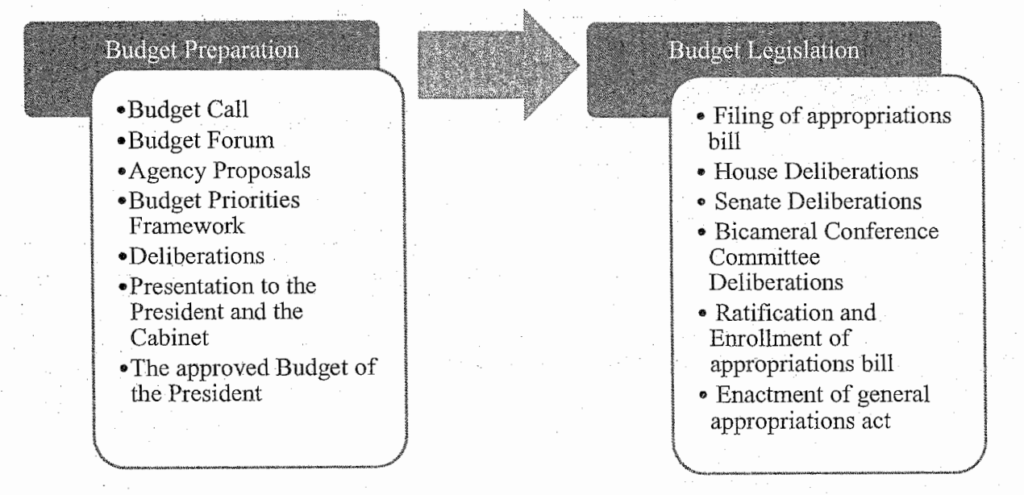
Ms. Suzara clarifies that the annual budget is composed of (1) Automatic Appropriations;¹⁴⁵ (2) New General Appropriations,¹⁴⁶ which consist of (i) Programmed Appropriations¹⁴⁷ and (ii) Unprogrammed Appropriations.¹⁴⁸
Ms. Suzara observes that historically, the level of Unprogrammed Appropriations in the enacted version of the Budget does not deviate from its proposed level in the NEP, except for fiscal years 2022, 2023, and 2024. Specifically, in the 2024 Budget, Congress fully or partially defunded multiple programs of various departments and agencies of the National Government from the Programmed Appropriations and reallocated them to the Unprogrammed Appropriations. This budget reallocation resulted in an excess of PHP 450 billion worth of programs and projects under the Unprogrammed Appropriations. Thus, from a proposed level of PHP 282 billion in the 2024 NEP, the Unprogrammed Appropriations ballooned to PHP 732 billion in the 2024 GAA.¹⁴⁹
Ms. Suzara opines that the 2024 Budget showed that the freed up fiscal space in the Programmed Appropriations went to departments where the hard and soft projects of legislators are traditionally lodged, such as local infrastructure projects of the Department of Public Works and Highways (DPWH).¹⁵⁰ She describes this as a “new scheme of massively funding pork barrel” and circumvents the Court’s ruling in Belgica v. Ochoa.¹⁵¹
Finally, Ms. Suzara submits that Special Provision 1(d) and DOF Circular 003-2024, should be declared unconstitutional. Special Provision 1(d) violates both the earmarking provision of the Sin Tax Laws and the prohibition against transferring any portion of PhilHealth’s “reserve fund” under the UHCA.¹⁵²
On October 8, 2025, the OSG submitted its Motion for Leave to File and Admit Manifestation and Motion, praying that the Petitions be dismissed for mootness in view of the announcement of President Marcos, Jr. that the PHP 60 billion excess funds of PhilHealth will be returned to the latter, and that the DBM is currently working with the Congress and the Executive to implement such restoration.
Issues
First. Are the requisites for a valid exercise of the expanded power of judicial review present?
Second. Is the 2024 GAA unconstitutional for bearing the certification of urgency by the president despite the alleged absence of a public calamity or emergency?
Third. Are Special Provision No. 1(d) and its implementing DOF Circular No. 003-2024 unconstitutional?
a) Is Special Provision No. 1(d), as implemented by DOF Circular No. 003-2024, an unconstitutional rider or an inappropriate provision in the 2024 GAA?
b) Does the transfer of PhilHealth funds to the National Treasury violate the people’s right to health, Section 11 of the UHCA, the Sin Tax Laws, and Article VI, Section 29(3) of the Constitution?
c) Is the DOF authorized to direct the transfer of savings of GOCCs back to the National Treasury under Article VI, Section 25 of the Constitution?
Fourth. Does DOF Circular No. 003-2024 violate Section 70 of the 2023 GAA insofar as it orders the transfer of PhilHealth funds the National Treasury before December 30, 2024?
Fifth. May alleged culpability for technical malversation and/or plunder in the so-called illegal transfer of PhilHealth funds be adjudged in the present cases?
Sixth. May petitioners properly seek guidelines from the Court on how and when the President may exercise his or her power to certify a bill for immediate enactment?
Seventh. Assuming that Special Provision 1(d) and DOF Circular No. 003-2024 are declared unconstitutional, may the Court order the return of the PHP 60 billion PhilHealth funds that have already been transferred to the National Treasury in 2024?
There are other issues raised in the petitions specifically pertaining to the creation, powers, and actions of the BCC vis-a-vis the enactment of the 2024 GAA, including the inclusion of unprogrammed appropriations or budgetary allocations for items or amounts not provided in the NEP. Significantly, the same legal questions are the core issues involved in G.R. No. 277975 titled Rodriguez, et al. v. House of Representatives, Senate of the Philippines, and Executive Secretary Lucas P. Bersamin; and G.R. Nos. 271059 & 271347 titled Lagman v. Congress, et al. Thus, in order not to preeınpt our actions on these twin cases, the Court defers its full discussion and resolution of the aforesaid legal issues in G.R. 277975 and G.R. Nos. 271059 & 271347, respectively.
Our Ruling
At the outset, the Court has resolved to drop the
President as a respondent in G.R. No. 275405
Foremost, the Court has resolved to drop President Marcos, Jr. as a respondent in G.R. No. 275405. He is immune from suit. We have so decreed in our Resolution¹⁵³ dated February 11, 2025. In De Lima v. President Duterte,154 the Court has lengthily discussed the origin and concept of presidential immunity from suit and affirmed that in the Philippines, the incumbent President may not be sued during his or her tenure, regardless of whether the suit arose from his or her official acts.155 As the incumbent sitting president, therefore, President Marcos, Jr. should not be sued as a respondent here. So must it be.
We now tackle the aforestated procedural and substantive issues.
All requisites for the exercise of the expanded
power of judicial review are present
Once again, the Court is called upon to exercise its extraordinary power of judicial review as part of the grand design of the Constitution’s principle of checks and balances to determine the constitutionality of the assailed acts of its co-equal branches—the Legislative and the Executive.
Article VIII, Section 1 of the Constitution vests the Judiciary with the expanded power of judicial review, empowering courts not only to settle actual controversies but to also determine grave abuse of discretion by any government branch or instrumentality, thus:
Section 1. The judicial power shall be vested in one Supreme Court and in such lower courts as may be established by law.
Judicial power includes the duty of the courts of justice to settle actual controversies involving rights which are legally demandable and enforceable, and to determine whether or not there has been a grave abuse of discretion amounting to lack or excess of jurisdiction on the part of any branch or instrumentality of the Government. (Emphasis supplied)
This expanded jurisdiction was enacted into the constitutional framework not only as a power but also as a duty which cannot be abdicated when the political question doctrine is invoked.156 The Court has enforced this constitutional mandate of curbing grave abuse of discretion by any branch of government.¹⁵⁷ A Rule 65 certiorari petition is the remedy for invoking this mandate.158
Consistent with the requisites of a Rule 65 petition, the Court’s exercise of this expanded power of judicial review is limited to a determination of grave abuse of discretion. It does not contemplate errors of law159 but palpable errors of jurisdiction, violations of the Constitution, the law and jurisprudence, and gross misapprehension of facts.160
Indeed, the Court’s expanded power of judicial review is so extraordinary that the mere invocation of the political question doctrine does not bar the Court from exercising this power. A political question exists when the issue does not call on the Court to adjudicate legality but to determine the wisdom or unwisdom or the desirability or undesirability of a law or a governmental act.161
In several cases, the Court even disregarded the plea for judicial restraint arising from the invocation of the political question doctrine when constitutional boundaries must be properly allocated.162 For instance, the Court in Belgica v. Ochoa163 ruled on budget-related reforms legislated by political branches despite objections based on the political question doctrine, thus:
It must also be borne in mind that “when the judiciary mediates to allocate constitutional boundaries, it does not assert any superiority over the other departments; does not in reality nullify or invalidate an act of the legislature [or the executive], but only asserts the solemn and sacred obligation assigned to it by the Constitution.” To a great extent, the Court is laudably cognizant of the reforms undertaken by its co-equal branches of government. But it is by constitutional force that the Court must faithfully perform its duty. Ultimately, it is the Court’s avowed intention that a resolution of these cases would not arrest or in any manner impede the endeavors of the two other branches but, in fact, help ensure that the pillars of change are erected on firm constitutional grounds. After all, it is in the best interest of the people that each great branch of government, within its own sphere, contributes its share towards achieving a holistic and genuine solution to the problems of society. For all these reasons, the Court cannot heed respondents’ plea for judicial restraint.¹⁶⁴ (Emphasis supplied)
Francisco, Jr. v. House of Representatives¹⁶⁵ ordained that the standard by which to determine if a case is justiciable despite the invocation of the political question doctrine is to inquire whether the power or functions have been conferred upon political bodies; and if so, the courts are duty-bound to examine whether the branch or instrumentality of the government properly acted within these limits.¹⁶⁶
Here, the issues require the Court to determine the constitutional boundaries set on the power of the purse lodged exclusively in the Congress and the power of the President to faithfully execute the laws and certify urgent bills. The Court’s exercise of its expanded judicial power to review the acts of political bodies does not offend the separation of powers, but in fact upholds the Court’s duty to ensure that pillars of change are erected on firm constitutional grounds.¹⁶⁷ As such, we cannot sustain respondents’ argument that the current issues are beyond the jurisdiction of the Court for being allegedly allocated to the wisdom of political bodies alone. For whether there are already boundaries set by law regarding the exercise of the powers of political bodies and whether these boundaries have been breached are issues open to our expanded power of judicial review.
However, our jurisdiction to adjudicate the issues in these cases does not mean that we have to exercise the same. There are requisites for the exercise the Court’s expanded power of judicial review, viz.: (1) an actual case or controversy; (2) a personal and substantial interest of the party raising the constitutional question; (3) the exercise of judicial review is pleaded at the earliest opportunity; and (4) the constitutional question is the very lis mota of the case. Only when these requisites are satisfied may the Court rule upon the constitutionality or unconstitutionality of an assailed act.¹⁶⁸
The Court holds that the four requisites for the exercise of its expanded power of judicial review are all present here.
One. An actual case or controversy exists when there is a conflict of legal rights or an assertion of opposite legal claims between the parties that is susceptible or ripe for judicial resolution. The contrariety of legal rights must be one that can be interpreted and enforced on the basis of existing laws including jurisprudence. This controversial status should be distinguished from a hypothetical or abstract difference or dispute when the litigants simply have a difference of opinion on what the law is but without any connection to any personal and substantial interest in a matter where they have sustained or will sustain direct injury as a result of the governmental act being challenged. In the negative, a justiciable controversy must neither be conjectural nor moot.¹⁶⁹ How this requisite can be established has also been simplified by the Court by just requiring a reasoned prima facie showing of an alleged grave abuse of discretion involving the assailed governmental act.¹⁷⁰
The contrariety of legal rights was satisfied in these cases by the antagonistic or conflicting reasoned positions¹⁷¹ of the parties vis-à-vis the constitutionality of Special Provision 1(d) and DOF Circular No. 003-2024.
The cases are also ripe for adjudication. As of date, PHP 60 billion of public funds was already remitted to the National Treasury allegedly contrary to the Constitution and other laws. There is therefore a prima facie demonstration of grave abuse of discretion given the reasoned allegations of petitioners that the remittance of these funds is unconstitutional or illegal. Of course, this prima facie showing is opposed by respondents by their own reasoned allegations.
The doctrine of hierarchy of courts states that “recourse must first be made to the lower-ranked court exercising concurrent jurisdiction with a higher court.” Thus, a petition must first be brought before the lowest court with jurisdiction and then appealed until it reaches the Court. The concurrent jurisdictions of courts do not give the party discretion on where to initiate a case or file a petition seeking the exercise of expanded judicial review. Non-compliance with this requirement is a ground for dismissal.¹⁷²
On the other hand, under the doctrine of exhaustion of administrative remedies, a party must first resort to all available administrative processes before seeking a court’s intervention. The administrative officer must first be given every opportunity to decide on the matter within his or her jurisdiction. Failing to exhaust administrative remedies affects the party’s cause of action as these remedies refer to a precedent condition which must be complied with prior to filing a case in court.¹⁷³
Procedurally, observance of the doctrines of hierarchy of courts and exhaustion of administrative remedies is a first-grade requirement for a remedy pursuant to Rule 65 of the Rules of Court. This requisite is found in Rule 65 itself when it states there being “no other plain, speedy and adequate remedy found in law.”¹⁷⁴ Constitutionally, the failure to abide by this step affects the ripeness of the case, which is necessary for the Court to adjudicate the constitutionality or validity of a governmental act. This, in turn, affects the existence of an actual case or controversy. As elucidated in Association of Medical Clinics for Overseas Workers, Inc. (AMCOW) v. GCC Approved Medical Centers Association, Inc.:¹⁷⁵
A basic requirement under Rule 65 is that there be “no other plain, speedy and adequate remedy found in law,” which requirement the expanded jurisdiction provision does not expressly carry. Nevertheless, this requirement is not a significant distinction in using the remedy of certiorari under the traditional and the expanded modes. The doctrine of exhaustion of administrative remedies applies to a petition for certiorari, regardless of the act of the administrative agency concerned, i.e., whether the act concerns a quasi-judicial, or quasi-legislative function, or is purely regulatory.
………………
Additionally, the failure to exhaust administrative remedies affects the ripeness to adjudicate the constitutionality of a governmental act, which in turn affects the existence of the need for an actual case or controversy for the courts to exercise their power of judicial review. The need for ripeness—an aspect of the timing of a case or controversy—does not change regardless of whether the issue of constitutionality reaches the Court through the traditional means, or through the Court’s expanded jurisdiction. In fact, separately from ripeness, one other concept pertaining to judicial review is intrinsically connected to it: the concept of a case being moot and academic.¹⁷⁶ (Emphasis in the original, citations omitted)
Ordinarily, therefore, the doctrines of hierarchy of courts¹⁷⁷ and exhaustion of administrative remedies¹⁷⁸ demand compliance. These doctrines, however, are not iron-clad rules and are subject to exceptions, such as when there is no other ordinary, speedy, and adequate remedy available and when the issues involved are of transcendental importance.
Gios-Samar, Inc. v. DOTC¹⁷⁹ clarified that the common denominator of the generally accepted exceptions to the doctrine of hierarchy of courts is the requirement that the issues raised in the case must be pure questions of law. As guidance, the Court emphasized:
Accordingly, for the guidance of the bench and the bar, we reiterate that when a question before the Court involves determination of a factual issue indispensable to the resolution of the legal issue, the Court will refuse to resolve the question regardless of the allegation or invocation of compelling reasons, such as the transcendental or paramount importance of the case. Such question must first be brought before the proper trial courts or the [Court of Appeals], both of which are specially equipped to try and resolve factual questions.¹⁸⁰ (Emphasis supplied)
Similarly, the doctrine of exhaustion of administrative remedies admits of exceptions, two of these are where the question involved is purely legal and will ultimately be decided by the courts of justice and where judicial intervention is urgent,¹⁸¹ thus:
Nonetheless, the doctrine of exhaustion of administrative remedies and the corollary doctrine of primary jurisdiction, which are based on sound public policy and practical considerations, are not inflexible rules. There are many accepted exceptions, such as: (a) where there is estoppel on the part of the party invoking the doctrine; (b) where the challenged administrative act is patently illegal, amounting to lack of jurisdiction; (c) where there is unreasonable delay or official inaction that will irretrievably prejudice the complainant; (d) where the amount involved is relatively small so as to make the rule impractical and oppressive; (e) where the question involved is purely legal and will ultimately have to be decided by the courts of justice; (f) where judicial intervention is urgent; (g) when its application may cause great and irreparable damage; (h) where the controverted acts violate due process; (i) when the issue of non-exhaustion of administrative remedies has been rendered moot; (j) when there is no other plain, speedy and adequate remedy; (k) when strong public interest is involved; and, (l) in quo warranto proceedings.¹⁸² (Emphasis supplied, citation omitted)
Here, the consolidated Petitions raise pure questions of law hinged on whether the enactment of the 2024 GAA and the transfer of the fund balance of PhilHealth to the National Treasury through Special Provision 1(d) and DOF Circular No. 003-2024 was tainted with grave abuse of discretion amounting to excess or lack of jurisdiction. In petitions involving pure questions of law, as in here, the Court has the ultimate discretion whether to abbreviate the review process by opting to hear and decide the legal issues outright based on the unique circumstances of the case.183
The exigencies of the matter at hand render ordinary remedies inadequate. PHP 60 billion of the funds of PhilHealth was already remitted to the National Treasury. These are funds that, if proven to have been transferred contrary to the Constitution and other laws, could have been otherwise utilized for the health care benefits of the Filipino people under the NHIP. The prompt disposition of the issues relating to these funds is therefore imperative. To be sure, the juggling of these funds has emanated from the highest levels of discretionary authority. Indeed, in situations like the one at bar, the Court has not hesitated to take cognizance of matters where ordinary remedies are plainly inadequate, or more precisely, incommensurate.
Two. Locus standi or legal standing is defined as a personal and substantial interest in the case such that the party has sustained or will sustain direct injury as a result of the governmental act that is being challenged. To have legal standing, therefore, a litigant must show that he or she has sustained or will sustain a “direct injury” as a result of a government action or has a “material interest” in the issue affected by the challenged official act.184 This is the traditional mode of standing.
It is clear that individual petitioners Pimentel III, et al.185 and Atty. Matula, et al.186 in G.R No. 274778 and petitioners 1Sambayan Coalition et al. in G.R. No. 276223187 are claiming direct injury being direct contributors to the NHIP. On the other hand, petitioners PMA, PSLINK and SENTRO in G.R. No. 274778 assert this direct injury on behalf of their respective members which, contrary to respondents’ position, was duly substantiated in their respective Compliances dated October 14, 2024, and October 16, 2024.
We affirm petitioners’ locus standi. As direct contributors who have consistently paid their premiums to PhilHealth, petitioners stand to be directly and materially injured by the assailed governmental acts which undisputedly affect and involve PhilHealth funds. As beneficiaries of the NHIP, they possess a legal interest in the effective management and utilization of these funds. Therefore, petitioners are entitled to a categorical determination of, or a court decision on, whether the transfer of PhilHealth funds to the National Treasury is constitutional, nay valid.
In any event, the Court may allow suits even if the petitioner fails to show direct injury as the rule on standing is a matter of procedure which can be relaxed when public interest so requires, such as when the matter is of transcendental importance, overarching significance to society, or paramount public interest.188 This is the nontraditional or liberal mode of standing.
Under this mode, nontraditional litigants may be accorded standing to sue by the Court, provided the following requisites are present: first, for taxpayers, a claim of illegal disbursement of public funds or that the tax measure is unconstitutional; second, for voters, a showing of obvious interest in the validity of the election law in question; third, for concerned citizens, a showing that the issues raised are of transcendental importance which must be settled early; and finally, for legislators, a claim that the official action complained of infringes their prerogatives as legislators.189
We find merit in petitioners’190 uniform assertion of standing as citizens-taxpayers assailing an alleged illegal disbursement of public funds. Clearly, the transfer of PhilHealth funds to the National Treasury involves the transfer of taxes paid in part by petitioners. As prefaced, the funding structure of PhilHealth involves earmarked funds of excise taxes on alcohol, tobacco, heated tobacco and vapor products under the Sin Tax Laws for the implementation of the UHCA. Even if, as respondents allege, the funds remitted consisted of government subsidies or appropriations for indirect members, still this remittance has an impact or effect on PhilHealth’s situation as a whole, as petitioners have correctly pointed out. True or not, petitioners’ standing must be recognized so the nature of the PhilHealth funds remitted to the National Treasury and the impact of this remittance on PhilHealth’s role as a publicly mandated health insurer would be satisfactorily resolved.
As in Belgica,191 petitioners here, as taxpayers, possess the requisite standing to question the validity of Special Provision 1(d) and DOF Circular No. 003-2024 which seek to utilize the taxes they paid to fund unprogrammed appropriations. Belgica relevantly decreed:
It is undeniable that petitioners, as taxpayers, are bound to suffer from the unconstitutional usage of public funds, if the Court so rules. Invariably, taxpayers have been allowed to sue where there is a claim that public funds are illegally disbursed or that public money is being deflected to any improper purpose, or that public funds are wasted through the enforcement of an invalid or unconstitutional law, as in these cases.192 (Emphasis supplied)
Petitioners have equally fulfilled the standing requirement as citizens since the issues raised are matters of transcendental importance, overreaching significance to society, and paramount public interest.193 Our country’s population has ballooned to more than 100 million194 as of the latest census of population and housing of the Philippine Statistics Authority (PSA). This is more than 100 million Filipinos spread all over the archipelago who require health care coverage by PhilHealth.
With this magnitude and immensity of PhilHealth’s responsibility, the remittance of PHP 60 billion gave petitioners reasonable grounds to assert that this governmental action affected PhilHealth’s ability to fulfill its mandate as the people’s insurer for the provision of coverage for healthcare goods and services. There is here a clash between the all-important right to health and life vis-à-vis the implementation of mandated fiscal policies. As petitioners aptly argue, the constitutional issues raised here are of transcendental importance to everyone as these issues revolve around our right to health and stable and responsive health care vis-à-vis the government’s avowed duty to maintain fiscal stability.
Three. The question of constitutionality was raised at the earliest possible opportunity. Our jurisprudence traditionally applied the “earliest opportunity” element of judicial review vertically, i.e., the constitutional argument must have been raised very early in any of the pleadings or processes prior in time in the same case. But this does not preclude the Court from adopting the horizontal test of “earliest opportunity” observed in the United States, i.e., constitutional questions must be preserved by raising them at the earliest opportunity after the grounds for objection become apparent. Otherwise stated, the threshold is not only whether the earliest opportunity was in the pleadings and processes prior in time in the same case, but also whether the grounds for the constitutional objection were already apparent when a prior case relating to the same issue and involving the same petitioner was being heard.195
In these cases, the constitutionality of the assailed issuances was raised at the earliest opportunity during the lifetime of the 2024 GAA and DOF Circular No. 003-2024 and immediately before their implementation. Thus, the relevant constitutional issues here were raised as soon as the constitutional objections became apparent.
Four. The issue of constitutionality is the very lis mota of the cases. Lis mota literally means “the cause of the suit or action.”196 It pertains to the requirements of judicial review where the Court will not pass upon a question of unconstitutionality, though properly presented, if the case can be disposed of on some other ground, such as the application of relevant statutes or any other law. The petitioner must show that the case cannot be resolved at all unless the constitutional question raised is determined. This requirement is based on the rule that every law has in its favor the presumption of constitutionality so that a mere doubt as to its constitutionality is resolved against such doubt. To justify the nullification of a law, there must be a clear and unequivocal breach of the Constitution, and not one that is doubtful, speculative, or argumentative.197
Thus, courts will not touch upon the issue of constitutionality unless it is unavoidable and, in instances where the Court has declined to exercise judicial review, the constitutional issue was far removed from the governmental act sought to be invalidated such as when the constitutionality of a separate and distinct matter must first be resolved in order to, in effect, invalidate another.198
Here, the constitutionality of the contents of, and the procedure for the enactment of, Special Provision 1(d) and the issuance of DOF Circular No. 003-2024 is at issue. The allegations and competing assertions of the parties show that the validity of the assailed issuances cannot be disposed of in any other way except through the constitutional assessment by the Court.
However, respondents view the present cases in this light that the issues around these cases could be resolved simply by the correct conceptualization and recomputation of PhilHealth’s “reserve funds”, which is distinct from the “fund balance” referred to in Special Provision 1(d) and DOF Circular No. 003-2024. Viewed this way, respondents posit that the remittance of PHP 60 billion of PhilHealth funds to the National Treasury has nothing to do with Section 11 of the UHCA.
We cannot agree.
Respondents’ perspective on the difference between “reserve funds” as regulated by Section 11 of the UHCA and “fund balance” as ordained to be remitted to the National Treasury is at this stage just that—a perspective from respondents or a matter of respondents’ argument or defense. It is still not a fact nor an accepted proposition as to avoid a constitutional litigation.
To be sure, respondents cannot skirt the essential constitutional issues involved here by framing them from their perspective of a mere conceptualization and recomputation of numbers. The facts on which this argument lies have yet to be vetted, clarified, and resolved through a careful scrutiny and interpretation of the laws relevant to the assailed transfer of funds by virtue of Special Provision 1(d) and DOF Circular No. 003-2024.
In sum, with the affirmation that the Court has jurisdiction to resolve the issues raised here and that the requisites of judicial review are all present in these cases, the Court finds it proper to exercise its expanded power of judicial review here and now.
The president did not commit grave abuse of discretion
when he certified as urgent House Bill No. 8980
To begin with, the president’s act of certifying House Bill No. 8980 and the factual circumstances that caused him to do so do not involve an exercise of judicial, quasi-judicial, or ministerial functions that are ordinarily reviewable under Rule 65. Rather, the President’s decision to certify the bill is a matter of policy which he alone may determine as the chief executive. Even then, the Court is not precluded from determining whether it is tainted with grave abuse of discretion pursuant to its expanded power of judicial review.
When the president exercises his or her prerogative under Article VI, Section 26(2) of the Constitution and certifies the immediate enactment of a bill, he or she exercise his or her full and binding discretionary power. It is thus incumbent upon Atty. Colmenares et al. to show that the president’s decision to certify House Bill No. 8980 was restricted in terms of basis and timing.
In his separate opinion,199 Associate Justice Henri Jean Paul Inting cited David v. Macapagal-Arroyo200 and Republic Act No. 10121 or the “Philippine Disaster Risk Reduction and Management Act of 2010” as basis to define what constitutes an “emergency.” In David v. Macapagal-Arroyo,201 We clarified that emergency, in its generic sense, “connotes the existence of conditions suddenly intensifying the degree of existing danger to life or well-being beyond that which is accepted as normal.” Meanwhile, Republic Act No. 10121202 defines emergency as “unforeseen or sudden occurrence, especially danger, demanding immediate action.”
In fine, public calamity or emergency does not only refer to physical calamities or emergencies, like pandemics, typhoons or earthquakes. This phrase refers to anything that in the president’s reasoned opinion causes or has the effect of causing harm, suffering, or damage, typically but not always, involving a large number of people and resulting in significant loss of life or property. It may even revolve around a disruption to normal life. The triggering event can stem from natural disasters and human-made incidents that threaten public safety and well-being, including both widespread and localized impact on daily routines, access to essential services, or the overall or aspectual social fabric of a community.
The timing of the public calamity or emergency does not have to be a present occurrence or a clear and present likelihood of occurrence. A mere possibility of it happening in the future is enough to certify a bill as urgent.
For House Bill No. 8980, the president issued the assailed certification because he recognized the importance of the timely passage of the 2024 GAA to sufficiently address the government’s priorities, goals, and needs for the 2024 fiscal year. True, Article VI, Section 25(7)203 of the Constitution provides that in case of delay in the enactment of the general appropriations law for the succeeding year, the prior one is deemed re-enacted. But there is a clear and convincing value in the OSG’s averment that the passage of a general appropriations law tailor-fit to the needs and priorities of the government for the following year is not only desired, but necessary and urgent, in order to achieve the ever-shifting development goals and address the ever-evolving internal and external concerns of the country. The president and the entire government structure cannot just sit idly by and wait for developments to overwhelm our governmental capacities and resources.
On the other hand, apart from arguing that the president’s reason for certifying as urgent House Bill No. 8980 was unjustified since there was allegedly no point in rushing the passage of the 2024 GAA as early as September 2023, Atty. Colmenares et al. proffered no other reason to support their assertion that the president’s certification was tainted with grave abuse of discretion amounting to excess or lack of jurisdiction. Between their unsubstantiated claim and the cogent ratiocination posited by the OSG, the latter must prevail.
In any event, the only appropriate judge of whether a certification of urgency is proper is the Congress. No one else. Not even the Court, absent any proof that it is tainted with grave abuse of discretion. It is for the Congress that this certification is intended; and so, it is the Congress alone which stands as the judge of its proper usage.
In this light, We take judicial notice that the Congress accepted the president’s certification for the immediate enactment of House Bill No. 8980 under his Letter dated September 20, 2023 addressed to Speaker Romualdez. Consequently, House Bill No. 8980 was approved by the House of Representatives on Second and Third Readings. Meanwhile, House Bill No. 8980 was read in the Senate on First Reading on November 6, 2023; on Second Reading with amendments, and on Third Reading both on November 28, 2023.
That Congress accepted the president’s certification for the immediate passage of House Bill No. 8980 was reinforced during the oral arguments by Associate Justice Japar B. Dimaampao (Justice Dimaampao)204 when he elicited from Atty. Colmenares himself that “[f]rom the records of the House and the Senate, the House and the Senate accepted the certification of the President.“
We emphasize anew that the Court cannot overrule the wisdom of the president and the wisdom of the Congress and substitute its own.205 The Court is enjoined by the long standing principle of separation of powers to give due deference and respect to the exercise of a constitutional prerogative by a co-equal branch of government absent any grave abuse of discretion, amounting to excess or lack of jurisdiction,206 as in these cases.
On whether the presidential certification violated the constitutional requirement that printed copies of a bill shall be distributed to members of the Congress in advance before it is subjected to a vote for approval, Tolentino v. Secretary of Finance207 has long settled that a presidential certification for immediate enactment of a bill dispenses not only with the requirement of reading on three separate days but also the requirement of printing and distribution of printed copies in advance. Thus:
…The presidential certification dispensed with the requirement not only of printing but also that of reading the bill on separate days. The phrase “except when the President certifies to the necessity of its immediate enactment, etc.” in Art. VI, § 26(2) qualifies the two stated conditions before a bill can become a law: (i) the bill has passed three readings on separate days and (ii) it has been printed in its final form and distributed three days before it is finally approved.
In other words, the “unless” clause must be read in relation to the “except” clause, because the two are really coordinate clauses of the same sentence. To construe the “except” clause as simply dispensing with the second requirement in the “unless” clause (i.e., printing and distribution three days before final approval) would not only violate the rules of grammar. It would also negate the very premise of the “except” clause: the necessity of securing the immediate enactment of a bill which is certified in order to meet a public calamity or emergency. For if it is only the printing that is dispensed with by presidential certification, the time saved would be so negligible as to be of any use in insuring immediate enactment. It may well be doubted whether doing away with the necessity of printing and distributing copies of the bill three days before the third reading would insure speedy enactment of a law in the face of an emergency requiring the calling of a special election for President and Vice-President. Under the Constitution such a law is required to be made within seven days of the convening of Congress in emergency session.
That upon the certification of a bill by the President the requirement of three readings on separate days and of printing and distribution can be dispensed with is supported by the weight of legislative practice. For example, the bill defining the certiorari jurisdiction of this Court which, in consolidation with the Senate version, became Republic Act No. 5440, was passed on second and third readings in the House of Representatives on the same day (May 14, 1968) after the bill had been certified by the President as urgent.
There is, therefore, no merit in the contention that presidential certification dispenses only with the requirement for the printing of the bill and its distribution three days before its passage but not with the requirement of three readings on separate days, also.208 (Emphasis supplied)
There is therefore no merit to the assertion of Atty. Colmenares et al. that the Congress undertook an unlawful short-cut in enacting the 2024 GAA when the distribution of the printed copies of the bill in question was dispensed with before it was submitted for approval.
At any rate, Our pronouncement on the enactment of the 2024 GAA in general is one thing, the issue on the constitutionality of Special Provision 1(d) is another.
Special Provision 1(d) must be struck down for being a rider
or an inappropriate provision due to its ambiguity and
amendatory effect on Section 11 of the UHCA and the
Sin Tax Laws and for being violative of Article VI,
Section 29(3) of the Constitution, diverting the
“reserve funds” of PhilHealth for
a different purpose
I. Test of Germaneness: Special Provision 1(d) is ambiguous.
A general appropriations law is a special kind of legislation, which Congress is constitutionally obliged to enact every year to ensure the seamless continuation of the business and operations of the government. Each line appropriation in a general appropriations bill authorizes the expenditure of public funds for a project, program, or operation of the government and all its agencies and instrumentalities. As such, an appropriations bill, especially the annual general appropriations bill, necessarily covers a broader range of subject matter and includes more details compared to an ordinary bill. Consequently, the title of an appropriations bill cannot be any broader as it is since it may not be feasible to craft a title that embraces all the details included in it.209
Generally, the Constitution prohibits bills from containing riders or provisions which are alien to or not germane to the subject or purpose of the bill in which they are incorporated.210 Section 26(1), Article VI of the Constitution requires that “(e)very bill passed by Congress shall embrace only one subject which shall be expressed in the title thereof”, thus, prohibiting bills from containing riders or provisions which are not germane to their subject or purpose.211 For general appropriations bills, the harm sought to be prevented by this constitutional prohibition is heightened because of their exponentially broader coverage.
To curb abuses that may be concealed through the voluminous items in an appropriations bill, Article VI, Section 25(2) of the Constitution commands that all provisions of a general appropriations bill must be germane to the purpose of the law:
Section 25…. (2) No provision or enactment shall be embraced in the general appropriations bill unless it relates specifically to some particular appropriation therein. Any such provision or enactment shall be limited in its operation to the appropriation to which it relates.
The test of germaneness is meant to prevent hodge-podge or log-rolling legislation. It is a protective mechanism to avoid surprise or fraud upon the legislature and to fairly apprise the people of the subjects of legislation that are being considered.213 A provision in a general appropriations bill complies with the test of germaneness if it is particular, unambiguous, and appropriate.213 Atitiw v. Zamora214 elucidates:
Therefore, in order that a provision or clause in a general appropriations bill may comply with the test of germaneness, it must be particular, unambiguous, and appropriate. A provision or clause is particular if it relates specifically to a distinct item of appropriation in the bill and does not refer generally to the entire appropriations bill. It is unambiguous when its application or operation is apparent on the face of the bill and it does not necessitate reference to details or sources outside the appropriations bill. It is an appropriate provision or clause when its subject matter does not necessarily have to be treated in a separate legislation.216 (Emphasis supplied)
Conversely, Philippine Constitution Association v. Enriquez216 identifies which provisions in a general appropriations bill are “inappropriate,” thus, must be struck down:
As the Constitution is explicit that the provision which Congress can include in an appropriations bill must “relate specifically to some particular appropriation therein” and “be limited in its operation to the appropriation to which it relates,” it follows that any provision which does not relate to any particular item, or which extends in its operation beyond an item of appropriation, is considered “an inappropriate provision” which can be vetoed separately from an item. Also to be included in the category of “inappropriate provisions” are unconstitutional provisions and provisions which are intended to amend other laws, because clearly these kinds of laws have no place in an appropriations bill. These are matters of general legislation more appropriately dealt with in separate enactments. Former Justice Irene Cortes, as Amicus Curiae, commented that Congress cannot by law establish conditions for and regulate the exercise of powers of the President given by the Constitution for that would be an unconstitutional intrusion into executive prerogative.217 (Emphasis supplied)
Under Article VI, Section 25(2) of the Constitution, the following provisions must be struck down for being inappropriate: (1) provisions that do not relate specifically to some particular appropriation; (2) even if they relate to some particular appropriation, they nonetheless violate the Constitution; or (3) provisions that intend to amend or repeal, or have the effect of amending or repealing, existing laws.
Special Provision 1(d) is particular as it relates to a particular appropriation in the 2024 GAA, i.e., the unprogrammed appropriations, which do not have definite funding sources, save for foreign assisted projects funded by foreign loans, thus:218
Special Provision(s)
1. Availment of the Unprogrammed Appropriations. The amounts authorized herein for Purpose Nos. 1, 3-5, and 7-51 may be used when any of the following exists:
(a) Excess revenue collections in the total tax revenues of any one of the identified non-tax revenue sources from its corresponding revenue collection target, as reflected in the 2024 BESF submitted by the President;
(b) New revenue collections or those arising from new tax or non-tax sources which are not part of, nor included in, the original revenue sources reflected in the BESF;
(c) Approved loans for foreign-assisted projects; or
(d) Fund balance of the Government-Owned or -Controlled Corporation (GOCCs) from any remainder resulting from the review and reduction of their reserve funds to a reasonable level taking into account disbursement from prior years.
The Department of Finance shall issue the guidelines to implement this provision within fifteen (15) days from effectivity of this Act. (Emphasis supplied)
On its face, Special Provision 1(d) provides the sources of funds including the conditions for the utilization of the allocated funds therefor, i.e., among others, that there be a fund balance from a GOCC.
While it satisfied the requirement of particularity, Special Provision 1(d) is ambiguous. As aptly observed by the erudite Justice Maria Filomena D. Singh (Justice Singh), the ambiguity of the subject provision can be gleaned from its introduction of the concept of “fund balance.”219
As will be further discussed, the definition of “fund balance” was not found in the 2024 GAA. It was merely referred to as the “remainder” resulting from the review and reduction of a GOCC’s reserve funds to “reasonable levels,” taking into account disbursements from prior years.
Yet, two questions arise from this definition, casting ambiguity on the provision. First, what is the composition of the so-called “fund balance”? Second, what does “reasonable levels” mean?
The existence of these questions suggests a clear conclusion: Special Provision 1(d) is ambiguous. The components of the so-called “fund balance” are unclear. The concept of “reserve funds” of GOCCs is undefined. Even the reduction of the reserve funds of GOCCs at “reasonable levels” is vague because it lacks objective criteria. The process for reviewing and reducing the “reserve funds” in itself is unspecified.
To hit the nail on the head, the DOF was in fact required to issue guidelines to supply the details for the implementation of this provision. In contrast, the other identified sources of funding for unprogrammed appropriations—items (a) to (c)—do not require supplementary issuances from the DOF.
While administrative bodies may validly promulgate implementing rules and regulations, it is axiomatic that their rule-making power is limited to what is found in the legislative enactment itself. It cannot extend the law or expand its coverage, as the power to amend or repeal a statute is vested in the legislature.220
In other words, implementing rules and regulations shall only carry out the provisions of the law. They only echo what is found in the law. They shall not be used as a vehicle to cure ambiguities in the law. It cannot supplant what is not found in its express provisions. Where the law itself is vague, reliance on IRRs to operationalize it is tantamount to an undue delegation of legislative power, as here.
On this score alone, We are already constrained to rule that Special Provision 1(d) is an unconstitutional rider to the 2024 GAA.
Still, assuming arguendo that Special Provision 1(d) satisfied the requirement of germaneness, it is not enough that the bill must relate to some particular appropriation and is unambiguous. As enunciated in Philippine Constitution Association v. Enriquez,221 there is another indicative test: does it violate the Constitution or repeal or amend an existing substantive law?
Conversely, is it an appropriate provision properly included in an appropriations bill or should it instead be the subject of a separate legislation? If the answer to the latter question is “yes,” the contested provision successfully refutes the suspicion that it is a rider and upholds its validity as an appropriate provision.
In Gov. Mandanas v. Hon. Romulo,222 We emphasized that the Congress is not allowed to amend statutes through a general appropriations law but must enact a separate law for such amendment, thus:
The respondents argue that this modification is allowed since the Constitution does not specify that the “just share” of the LGUs shall only be determined by the Local Government Code of 1991. That it is within the power of Congress to enact other laws, including the GAAs, to increase or decrease the “just share” of the LGUs. This contention is untenable. The Local Government Code of 1991 is a substantive law. And while it is conceded that Congress may amend any of the provisions therein, it may not do so through appropriations laws or GAAs. Any amendment to the Local Government Code of 1991 should be done in a separate law, not in the appropriations law, because Congress cannot include in a general appropriations bill matters that should be more properly enacted in a separate legislation.223 (Emphasis supplied, citations omitted)
In that case, the Court struck down provisions of the 1999, 2000, and 2001 GAAs that intended to increase or decrease the internal revenue allotments of local government units. It held that these provisions were inappropriate, not only because they unduly infringed the fiscal autonomy of local government units, but also since they amended the provisions of the Local Government Code of 1991.
Here, We find that Special Provision 1(d) is equally infirm because it amended the provisions of the UHCA and the Sin Tax Laws.
There are two kinds of repeal under the law: express repeal and implied repeal. There is express repeal when a statute expressly declares, usually in its repealing or amendatory clause, that a specific statute or any other law or any of its provisions is repealed or amended. On the other hand, implied repeal exists when a substantial conflict arises between the new and old laws. In the absence of an express repeal, a subsequent law cannot be construed as repealing or amending a prior law unless an irreconcilable inconsistency and repugnancy exists in the terms of the new and the old laws.224
It is also possible that only some provisions, not the entirety, of the old law is repealed by some provisions of the new one. Jurisprudence recognizes two categories of repeal by implication: first, when the provisions in the two laws on the same subject matter are irreconcilable; and second, when the new law covers the whole subject of the old law and is clearly intended as a substitute, the former will operate to repeal the latter.225
As correctly pointed out by the OSG, the 2024 GAA does not contain any express repealing or amendatory clause stating that it was repealing or amending any existing statute, rule or regulation, or provisions thereof, precisely because it is not within the ambit of a general appropriations law to introduce amendments to, or to repeal, existing laws. The 2024 GAA, therefore, cannot be said to have expressly repealed Section 11 of the UHCA or the Sin Tax Laws.
II. Special Provision 1(d) is not appropriate because it impliedly repealed/amended Section 11 of the UHCA
But did Special Provision 1(d) impliedly repeal or amend Section 11 of the UHCA and the Sin Tax Laws?
The general rule on implied repeal is that every statute or any other law must be interpreted with other laws so as to form a uniform system of jurisprudence—interpretere et concordare legibus est optimus interpretendi. Thus, if diverse statutes relate to the same thing, they ought to be taken into consideration in construing any one of them, as it is an established rule of law that all acts in pari materia are to be taken together, as if they were one law.226 More, it is presumed that when the lawmaking body enacted a statute, it had full knowledge of prior and existing legislations on the subject of the statute and acted in accordance or with respect thereto.227
Implied repeal, therefore, finds application only in the most exceptional of circumstances. There must be such a repugnancy between the laws or their provisions that they cannot be made to stand together,228 i.e., the two laws cover the same subject matter; they are so clearly inconsistent and incompatible with each other that they cannot be reconciled or harmonized; and both cannot be given effect at the same time—one law cannot be enforced without nullifying the other.229
We first discuss whether Section 11 of the UHCA and the Sin Tax Laws, on one hand, and Special Provision 1(d), on the other, cover the same subject matter.
A. The laws cover the same subject matter – the “reserve funds” of PhilHealth
i. “Reserve Funds” under Section 11 of the UHCA
Section 11 of the UHCA states:
Section 11. Program Reserve Funds. PhilHealth shall set aside a portion of its accumulated revenues not needed to meet the cost of the current year’s expenditures as reserve funds: Provided, That the total amount of reserves shall not exceed a ceiling equivalent to the amount actuarially estimated for two (2) years’ projected Program expenditures: Provided, further, That whenever actual reserves exceed the required ceiling at the end of the fiscal year, the excess of the PhilHealth reserve fund shall be used to increase the Program’s benefits and to decrease the amount of members contributions.
Any unused portion of the reserve fund that is not needed to meet the current expenditure obligations or support the abovementioned programs shall be placed in investments to earn an average annual income at prevailing rates of interest and shall be referred to as the Investment Reserve Fund. The Investment Reserve Fund shall be invested in any or all of the following:
No portion of the reserve fund or income thereof shall accrue to the general fund of the National Government or to any of its agencies or instrumentalities, including government-owned or-controlled corporations.
As part of its investments operations, PhilHealth may hire institutions with valid trust licenses as its external local fund managers to manage the reserve fund, as it may deem appropriate, through public bidding. The fund manager shall submit an annual report on investment performance to PhilHealth.
The PhilHealth shall set up the following funds:
(1) A fund to secure benefit payouts to members prior to their becoming lifetime members;
(2) A fund to secure payouts to lifetime members; and
(3) A fund for optional supplemental benefits that are subject to additional contributions.
A portion of each of the above funds shall be identified as current and kept in liquid instruments. In no case shall said portion be considered part of invested assets.
The PhilHealth shall allocate a portion of all contributions to the fund for lifetime members based on an allocation to be determined by the PhilHealth actuary based on a pre-determined percentage using the current average age of members and the current life expectancy and morbidity curve of Filipinos.
The PhilHealth shall manage the supplemental benefits and the lifetime members’ fund in an actuarially sound manner.
The PhilHealth shall manage the supplemental benefits fund to the minimum required to ensure that the supplemental benefit payments are secure. (Emphasis supplied)
In sum, Section 11 of the UHCA: (1) identifies the “reserve funds;” (2) sets forth its ceiling, usage, and investment parameters; (3) establishes a prohibition against the transfer of these “reserve funds;” and (4) requires the creation of the “reserve funds” for specific purposes.
As set forth in the first paragraph of Section 11, PhilHealth derives its “reserve funds” from a portion of PhilHealth’s accumulated revenues less their current year expenditures. In practice, PhilHealth sets aside the entire portion of this difference to make up the “reserve funds.” This portion shall answer for any unexpected expense or financial obligation of PhilHealth.230
On the other hand, Section 11 provides a ceiling for the amount of the “reserve funds” which PhilHealth may set aside. It shall not exceed a ceiling equivalent to the amount “actuarially estimated” to be PhilHealth’s projected Program Expenditures for two years.
Before PhilHealth may apportion part of its net income as “reserve funds,” therefore, the ceiling must first be set. This is done by the PhilHealth Office of the Actuary under its Actuarial Services and Risk Management Sector, which computes the projected expenditures of PhilHealth for the next two years, including its estimation of the benefit expense payouts and the operating expenditures of PhilHealth.231 This actuarially-estimated amount is submitted to the PhilHealth Executive Committee, which evaluates and presents the same to the Board of Directors for approval.232
For Fiscal Years 2023 and 2024, PhilHealth estimated its two-year ceiling at PHP 560.55 billion.233 For 2021 and 2022, the actuarially estimated ceiling was PHP 470.59 billion.234 Applying Section 11 of the UHCA, the amount of “reserve funds” set aside by PhilHealth from 2021 to 2024 must not have exceeded the corresponding ceiling for these years.
Again, in practice, after identifying the ceiling, PhilHealth is free to set the amount of its “reserve funds.” Per its financial statements, PhilHealth does so by carrying over the amount of “reserve funds” from the preceding fiscal year plus PhilHealth’s surplus, i.e., net income,235 from the past year, if any, plus adjustments during the prior year.
To expound, this additional surplus or net income of PhilHealth consists of the premium contributions of all members, direct and indirect, plus interest and other income minus benefit claims expenses and total operating expenses.236 In other words, the surplus or net income is the remaining funds of PhilHealth at the end of the fiscal year after paying off the benefit claims expenses of members under the NHIP. But this surplus or net income does not remain as excess for long, because its entire amount is plowed back by PhilHealth to form part of its “reserve funds” for the following year.
This surplus or net income eventually forms part of the “reserve funds” of PhilHealth. Its so-called fund balance of PHP 89.9 billion, which DOF ordered to be returned to the National Treasury, was derived from such surplus or net income. In short:
Old reserve funds + surplus or net income + prior years’s adjustments = PhilHealth’s reserve funds for the incoming fiscal year
The Notes to the Financial Statements submitted by PhilHealth to the COA for 2021,237 2022,238 and 2023,239 bears the following computations of PhilHealth’s “reserve funds”:
2023 2022
(as Restated)2021
(As Restated)Reserve at January 1 275,785,094,946 191,498,004,527 140,720,729,654 Net Income 174,064,380,907 79,038,542,242 47,906,067,501 Prior year’s adjustments 14,437,516,296 5,248,548,177 2,871,207,372 Reserve Fund 464,286,992,149 275,785,094,946 191,498,004,527
As shown, the “reserve funds” for 2021 was carried over to 2022. Added to it were the surplus or net income and the prior year’s adjustment from 2021 in order to arrive at the new amount of “reserve funds” for 2022. The same computation was replicated for 2023, and so on.
More, the total “reserve funds” of PhilHealth in 2021 was PHP 191.498 billion;240 in 2022, PHP 275.758 billion;241 in 2023, PHP 464.286 billion,242 all below the ceilings set by PhilHealth for those years consistent with Section 11 of the UHCA:
Fiscal Year Ceiling (in PHP) Reserve Funds (in PHP) 2021 560.55 billion 191.498 billion 2022 470.59 billion 275.758 billion 2023 470.59 billion 464.286 billion
Section 11 of the UHCA further provides that “whenever actual reserves exceed the required ceiling at the end of the fiscal year, the excess of the PhilHealth ‘reserve funds’ shall be used to increase the Program’s benefits and to decrease the amount of members’ contributions.”
This brings us to the next paragraph of Section 11 which mandates PhilHealth to invest any unused portion of the “reserve funds” to earn an average annual income at prevailing rates of interest.243 The “unused portion of the reserve fund” refers to the amounts not called to answer the unexpected expenditures of PhilHealth arising from its financial obligations or the implementation of the NHIP. This unused portion of the “reserve funds” of PhilHealth is not meant to be stagnant but is intended to gradually grow by earning interest income.
As clearly instructed by Section 11, PhilHealth shall invest such unused portion to earn an annual average income. This income is then recorded in the Statements of Comprehensive Income of PhilHealth as “interest and other income,”244 which then forms part of PhilHealth’s total surplus or net income. To repeat, this total surplus or net income is plowed back or transferred at the end of the fiscal year to form part of the “reserve funds” of PhilHealth for the following year.
In terms of projections, when PhilHealth’s investments produce gains that translate to “interest and other income” which if plowed back or transferred to constitute PhilHealth’s “reserve funds,” there will come a time when, as envisioned in the second proviso of Section 11 of the UHCA, “actual reserves exceed the required ceiling at the end of the fiscal year…,” in which case, these excess reserves would fund the increase in PhilHealth’s program benefits and the decrease in the amount of members’ contributions.
As repeatedly confirmed by Associate Justice Alfredo Benjamin S. Caguioa (Justice Caguioa) in his interpellation of PhilHealth Acting Senior Vice President for Actuarial Services & Risk Management Sector Nerissa R. Santiago (Acting Senior Vice President Santiago),245 unless and until the “reserve funds” reaches its ceiling, the mandate of Section 11 of the UHCA is to invest the unused portion of the “reserve funds” so that the amount of the “reserve funds” can grow by earning, among others, interest income. As it earns and its amount increases, the “reserve funds” can predictably eventually exceed its ceiling, triggering the scenario in Section 11 for PhilHealth to increase the benefits under the NHIP and decrease the members’ contributions.
In her interpellation, Associate Justice Amy C. Lazaro-Javier (Justice Lazaro-Javier) clarified the general steps PhilHealth must execute when dealing with the “reserve funds”246 and confirmed the following dictum of Section 11 to PhilHealth: first, determine its actuarially-estimated ceiling equivalent to two years’ projected program expenditures; second, set aside at least a portion of its net income as “reserve funds,” which shall not exceed the actuarially-estimated ceiling; third, invest the unused or unutilized portion of its “reserve funds” to earn an average annual income until the total “reserve funds,” which includes the interest income from investments, exceed the ceiling; and, fourth, once the accumulated “reserve funds” exceeds the ceiling, the excess actual “reserve funds” shall be used to increase the benefits under the NHIP and to decrease the amount of members’ contributions.
It was repeatedly articulated during the oral arguments,247 Section 11 of the UHCA commands how the “reserve funds” of PhilHealth shall be utilized and in what order. The language of Section 11 does not leave PhilHealth any discretion on what to do with their “reserve funds,” but strictly requires PhilHealth, for the sake of fulfilling their mandate as the public health insurer, to comply with the directives of this provision. Any action contrary to, or outside, the clear dictum of Section 11 of the UHCA is ultra vires, hence, void.
Finally, Section 11 of the UHCA, in no equivocal terms, further commands that “no portion of the reserve fund or income thereof shall accrue to the general fund of the National Government or to any of its agencies or instrumentalities, including GOCCs.”
Therefore, so long as the funds form part of the “reserve funds” of PhilHealth, which includes the contributions of both direct and indirect members, government subsidies, and the income arising from investing unused portions of the “reserve funds,” this “reserve funds” (including the PHP 60 billion already remitted to the National Treasury) cannot lawfully accrue or be transferred to the National Government or any of its agencies or instrumentalities. As Justice Lazaro-Javier pointed out during the oral arguments, the “reserve funds” or any portion of it is sacred and untouchable248 and for good reason.
This restriction is based on sound public policy. The “reserve funds” of PhilHealth is a restricted fund earmarked for two purposes vital to the existence and viable and sustainable operations of PhilHealth as a public health insurer: first, to answer for the urgent yet unexpected obligations of PhilHealth and NHIP as they fall due, ensuring that PhilHealth as a public health insurer continues as a going concern; and second, to generate sufficient funds to expand and elevate the goods and services, inclusive of premium contributions, that PhilHealth can viably provide to our people. The role of the “reserve funds” goes into the essential mandate vested by law upon PhilHealth to faithfully execute.
ii. Fund Balance under the 2024 GAA and DOF Circular No. 003-2024
On the other hand, Special Provision 1(d) of the 2024 GAA states:
Special Provision(s)
1. Availment of the Unprogrammed Appropriations. The amounts authorized herein for Purpose Nos. 1, 3-5, and 7-51 may be used when any of the following exists:
(d) Fund balance of the GOCCs from any remainder resulting from the review and reduction of their reserve funds to a reasonable level taking into account disbursement from prior years.
The DOF shall issue the guidelines to implement this provision within fifteen (15) days from effectivity of this Act. (Emphasis supplied)
As stated, “fund balance” is an ambiguous euphemistic language. This arises because one, “fund balance” is an undefined term under the UHCA or other pertinent legislations; and two, though the OSG consistently maintains that “reserve funds” and “fund balance” are two different concepts, Special Provision 1(d) invariably refers to the GOCC’s “reserve funds” when deriving the “fund balance.” The term’s euphemism derives from its seeming complexities but with the sole effect of, at least in relation to PhilHealth’s “reserve funds,” doing away with the layers of protection for this core element of the UHCA.
We look into the first point of ambiguity. The definition of “fund balance” is not found in the UHCA or other relevant statutes, causing obscurity as to its nature especially vis-à-vis the “reserve funds” of PhilHealth. Rather, “fund balance” is defined in Section 3.1 of DOF Circular No. 003-2024 which sets forth the guidelines on the implementation of Special Provision 1(d):
Section 3. DEFINITION OF TERMS
For purposes of these Guidelines, the following definitions shall apply:
1. Fund Balance refers to the unrestricted fund in the a form of (i) cash on hand, (ii) cash in banks (e.g., savings account, current account, or time deposits), (iii) investment in government securities, private institutions (e.g., corporate securities and Unit Investment Trust Funds), and other securities, and (iv) other fund balances, including government funds and balances created for specific purposes (e.g., subsidy releases from the National Government and fund transfers from other national government agencies), financial assets (e.g., Treasury Bills, marketable securities, money market funds) and other cash equivalents/investments that are classified under other accounts in the Financial Statements (e.g., Other Assets), subject to the factors as provided in Sections 4.2 and 4.3. (Emphasis supplied)
Interestingly, Section 3.1 defines “fund balance” as unrestricted fund, that is, the amount constituting the fund is not reserved for a specific purpose but is generally available for any spending purpose. With this qualification under Section 3.1, it is clear that the “reserve funds” of PhilHealth should not have right off qualified by any measure as a “fund balance” precisely because, being severely restricted funds, the “reserve funds” has been set aside to fulfill specific purposes as earlier discussed,249 and its entirety or a portion thereof cannot accrue, or be transferred to the National Treasury per Section 11 of the UHCA.
The second point of ambiguity points to the consistent reference of Special Provision 1(d) and DOF Circular No. 003-2024 to “reserve funds” when deriving the “fund balance” of GOCCs.
Special Provision 1(d) expressly and unequivocally describes the source of the “fund balance” as the “remainder resulting from the review and reduction of the GOCCs’ ‘reserve funds’ to a reasonable level taking into account the disbursements from prior years.” This provision in the 2024 GAA suggests that to derive the so-called “fund balance,” the “reserve funds” of the GOCCs must first be reviewed and then reduced. From this reduction results the remainder, and from this remainder, the “fund balance” is obtained.
This interpretation is consistent with the tenor of Sections 4.2 and 4.3 of DOF Circular No. 003-2024, which also refer to the “reserve funds” of the GOCCs in determining their “fund balance,” i.e., the GOCCs must maintain a “reasonable level of reserve funds” in computing their “fund balance” after considering the disbursements from fiscal years 2020 to 2023, thus:
Section 4. GENERAL GUIDELINES IN DETERMINING FUND BALANCE
4.1 …
4.2 In computing the Fund Balance, a reasonable level of Reserve Funds must be maintained by the GOCC considering the disbursements from FYs 2020 to 2023;
4.3 The reasonable level of Reserve Funds shall be computed by the DOF on a case-by-case basis; considering the following factors, such as but not limited to:
a. historical performance including absorptive capacity which presents the actual financial performance versus the approved budget;
b. regular and recurring operating expenses, excluding non-cash expenses such as but not limited to depreciation, amortization, bad-debts, and impairment expenses;
c. dividend arrears and estimated dividend for net earnings for dividend year 2023, as applicable;
d. employee-related expenses, such as but not limited to, government contributions, benefits, and retirement pay;
e. debt servicing requirements;
f. capital expenditures;
g. trust liabilities and security deposits;
h. legal claims and obligations;
i. regulatory requirements and restrictions of Bangko Sentral ng Pilipinas and other regulatory agencies;
j. mandatory contributions of funds to other agencies;
k. unutilized subsidies and fund transfers for programs and projects; and
l. other factors that may be identified during the course of the DOF-Corporate Affairs Group (CAG) review of the Reserve Funds of the GOCCs. (Emphasis supplied)
Both Special Provision 1(d) and Sections 4.2 and 4.3 of DOF Circular No. 003-2024 plainly mandate the DOF to recompute the “reserve funds” of affected GOCCs by reducing the original amount to an amount less than the original but still within a “reasonable level” after taking into account the above-enumerated factors. Notably, these factors do not include circumstances that are unique to insurance corporations, such as the Provision for ICL. It is only by freeing up “reserve funds” as a result of this rationalization and reduction that the GOCCs will have their so-called “fund balance” for remittance to the National Treasury.
Following Section 3.1 of the DOF Circular No. 003-2024, the “fund balance” may take the form of: (i) cash on hand; (ii) cash in banks; (iii) investment in government securities, private institutions and other securities; and (iv) other fund balances, including government funds and balances created for specific purposes, financial assets, and other cash equivalents or investments. The circular explicitly cites as an example of “other fund balances” the subsidy releases from the National Government and fund transfers from other national government agencies.
Applying Special Provision 1(d) and the implementing Sections 4.2 and 4.3 of DOF Circular No. 003-2024 to PhilHealth, the DOF identified PhilHealth’s “fund balance” consisting of the latter’s alleged unutilized government subsidies from 2021 to 2023. The OSG explains how the DOF computed the “fund balance” of PhilHealth for remittance to the National Treasury:
First, to establish a reasonable level of two years’ projected program expenditures, designated as the ceiling under Section 11 of the UHCA, the DOF reviewed the financial statements of PhilHealth from 2018 to 2023. The DOF looked keenly into the Statements of Comprehensive Income of PhilHealth. It then computed the average two-years’ worth of expenditures of PhilHealth from 2018 to 2023 and arrived at the amount of PHP 280.6 billion. The DOF treated this amount as the “reasonable two-year forward expenditure estimate” of PhilHealth:250
2018-2019
2019-2020
2020-2021
2021-2022
2022-2023
Average
PHP 269.7 billion
PHP 278.0 billion
PHP 276.0 billion
PHP 300.7 billion
PHP 278.4 billion
PHP 280.6 billion
Second, the DOF considered the “reserve funds” in the amount of PHP 463.7 billion from PhilHealth’s 2023 Statements of Changes in Equity, (although the precise amount of “reserve funds” actually reflected therein is PHP 464.286 billion). It then treated this PHP 463.7 billion “reserve funds” as the accumulated net income of PhilHealth throughout the years. Interestingly, the DOF interpreted this amount as the unrestricted portion of the PhilHealth assets net of financial liabilities251 notwithstanding the clear tenor of Section 11 of the UHCA.
Third, the DOF then deducted the PHP 280.6 billion average two-year actual expenditure of PhilHealth from its PHP 463.7 billion “reserve funds”, resulting in a difference or remaining amount of PHP 183.1 billion. This PHP 183.1 billion was tagged by the DOF as the “fund balance” of PhilHealth.252
Fourth, the DOF thereafter deducted PHP 149.2 billion representing the total benefit claims for indirect contributors from the PHP 239.1 billion total premium for indirect contributors, resulting in a difference of PHP 89.9 billion, which was thus labelled as PhilHealth’s “unutilized government subsidy” from fiscal years 2021 to 2023.253
Finally, the DOF decided to command PhilHealth to remit the lesser amount of PHP 89.9 billion, instead of the whole PHP 183.1 billion “fund balance,” to the National Treasury in four tranches.254
Respondents claim that the PHP 89.9 billion “fund balance” was unrestricted funds of PhilHealth. However, this was refuted at the oral arguments when respondents, through the OSG, admitted that the PHP 89.9 billion “fund balance” for remittance to the National Treasury was sourced from and formed part of the “reserve funds” of PhilHealth. In his interpellation, Justice Caguioa was able to confirm from the solicitor general that the “fund balance” was obtained by DOF from the PHP 183.1 billion difference between the PHP 464.26 billion “reserve funds” and the DOF-imposed ceiling of PHP 280.1 billion.255
During the hearing, Justice Caguioa also got a confirmation from the Solicitor General that this PHP 183.1 billion difference was removed by PhilHealth from its “reserve funds” account and transferred to its surplus or net income account to comply with Special Provision 1(d). In other words, the PHP 183.1 billion “fund balance” from which the PHP 89.9 billion remittance was sourced had originated from the “reserve funds” of PhilHealth and would have remained with PhilHealth as “reserve funds,” because surplus or net income has always been part of “reserve funds” were it not for Special Provision 1(d).256
To repeat, based on its financial statements, the practice of PhilHealth was to transfer any surplus or net income from the previous year to form part of its “reserve funds” for the following year. The statement of Justice Caguioa that “all of the money not needed for the current year’s expenditures was actually placed by PhilHealth in the reserve fund” is duly supported by the audited financial statements of PhilHealth documenting this kind of practice.
It means that the PHP 89.9 billion “unutilized” government subsidies of PhilHealth for years 2021 to 2023 formed part of its surplus or net income, which PhilHealth, in turn, transferred at the end of every fiscal year to form part of its “reserve funds” for the following year. This surplus or net income has long assumed the nature of restricted funds of PhilHealth as “reserve funds” under Section 11 of the UHCA prior to the implementation of Special Provision 1(d).
In other words, “fund balance” originated from and was part of PhilHealth’s “reserve funds.” We have direct proof from the OSG itself that the “fund balance” from PhilHealth is nothing but PhilHealth’s “reserve funds.” If PhilHealth’s “fund balance” was hatched from PhilHealth’s “reserve funds” and swam as PhilHealth’s “reserve funds” to the National Treasury, then these “reserve funds,” no matter how they were labelled subsequently, are still PhilHealth’s “reserve funds.”
Simply put, the “fund balance” is a subset of funds subsumed by, or forming part of, the “reserve funds.” Only, there is nothing in the UHCA or between its lines which sanctions the apportionment of such “reserve funds” such that a portion of it may be exempt from the restrictions clearly imposed by Section 11 of the UHCA. Certainly, christening such portion by another name, such as “fund balance,” will not work to alter the restricted nature of the “reserve funds” or any portion thereof.
Notably, the OSG is nitpicking when it differentiated the “fund balance” from PhilHealth’s “reserve funds,” albeit, in truth, they are one and the same.
Therefore, when Special Provision 1(d) speaks of the “fund balance” of GOCCs, it pertains to no other than their “reserve funds” or a portion of such “reserve funds.” As a result, Special Provision 1(d) and Section 11 of the UHCA indubitably cover the same subject matter—the “reserve funds” of PhilHealth, but with clearly contradicting outcomes. Whereas Section 11 prohibits the movement of PhilHealth’s “reserve funds” beyond the comfort zones that Section 11 itself specifies, Special Provision 1(d) removes this prohibition and commands in no uncertain terms the transfer or remittance of a portion of this same “reserve funds” to the National Government through the National Treasury.
B. Special Provision 1(d), as implemented by DOF Circular No. 003-2024
is inconsistent and incompatible with Section 11 of the UHCA
and both cannot be given effect at the same time
We focus further on the second and third requirements of implied repeal/amendment that have been briefly referenced above: the laws are so clearly inconsistent and incompatible with each other that they cannot be reconciled or harmonized, and both cannot be given effect at the same time—one law cannot be enforced without nullifying the other.
As manifested during the oral arguments, not only did the “fund balance” of PhilHealth originate from PhilHealth’s “reserve funds,” the computation by the DOF of PhilHealth’s “fund balance” pursuant to Special Provision 1(d) and DOF Circular No. 003-2024 disregarded the clear language of Section 11 of the UHCA on several material points. This direct incompatibility between Special Provision 1(d) and its implementing DOF Circular No. 003-2024, on one hand, and Section 11 of the UHCA, on the other, rendered them irreconcilable and incapable of simultaneous compliance. Thus:
First. The DOF used an averaging method in place of the actuarial computation required by Section 11 of the UHCA when the DOF computed and imposed the PHP 280.6 billion ceiling. This averaging method or, to borrow the words of Justice Caguioa, “the straightforward getting of the average of expenses for five years divided by five” was confirmed by Acting Senior Vice President Santiago, during her interpellation by Justice Caguioa. She also agreed that, by doing so, the DOF disregarded the amount actuarially estimated by her office and utilized a method different from that sanctioned by Section 11 of the UHCA.257
Even the solicitor general agreed to this observation and admitted that “the computation by the DOF was based on disbursements for the past three years and not the actuarial”258 as otherwise required by Section 11 of the UHCA. As a result, the DOF-computed ceiling of PHP 280.6 billion was much lower than the actuarially estimated ceiling of PHP 560.55 billion computed by the Office of the Actuary of PhilHealth.
Section 11 of the UHCA is clear: the ceiling for the “reserve funds” of PhilHealth is “equivalent to the amount actuarially estimated for two years’ projected program expenditures.” Indeed, actuarial science is essential and cannot be disregarded in the business of insurance. It is upon sound actuarial practice that insurance corporations, like PhilHealth, are able to safely and viably assess, estimate, and cover the risks against which their clients are insured and to determine the amount of premiums that must be paid to sustain the viability of their business. This is a practice peculiar to insurance companies.
In Philippine Health Care Providers, Inc. v. Commissioner of Internal Revenue259 the Court needed to delineate which kind of risk is definitive of an insurance business, that is, actuarial risk, absent of which, a business may not be considered an insurer, viz.:
Fifth. Although risk is a primary element of an insurance contract, it is not necessarily true that risk alone is sufficient to establish it. Almost anyone who undertakes a contractual obligation always bears a certain degree of financial risk. Consequently, there is a need to distinguish prepaid service contracts (like those of petitioner) from the usual insurance contracts.
Indeed, petitioner, as an HMO, undertakes a business risk when it offers to provide health services: the risk that it might fail to earn a reasonable return on its investment. But it is not the risk of the type peculiar only to insurance companies. Insurance risk, also known as actuarial risk, is the risk that the cost of insurance claims might be higher than the premiums paid. The amount of premium is calculated on the basis of assumptions made relative to the insured.²⁶⁰ (Emphasis supplied)
This is because insurance corporations employ a risk-distributing mechanism,²⁶¹ which entails a complicated process of estimation that cannot be easily and safely replaced by simple arithmetic computations like the averaging method employed by DOF.
As explained by Acting Senior Vice President Santiago during the oral arguments, the actuaries and financial analysts of PhilHealth consider many factors in computing PhilHealth’s actuarially estimated ceiling, depending on the current context and circumstances upon which PhilHealth operates. Such factors include the operating expenditures and benefit expense payouts of PhilHealth which accounts for specific data on the benefit plan of PhilHealth such as the benefit enhancements, target coverage and number of population, among others.²⁶²
With the authority coming from Special Provision 1(d), the DOF issued and implemented DOF Circular No. 003-2024 to set aside and replace the carefully derived actuarial estimate with the DOF’s averaging of PhilHealth’s historical two-year worth of expenditures. By doing so, Special Provision 1(d), as implemented by DOF Circular No. 003-2024, completely covers the subject of Section 11 of the UHCA and substituted or repealed, or at the very least, amended this provision by disregarding the other factors relevant to PhilHealth’s current and future operations when it simplistically limited the computation of the ceiling to the past and, possibly, already obsolete historical financial data of PhilHealth.
Special Provision 1(d) and its implementing DOF Circular No. 003-2024 are, therefore inconsistent and irreconcilable with Section 11 of the UHCA as they repealed, or at the very least, amended Section 11 in several ways:
1. In determining the ceiling of PhilHealth’s “reserve fund,” Special Provision 1(d) and DOF Circular No. 003-2024 commanded the use of the averaging method, while Section 11 of the UHCA requires an actuarial estimation of two years of PhilHealth’s projected program expenditures.
2. These divergent methods resulted in different ceilings with the averaging method yielding a lower ceiling than the actuarial estimation.
3. Special Provision 1(d) and DOF Circular No. 003-2024 then—
a. used this lower ceiling to come out with a bizarre formula to set aside what is in reality a part of the “reserve funds;”
b. labeled this amount as “fund balance;” and,
c. required the remittance of this portion of PhilHealth’s “reserve funds,” a.k.a. “fund balance,” to the National Treasury, contrary to the express prohibition in Section 11 against the accrual and transfer of PhilHealth’s “reserve funds” or a portion thereof.
By doing so, Special Provision 1(d), which DOF Circular No. 003-2024 implemented, became an inappropriate provision in the 2024 GAA and is, therefore, void.
In his Separate Opinion, Associate Justice Ramon Paul L. Hernando (Justice Hernando) also proffered that there was a miscomputation of the PhilHealth reserve funds under the subject DOF Circular as “Section 11’s language mandates an actuarial, not arithmetic, method.” The Circular clearly veered away from the express provision of the law.²⁶³
Second. Assuming for the sake of argument that the PHP 280.6 billion ceiling imposed by the DOF was correct and the “reserve funds” of PhilHealth in 2023 amounted to PHP 464.28 billion, the balance of PHP 183.1 billion is still the difference between the “reserve funds” and the ceiling for the “reserve funds,” which then makes this balance the excess “reserve funds” of PhilHealth.
We have explained above how PhilHealth’s “reserve funds” can actually breach or exceed the ceiling for “reserve funds” even when Section 11 of the UHCA imposes the ceiling as the maximum amount of the “reserve funds.” This happens when premium contributions to and investments by PhilHealth provide steady income streams that augment the “reserve funds” beyond the amount imposed as the ceiling.
Under Section 11 of the UHCA, when the “reserve funds” exceeds the ceiling, as in the computation provided by the OSG and the DOF, the excess “reserve funds” shall be devoted only to two specific purposes and no other: one, to increase the benefits under the NHIP; and two, to decrease the contributions of members. This otherwise self-evident dedicated and mandatory use of the excess reserve funds for the above-stated twin purposes under Section 11 was ferreted out by Justice Lazaro-Javier during the oral arguments.²⁶⁴
On the other hand, Justice Caguioa further elicited partial agreements from the solicitor general with these propositions: first, deducting amounts from PhilHealth’s “reserve funds” in the guise of “fund balance” will subvert the very design of Section 11 of the UHCA for the “reserve funds” to obtain an excess, and PhilHealth has the authority to use this excess “reserve funds” only for the two dedicated purposes under Section 11; and second, the very design of Section 11 authorizes only specific options to PhilHealth when dealing with their “reserve funds”—the excess is to be used only for the dedicated purposes, and absent any excess, the “reserve funds” shall remain and be maintained only as such and only for its own purpose as “reserve funds.”²⁶⁵
Therefore, when Special Provision 1(d) diverted the use of these excess “reserve funds” to fund the projects and programs 266 under the Unprogrammed Appropriations of the 2024 GAA, Special Provision 1(d) set aside or substituted or repealed or, at the very least, amended Section 11 of the UHCA by:
1. directly replacing the purposes under Section 11 to which the excess “reserve funds” of PhilHealth is mandatorily devoted; and
2. directly putting in place a mechanism that recharacterizes the “reserve funds” as unrestricted “fund balance,” which can then be literally taken out of PhilHealth and the NHIP and away from their mandatory intended purposes – both contrary to Section 11.
All told, Special Provision 1(d) of the 2024 GAA, which repealed or amended Section 11 of the UHCA, is void for being unconstitutional.
But we raise three more points:
One. There is nothing in the UHCA, much less in its Section 11, which gives PhilHealth the luxury of delaying the usage of the excess “reserve funds” to the twin dedicated purposes as mandated by Section 11 up until the 10th year of the UHCA’s implementation. Logic dictates that PhilHealth cannot delay such usage because PhilHealth is in any event prohibited by the same Section 11 from accruing their “reserve funds” to the government, and the whole NHIP is founded on urgency and immediacy because it is the people’s healthcare and ultimate health that are involved.
As forthrightly put by Justice Lazaro-Javier, “… not all, not all were paid… yet you [PhilHealth] transferred the funds already” to which PhilHealth itself, through Senior Vice President Renato L. Limsiaco, Jr. (Senior VP Limsiaco), admitted that at the time it remitted its “fund balance” to the National Treasury, it still had pending claims awaiting payment.²⁶⁷
Each day, the number of claims filed against PhilHealth mounts as more people get sick and hospitalized. Simply stated, the duty of PhilHealth to the people is continuing in nature. It will never end. PhilHealth will never be functus officio for so long as there are Filipino people. Hence, at no point in time can PhilHealth’s funds be whisked away to serve any other purpose—for the purpose for which PhilHealth has been created has no perceptible end.
Section 11 of the UHCA has already very carefully planned how the “reserve funds” or portions of it are to be used.²⁶⁸ The PhilHealth Board is bound to follow Section 11, and the Board can consider no other policy considerations over the mandate specified by Section 11. The PhilHealth Board must first follow Section 11, and only then may other considerations come into play, and only if there is still room for discretion.
Two. Respondents assert that the inordinately high level investments of PhilHealth, representing its “idle” funds, justifies the transfer of PHP 89.9 billion fund balance to the National Treasury and the lack of further subsidy from the National Government.²⁶⁹ Reduced to its very bare, respondents argue that because PhilHealth continues to fail to utilize their funds efficiently, these funds or portions of them must be taken away to fund other programs or projects.
We cannot, with sound reason or good conscience, agree.
To begin with, this justification is a defense laden with admissions. To recall, Section 3.1 of the DOF Circular No. 003-2024 defined the “fund balance” as an unrestricted fund. Yet, as established during the oral arguments and admitted by the OSG,²⁷⁰ the “fund balance” of PhilHealth actually consists of nothing else but “restricted funds” as it originally formed part of the “reserve funds” of PhilHealth prior to the implementation of Special Provision 1(d).
Following Section 11 of the UHCA, it means that this portion of the “reserve funds” of PhilHealth, though already labelled as “fund balance,” shall not accrue to the general fund of the National Government or any of its agencies or instrumentalities, including GOCCs. Any mandate to the contrary, similar to those entombed in Special Provision 1(d), implemented by DOF Circular No. 003-2024, cannot operate within the same breath as this clearly worded restriction in Section 11 of the UHCA.
By saying that the so-called idleness of PhilHealth’s “reserve funds” justifies taking them for other usage and, under the name “fund balance” although they are one and the same, respondents are in fact admitting that they have outrightly disregarded Section 11 of the UHCA. This reinforces Our finding of incompatibility and irreconcilability between Special Provision 1(d) of the 2024 GAA and Section 11 of the UHCA to the point of repeal or amendment.
There is no merit to the government’s argument that the “fund balance” of PhilHealth, as computed by the DOF, is the “unutilized” government subsidies, i.e., the difference between the premium for indirect contributors subsidized by the national government and the total benefit claims of indirect contributors. There is no such legal construct as “unutilized” funds of PhilHealth. For even the unused portion of PhilHealth’s “reserve funds” is to be invested to generate income, which is ultimately added by the end of the fiscal year into PhilHealth’s existing “reserve funds.” The “reserve funds,” to reiterate, shall either answer for unexpected financial obligations or, upon breaching the ceiling actuarially estimated, improve the benefits under the NHIP or decrease the members’ contributions.
To borrow the wisdom of Justice Caguioa, blending with Justice Lazaro-Javier’s earlier interpellations, “there is a specific design in Section 11 [of the UHCA] in that, there will never be an unused portion of the reserve fund that can be taken; if the two-year ceiling is not reached, the reserve fund shall be deposited. If the ceiling is breached, then the excess is mandated to be distributed. That’s the design of Section 11, [a] very good design,²⁷¹ indeed. Yet, it is this meticulously crafted design that Special Provision 1(d), as implemented by DOF Circular No. 003-2024, sets aside when it whisked away a sizeable portion of PhilHealth’s “reserve funds.”
The Court is aware that there have been instances where the Executive reallocated “idle” public funds to meet an emergency, or to support the country’s fiscal needs. Notably, in his Memorandum ²⁷² and during his interpellation²⁷³ by Associate Justice Ricardo R. Rosario (Justice Rosario), Secretary Teves recalled that reallocation of “idle” public funds has been a practice resorted to by previous administrations in addressing the country’s fiscal problems, such as during the time of President Ramos when the country was confronted by the Asian Financial Crisis; during President Macapagal-Arroyo’s term when there was a large fiscal deficit; and, quite recently, during the time of President Duterte to fund the government’s COVID-19 response.
Secretary Teves, nonetheless, clarified during his interpellation²⁷⁴ by Associate Justice Rodil V. Zalameda (Justice Zalameda) that the act of reallocating or reprogramming “idle” funds should not contravene the Constitution or violate any statute. He concluded that there should be a solid legal basis when the country’s financial managers resort to reallocation of “idle” public funds.
Unfortunately, apart from the formal legislative irregularity of this course of action (i.e., a general appropriations bill cannot repeal or amend a substantive law), this manner of repealing Section 11 of the UHCA has hampered and retarded the realization of the NHIP goals under the UHCA’s 10-year plan. In the sincere statements of Dr. Edwin M. Mercado (Dr. Mercado), president and chief executive officer (CEO) of PhilHealth, he admitted to Senior Associate Justice Marvic M.V.F. Leonen (SAJ Leonen) that PhilHealth had not “achieved the fullest potential of our universal health care,”²⁷⁵ “ha[d] not accomplished what it needs to do under the [UHCA]”²⁷⁶ …in terms of financial risk protection”²⁷⁷ and the current case rate of an average of 44.7% “[wa]s far from ideal”²⁷⁸ despite several years of effectivity of the UHCA.
As summarized by amicus curiae Dr. Ho in her Memorandum, the benefit expansion of PhilHealth has been sluggish and delayed: (1) on average, only 40% of the total hospital bill is covered by PhilHealth. Of the 9,000 case rate packages, only 17 have been upgraded to Z benefits, or those that provide competitive financial risk protection against illnesses; (2) covered outpatient diagnostic tests are only at 13 tests or around 7% of the 183 tests considered by the WHO as essential; (3) covered outpatient drugs total to only 21 molecules or around 11% of the 189 drugs in the Philippines’ Primary Care Formulary; (4) covered primary care benefit packages and outpatient specialist cares are limited; and (5) emergency services were only recently covered in 2024.
At some point, SAJ Leonen questioned the morality of the course of action taken by the DOF in ordering the remittance of PhilHealth funds to the National Treasury: “Was it moral that PhilHealth has not yet accomplished what it needed to do and yet funds were taken from it? Your personal point of view.” Dr. Mercado, in response, only mustered to explain that reforms will take time “given the immensity of the task that lies ahead.”²⁷⁹
Three. Indeed, despite years of implementation of the UHCA, the benefit packages offered and the financial risk protection afforded to the Filipino people remain meager compared to the ideal. This is the problem. The solution, according to the government is to reprogram PhilHealth’s “reserve funds,” allegedly because they are “idle,” in the manner that a seemingly innocuous provision in the 2024 GAA, as implemented by the DOF, envisions.
The solution will not solve the problem because the means utilized does not conform to the Constitution. Section 11 of the UHCA is repealed through the unacceptable means of a provision in the 2024 GAA. This is objectionable not only because it is not allowed under the Constitution but because a crucial design in the UHCA and the NHIP is done away with without the benefit of a full debate and argumentation that would ordinarily attend the repeal of a substantive law. Imagine, would a legislator file a bill to repeal the UHCA? The political implications from such a fall out are many—and it is for this reason that the Constitution does not allow repeals or amendments through a general appropriations law. We need to be upfront about obliterating a piece of social justice measure. Short of being upfront, when the solution hides behind the numbers of a general appropriations law, the solution is void for being unconstitutional.
In truth, it is not difficult to see that the “reserve funds” is not the problem. The inordinately high amount of investments is not a bad thing. Section 11 of the UHCA has programmed the usage of PhilHealth’s “reserve funds” in the manner most suitable to a public health insurer. The bane lies on how the “reserve funds” has been underutilized. We do not see this problem euphemistically as one of absorptive capacity, but more candid of poor and inefficient management that can be addressed by the proper and judicious handling of funds by the right people.
As Dr. Ho astutely observes in her Memorandum, PhilHealth must disavow any inaccurate and unfair claim of “savings” while its mandate remains unmet in order to fulfill the directive of the UHCA to implement aggressive benefit expansions for the people. To be sure, there may be external factors that have exacerbated the underutilization of this “reserve funds.” As even Dr. Solon observes, there are supply-side constraints that hamper the efficient delivery of health care services. Nonetheless, he also attributes the persistence of “unused funds” to PhilHealth’s weak administrative infrastructure. He even calls for reforms to improve PhilHealth’s administration of the NHIP.
The presence of “unused funds” despite the poor administration of the NHIP only highlights the necessity to introduce structural reforms within PhilHealth. Undeniably, there remains great room for improvement for PhilHealth to efficiently and lawfully allocate its funds. As Associate Justice Antonio T. Kho, Jr. (Justice Kho) ardently emphasized in his interpellation, “the fault is on PhilHealth for not spending [the funds]. It is not for the government to take this away and for PhilHealth to expand its programs so that the subsidies that were allocated by government for healthcare should not be taken away.”²⁸⁰
And if absorptive capacity poses a barrier to implementation, the appropriate and lawful response is to strengthen institutional mechanisms and remedy these gaps to ensure that the UHCA’s goals are met. Troublingly, as Justice Kho noted, PhilHealth’s absorptive capacity was invoked as a justification to reallocate its “unutilized” funds—an act that does not even solve the problem of absorptive capacity. Worse, it diverts resources away from their legally designated use.²⁸¹
In providing commentaries about the inappropriate solution, i.e., Special Provision 1(d), to the alleged problems of fund idleness and funding insufficiency, matters already disproved above, we are not delving into the wisdom of the appropriations deemed proper by Congress. Our point is to demonstrate the arbitrary imposition of the so-called “fund balance” upon PhilHealth’s “reserve funds” and refracting it for remittance to the National Treasury, when all these are contrary to Section 11 of the UHCA.
Third. Another indicator of the incompatibility and irreconcilability between Special Provision 1(d) and DOF Circular No. 003-2024, on one hand, and Section 11 of the UHCA, on the other, is the fact that the excess “reserve funds” is intended to fund programs or projects that were already funded. With this intention or effect of Special Provision 1(d) upon PhilHealth’s excess “reserve funds,” there is really no way for both this provision in the 2024 GAA and Section 11 to co-exist. Both laws touch upon the same subject matter of “reserve funds,” especially its excess, and their actions upon this subject matter have effects in ways that are diametrically opposed to each other.
Justice Lazaro-Javier pointed out that at least some of the programs sought to be funded by the special funds of PhilHealth already have sources of funding under the programmed appropriations of the 2024 GAA, or are otherwise already fully funded, which then begs the question about the moral and fiscal urgency and necessity of diverting PhilHealth excess “reserve funds” to bank roll them and the legislative compatibility between Section 11 of the UHCA and Special Provision 1(d).²⁸²
Justice Lazaro-Javier harped on the fact that, for example, the PGN Bridges project was already fully funded, having received over PHP 174.49 billion from the Export-Import Bank of Korea. Worse, the solicitor general also admitted that the government had not spent a single centavo thereof because the project had not yet started and the government even allocated additional funds to the said project through the 2022 and 2023 GAAs totalling PHP 107 million. And yet, PhilHealth funds had been whisked away for this supposedly “urgent” expense even though, again, the project is yet to be implemented.²⁸³
The PGN Bridges project is just one of the many other projects sought to be funded, using among others, the special funds of PhilHealth under the 2024 GAA, albeit they already have corresponding funding under the programmed appropriations, most of which notably share the remotest connection to healthcare. As SAJ Leonen astutely observes in his Concurring and Dissenting Opinion, Special Provision 1(d) provided a mechanism by which PhilHealth’s reserve funds were reverted to the National Treasury and diverted the use of these funds to other projects and programs that were already funded.²⁸⁴ In addition to the PGN Bridges projects, we also have the following double funded projects, viz.:²⁸⁵
Project Amount Appropriated therefor under the 2024 GAA Maintenance, repair, and rehabilitation of infrastructure facilities (routine maintenance of national roads) PHP 15 million under the “Special Road Fund”
PHP 1.6 billion under “Maintenance Repair, and Rehabilitation of Infrastructure Facilities and Other Related Activities—Routing Maintenance of National Roads”
PHP 463 million under “Maintenance, Repair, and Rehabilitation of Infrastructure Facilities and Other Related Activities—Routing Maintenance of National Bridges” all under the DPWH budget.
Payment of right-of-way PHP 2.5 billion under “Right-of-Way Acquisitions and Payments of Contractual Obligations” Management and supervision of peace process PHP 459.922 million under “Office of the Presidential Advisor on Peace, Reconciliation, and Unity (OPARRU) Priority social programs for health, social welfare and development, higher education, and technical and vocational education PHP 28.582 billion for the “implementation of Health Facilities Enhancement Program”
PHP 58.093 billion for “medical assistance to indigent and financially-incapacitated patients”
As Justice Hernando, correctly echoes in his Separate Concurring Opinion, to seize PhilHealth funds for “priority infrastructure and social projects,” is not fiscal prudence, but is a “repudiation of the State’s own articulated priorities in the Constitution and in statute.”²⁸⁶ To invoke their urgency, sans compliance with the law is a mistake and to ground government action upon a mistake at the expense of a fundamental right, here the right to health and the right to an accessible and a sustainable and viable healthcare, is unjustifiable.
In any case, we reiterate that the reallocation of PhilHealth excess “reserve funds” is contrary to Section 11 of the UHCA. This contradiction renders compliance with both Special Provision 1(d) and Section 11 impossible. They are irreconcilable and incompatible, the end result being the repeal or amendment by Special Provision 1(d) of Section 11 of the UHCA. The repealing or amendatory provision destroys the very nature of PhilHealth funds as pooled funds for social health insurance, retards the attainment of UHCA goals of providing comprehensive and universal healthcare, and infringes on the people’s right to health.
Mr. Africa,²⁸⁷ one of the Court’s amici curiae, correctly asserts that in the end, sacrificing the right to accessible and sustainable healthcare impacts most disproportionately the poor—all because they have no other alternative but to go to public hospitals and avail of publicly available healthcare. While some of us may have options, only a minuscule, not even the middle class, would have the luxury of becoming sick and getting away with it.
Associate Justice Jhosep Y. Lopez (Justice Lopez) recounted his own experience with PhilHealth only two years ago, where less than 2% of his hospital bill got covered by PhilHealth.²⁸⁸ On the average, he confirmed from Senior VP Limsiaco that PhilHealth only covered 5% of the total bill until 2024. It was only after the filing of the present Petitions, when PhilHealth decided to increase the rate to 30% in February 2024 and allegedly another 50% in December 2024.²⁸⁹
In Mr. Africa’s own words:²⁹⁰
[This] deprioritization of social services – including outright budget cuts including, but not only, for PhilHealth – are disproportionately borne by the poorest, most marginalized and most vulnerable Filipino families whose incomes are so low that they are more dependent on publicly-provided social services, emergency ayuda, and subsidized food. Diverting scarce government resources away from socially critical spending to infrastructure projects is unconscionable especially amid many quarters now of surveys indicating growing poverty and hunger.
Fourth. The conflation between “fund balance” and “reserve funds” in Special Provision 1(d), as implemented by DOF Circular No. 003-2024, is problematic not only because of the strictures of Section 11 of the UHCA which the Special Provision regrettably superseded and repealed. The conceptualization of “fund balance” in the assailed Special Provision and its implementing rule also destabilized the operations of PhilHealth in the scheme of the UHCA and the NHIP – another indicator of the incompatibility and irreconcilability of these laws.
As argued by petitioners in their Compliance,²⁹¹ PhilHealth’s unused government subsidies, which have been targeted as the “fund balance,” albeit not yet used to pay the benefit claims of indirect contributors, retain their nature as insurance premiums. They are the elixir vitae of an insurance business, and for this reason, cannot be diminished once paid although the loss insured has not yet occurred.
In Gaisano v. Development Insurance and Surety Corporation,²⁹² citing Spouses Tibay v. Court of Appeals,²⁹³ the Court carefully expounded on the importance of ensuring the receipt of the full amount of the premiums by insurance corporations in order to maintain sound operations:
In Tibay v. Court of Appeals, we emphasized the importance of this rule. We explained that in an insurance contract, both the insured and insurer undertake risks. On one hand, there is the insured, a member of a group exposed to a particular peril, who contributes premiums under the risk of receiving nothing in return in case the contingency does not happen; on the other, there is the insurer, who undertakes to pay the entire sum agreed upon in case the contingency happens. This risk-distributing mechanism operates under a system where, by prompt payment of the premiums, the insurer is able to meet its legal obligation to maintain a legal reserve fund needed to meet its contingent obligations to the public. The premium, therefore, is the elixir vitae or source of life of the insurance business:
In the desire to safeguard the interest of the assured, it must not be ignored that the contract of insurance is primarily a risk-distributing device, a mechanism by which all members of a group exposed to a particular risk contribute premiums to an insurer. From these contributory funds are paid whatever losses occur due to exposure to the peril insured against. Each party therefore takes a risk: the insurer, that of being compelled upon the happening of the contingency to pay the entire sum agreed upon, and the insured, that of parting with the amount required as premium without receiving anything therefor in case the contingency does not happen. To ensure payment for these losses, the law mandates all insurance companies to maintain a legal reserve fund in favor of those claiming under their policies. It should be understood that the integrity of this fund cannot be secured and maintained if by judicial fiat partial offerings of premiums were to be construed as a legal nexus between the applicant and the insurer despite an express agreement to the contrary. For what could prevent the insurance applicant from deliberately or willfully holding back full premium payment and wait for the risk insured against to transpire and then conveniently pass on the balance of the premium to be deducted from the proceeds of the insurance?
……….
And so it must be. For it cannot be disputed that premium is the elixir vitae of the insurance business because by law the insurer must maintain a legal reserve fund to meet its contingent obligations to the public, hence, the imperative need for its prompt payment and full satisfaction. It must be emphasized here that all actuarial calculations and various tabulations of probabilities of losses under the risks insured against are based on the sound hypothesis of prompt payment of premiums. Upon this bedrock insurance firms are enabled to offer the assurance of security to the public at favorable rates.²⁹⁴ (Emphasis supplied, citations omitted)
Thus, as applied to the present Petitions, the full—not merely partial—amount of the premiums must be paid to preserve the integrity of PhilHealth’s “reserve funds,” which is maintained by PhilHealth to answer for contingent liabilities concomitant to running an insurance business.
As Chief Justice Alexander G. Gesmundo (Chief Justice Gesmundo) lucidly explained during our deliberations,²⁹⁵ the premiums contributed by any person in a social health insurance scheme, whether as a direct or indirect contributor, enters a general fund which is meant to cover the health risks not just of that specific contributor, but of all those enrolled in the system. The pool of premium contributions must cover health risks for as long as the insurance program is in place, and not just in the specific year that certain
contributions are made. Consequently, an unwarranted withdrawal of any part of the insurance fund threatens the fund as a whole and has the potential of increasing everyone’s exposure to risk.
Here, by labeling the government subsidies as “fund balance” the DOF deprived PhilHealth of a portion of the premiums maintained in its “reserve funds.” It is no justification that these amounts have not yet been spent by PhilHealth to pay the benefit claims of members from 2021 to 2023.
On this score, Chief Justice Gesmundo also aptly underscored that the special nature of the NHIP and the NHIF, which is made up of premium contributions from the members of the NHIP, among other fund sources. As a social insurance program, the NHIP relies primarily on the premium contribution of its members.²⁹⁶
As we explained in Kilusang Mayo Uno v. Aquino,²⁹⁷ viz.:
The NHIP is a social insurance program. It is the government’s means to allow the healthy to help pay for the care of the sick, and for those who can afford medical care to provide subsidy to those who cannot. The premium collected from members is neither a fee nor an expense but an enforced contribution to the common insurance fund.²⁹⁸ (Emphasis supplied, citations omitted)
As enforced contribution to the common insurance fund, Chief Justice Gesmundo sagely posited that the premiums must be protected and used solely to implement the social health insurance program for which they were paid. They cannot be transferred, used, or allocated for other purposes, however noble such other purposes might be.²⁹⁹
Albeit the “fund balance” were allegedly sourced from the “unutilized government subsidy,” the same are still insurance premiums—funds that are held in trust by PhilHealth for the benefit of its members. To hold otherwise would, as Chief Justice Gesmundo rationalized, mean that indirect contributors to PhilHealth are entitled to fewer rights than direct contributors, an absurd conclusion that directly breaches the basic principles of social health insurance which is meant to equalize the treatment of rich and poor alike.³⁰⁰
Worse, in choosing to run after these government subsidies paid to PhilHealth as premiums for indirect members, no consideration was given to
whether this reduction impaired the ability of PhilHealth to answer contingent liabilities as they fall due. As admitted by the OSG, the DOF did not at all account for the Provision for ICL in computing the “fund balance” of PhilHealth because it is not an actual obligation incurred by PhilHealth, but allegedly a mere estimate of PhilHealth’s potential obligations in the future. The OSG submits that there is no operational or financial consequence for PhilHealth if it does not have enough assets to cover the Provision for ICL.³⁰¹
We are not persuaded.
The Provision for ICL is a non-current liability for contractual benefits that are expected to be incurred in the future and which must already be recorded when the premiums are recognized.³⁰² Although it is non-current and contingent, it is nonetheless real and an essential part of the sound operations of an insurance business, hence, cannot be safely discounted. This is precisely why the PFRS requires the Provision for ICL to be reported in the financial statements of an insurance business.
It is an elementary rule in insurance law that the payment of premium is the operative requisite for insurance coverage,³⁰³ as provided under Section 77 of the Insurance Code.³⁰⁴ This is because upon payment of the premium, the obligation of the insurer to indemnify the insured for the loss sustained as a result of the happening of an insured risk already attaches. In such a case, an insurance company like PhilHealth must necessarily and forthwith reckon with the anticipated risks and estimate the amount of the corresponding future liability covered by the policy for which the premiums were paid. On this score, Dr. Solon stresses that the Provision for ICL should be based on assumptions on factors like mortality and morbidity rates, relevant beneficiary behavior, asset default, expenses, and inflation. Verily, the Provision for ICL ensures that upon the happening of the risks and filing of a valid claim, the insurer has sufficient funds to indemnify the insured.
Conversely, an insurer who disregards the Provision for ICL also disregards their obligations to the insured. Without considering this significant non-current liability, an insurer may freely but erroneously perceive their net income as unrestricted, i.e., free for disposal for any purpose, regardless if, in the future, the amount is needed to fulfill their insurance obligations to the insured once the insured risks occur. By
disregarding the Provision for ICL, both the insurer and the insured are placed at risk—the insurer will not have enough funds to satisfy the claim of the insured, and the insured will not be indemnified for the loss sustained albeit validly covered by the insurance.
Neglecting the Provision for ICL is a haphazard business practice that introduces instability and erodes trust in the insurance business. When the Provision for ICL is freely disregarded by insurance companies when disposing of their assets, an insurance contract becomes a gamble, with no assurance that the insurance company has exercised prudence and observed sound business practice by maintaining sufficient reserves to satisfy the claims of the insured.
In the present cases, for the fiscal years 2021, 2022, and 2023, PhilHealth recorded in its Statements of Changes in Equity the following amounts as Provision for ICL vis-à-vis PhilHealth’s “reserve funds:”³⁰⁵
2021 (as restated) 2022 (as restated) 2023 Reserve Fund at December 31 PHP 191.498 billion PHP 275.785 billion PHP 464.286 billion Minus Provision for ICL PHP 317.647 billion PHP 245.210 billion PHP 1.127 trillion Total Members’ Equity (PHP 126.149 billion) PHP 30.574 billion (PHP 663.706 billion)
As shown, PhilHealth had a negative total members’ equity in 2021 and 2023 because PhilHealth had insufficient “reserve funds” to cover the entire amount of their estimated Provision for ICL. In other words, in the event that all PhilHealth members seek benefit payments from PhilHealth, an eventuality that an insurer must perpetually consider, PhilHealth would not have enough funds to satisfy all the members’ claims even if valid. Surely, as PhilHealth is a public health insurer through and through, this negative portfolio arising from insufficient “reserve funds” is not what the UHCA mandate envisions. Special Provision 1(d) cannot unilaterally alter or repeal this UHCA mandate to establish and maintain an accessible and sustainable public health insurance scheme.
PhilHealth itself recognizes the value and relevance of the Provision for ICL in any discussion of “fund balance” and “reserve funds.” In its Compliance dated November 7, 2024, PhilHealth admitted that having insufficient assets to cover their Provision for ICL means that their current contribution scheme is inadequate to sustain the benefits and the administration of benefit availment of members in the future.³⁰⁶ Therefore, having a negative total members’ equity, as PhilHealth did in 2021 and 2023, is an indicator that the “fund balance” computation by DOF, assuming without admitting that the “fund balance” concept applies as well to PhilHealth’s “reserve funds,” is flawed.
The Commission on Audit offered concurring audit observations. In its Independent Auditor’s Report dated June 30, 2022 covering fiscal year 2021,³⁰⁷ the COA flagged PhilHealth’s ability to continue as a going concern, i.e., as an insurer that is financially stable and has the ability to continue their operations in the foreseeable future. For fiscal year 2023, the COA expressed concerns that if PhilHealth’s negative members’ equity was not properly addressed, this blight could cast doubt on PhilHealth’s ability to continue as a going concern.³⁰⁸
Thus, when DOF ordered PhilHealth to transmit PHP 89.9 billion of its “reserve funds” as “fund balance” on April 24, 2024,³⁰⁹ PhilHealth had a negative total members’ equity as shown in their 2023 financial statements. The DOF ignored corresponding implications to PhilHealth’s “reserve funds,” including the increase in the disparity between the amount of PhilHealth’s “reserve funds” and the Provision for ICL.
Notably, the following year, in PhilHealth’s 2024 Statements of Changes in Equity,³¹⁰ PhilHealth reported a significantly reduced “reserve funds” of PHP 280.574 billion (from PHP 464.286 billion in 2023) and an increased Provision for ICL of PHP 1.385 trillion (from PHP 1.127 trillion in 2023). This led to a bigger negative total members’ equity of PHP 941.749 billion.
Therefore, the ascription of a “fund balance” to PhilHealth’s “reserve funds” is not only legally erroneous, but also factually mistaken. PhilHealth had no “fund balance” to remit but PhilHealth still made the remittance to the National Treasury totaling PHP 60 billion. By reducing PhilHealth’s “reserve funds,” DOF exacerbated the negative position of PhilHealth vis-à-vis their Provision for ICL. This situation, brought about by Special Provision 1(d), as implemented by DOF Circular No. 003-2024, disrupted, set aside, or repealed not only Section 11 of the UHCA, but the entire healthcare insurance scheme enshrined in the UHCA of maintaining sound insurance operations and providing an accessible, universal, sustainable, and affordable healthcare to all of Filipinos.
In light of the foregoing considerations, the Court is constrained to rule that Special Provision 1(d) repealed, by clear and convincing implication, Section 11 of the UHCA, a substantive law. Notwithstanding its plenary legislative power, the Congress is barred from doing this through the 2024 GAA. The latter may only provide appropriation items within the limitations of existing legislations. Changes in policy and practice affecting the UHCA, especially PhilHealth’s “reserve funds,” must be coursed through separate enactments for this purpose.
III. Special Provision 1(d) also repealed or amended the Sin Tax Laws and is violative of Article VI, Section 29(3) of the Constitution
Across their amendments, the Sin Tax Laws contain a similar mandatum vis-à-vis certain percentages of the excise tax on sweetened beverages, alcohol, tobacco products, heated tobacco products, and vapor products—these percentiles of the excise taxes “shall be allocated and used exclusively…for the implementation of [the UHCA]:”311
Republic Act No. 11346
Section 14. A new section designated as Section 288-A under Chapter II, Title XI of the National Internal Revenue Code of 1997, as amended, is hereby inserted and shall be read as follows:
“Sec. 288-A. Disposition of Revenues from Excise Tax on Sugar-Sweetened Beverages, Alcohol, Tobacco Products, Heated Tobacco Products, and Vapor Products. —
“(A) Revenues from Excise Tax on Sugar-Sweetened beverages from Republic Act No. 10963. — The provisions of existing laws to the contrary notwithstanding, fifty percent (50%) of the total revenues collected from the excise tax on sugar-sweetened beverages shall be allocated and used exclusively in the following manner:
“(1) Eighty percent (80%) to the Philippine Health Insurance Corporation (PhilHealth) for the implementation of Republic Act No. 11223, otherwise known as the ‘Universal Health Care Act’ of 2019; and
“(B) Revenues from Excise Tax on Alcohol Products. — The provisions of existing laws to the contrary notwithstanding, fifty percent (50%) of the total revenues collected from the excise tax on alcohol products shall be allocated and used exclusively in the following manner:
“(1) Eighty percent (80%) to PhilHealth for the implementation of Republic Act No. 11223, otherwise known as the ‘Universal Health Care Act’ of 2019; and
“(C) Revenues from Excise Tax on Tobacco Products.— The provisions of existing laws to the contrary notwithstanding, the total revenues collected from the excise tax on tobacco products shall be distributed in the following manner:
“(2) Fifty percent (50%) of the total excise tax collection from tobacco products shall be allocated and used exclusively in the following manner:
“(a) Eighty percent (80%) to PhilHealth for the implementation of Republic Act No. 11223, otherwise known as the ‘Universal Health Care Act’ of 2019; and
“(D) Revenues from Excise Tax on Heated Tobacco Products and Vapor Products.— The provisions of existing laws to the contrary notwithstanding, the total revenues collected from the excise tax on heated tobacco products and vapor products shall be allocated and used exclusively in the following manner:
“(1) Eighty percent (80%) to PhilHealth for the implementation of Republic Act No. 11223, otherwise known as the ‘Universal Health Care Act’ of 2019[.] (Emphasis supplied)
In 2020, Republic Act No. 11467 amended the aforesaid provision to increase the percentages of the excise taxes that should be reserved for funding the UHCA using the same style of language:
Section 9. Section 288-A of the National Internal Revenue Code of 1997, as amended, is hereby amended to read as follows:
“SEC. 288-A. Disposition of Revenues from Excise Tax on Sweetened Beverages, Alcohol, Tobacco Products, Heated Tobacco Products, and Vapor Products. —
“(B) Revenues from Excise Tax on Alcohol Products. – The provisions of existing laws to the contrary notwithstanding, one hundred percent (100%) of the total revenues collected from the excise tax on alcohol products shall be allocated and used exclusively in the following manner:
“(1) Sixty percent (60%) for the implementation of Republic Act No. 11223, otherwise known as the ‘Universal Health Care Act’ of 2019;
“(D) Revenues from Excise Tax on Heated Tobacco Products and Vapor Products. – The provisions of existing laws to the contrary notwithstanding, one hundred percent (100%) of the total revenues collected from the excise tax on heated tobacco products and vapor products shall be allocated and used exclusively in the following manner:
“(1) Sixty percent (60%) for the implementation of Republic Act No. 11223, otherwise known as the ‘Universal Health Care Act’ of 2019[.] (Emphasis supplied)
In consonance with the Sin Tax Laws, Section 37 of the UHCA cites sin tax collections as one of the sources of appropriations to fund the NHIP:
Section 37. Appropriations. – The amount necessary to implement this Act shall be sourced from the following:
(a) Total incremental sin tax collections as provided for in Republic Act No. 10351, otherwise known as the “Sin Tax Reform Law:” Provided, That the mandated earmarks as provided for in Republic Act Nos. 7171 and 8240 shall be retained; …
….
The amount necessary to implement the provisions of this Act shall be included in the GAA and shall be appropriated under the DOH and National Government subsidy to PhilHealth. In addition, the DOH, in coordination with PhilHealth, may request Congress to appropriate supplemental funding to meet targeted milestones of this Act. (Emphasis supplied)
Clearly, when the Congress enacted both the Sin Tax Laws and the UHCA, it expressly intended that a specific portion of the excise taxes be devoted solely to fund the UHCA.
The 2023 Sin Tax Annual Report states that there was a total allocated appropriations for health in the 2023 GAA of PHP 309.37 billion.³¹² Of this PHP 309.37 billion, 58% or PHP 178.34 billion was attributed from actual earmarked funds from sin tax, while the rest was shouldered by the national government from other funding sources.³¹³ On the other hand, PHP 83.9 billion of this PHP 178.34 billion sin tax-sourced allocation was devoted to the premium subsidies of indirect contributors under the NHIP. Yet, only PHP 79 billion of the PHP 83.9 billion was appropriated in the 2023 GAA for PhilHealth,³¹⁴ despite the clear wording of the Sin Tax Laws allocating a specific percentage of the sin tax collections for the implementation of the UHCA.
In Guiao v. PAGCOR, PCSO, and Office of the President,³¹⁵ the Court ordered the Philippine Amusement and Gaming Corporation and the Philippine Charity Sweepstakes Office (PCSO) to account and remit to the Philippine Sports Commission 5% of their gross income and 30% representing their charity fund and proceeds of six sweepstakes or lottery draws per annum, respectively, as set forth in Section 26 of Republic Act No. 6847,³¹⁶ which states that such amounts “shall be automatically remitted directly to the Commission.” The Court found, through the observation of Justice Caguioa, that the remittance required by Section 26 of Republic Act No. 6847 is unqualified, hence, must be strictly complied with.
As in Guiao, the allocation required by the Sin Tax Laws in favor of PhilHealth is also unqualified: the relevant percentages of sin tax collections as set forth in the amended Section 288-A of the NIRC “shall be allocated and used exclusively” for, among others, the implementation of the UHCA. Following the letter of the law, the Bureau of Treasury has the ministerial duty to account the percentage of sin tax collections for the implementation of the UHCA, while the Congress shall fully allocate such amount to PhilHealth in the general appropriations law. Having been expressly provided under the Sin Tax Laws, Congress has no discretion to reduce or withhold such amount or suspend its allocation to PhilHealth.
At any rate, based on the 2023 Sin Tax Annual Report, it is established that the premiums of indirect contributors subsidized by the National Government originated from the sin taxes that are, by law, specifically earmarked for funding the UHCA. This also means that the PhilHealth “fund balance” computed by the DOF—which to recall is the remaining premiums for indirect contributors after payment of their total benefit claims—was taken from the sin taxes which are to be allocated and used exclusively to fund the UHCA.
In Estate of Susano J. Rodriguez v. Republic,³¹⁷ citing Republic v. Silim,³¹⁸ we clarified what the word “exclusive” means, i.e., excluding, preventing, or limiting the use of something. By using the phrase “allocated or used exclusively,” the Sin Tax Laws limited the use and purpose of the portion of the excise taxes for funding the UHCA and no other, not even for funding the Unprogrammed Appropriations under the 2024 GAA or fulfilling any purpose other than the UHCA funding set forth in the Sin Tax Laws. Justice Caguioa elicited the same conclusion from the solicitor general during the interpellation.³¹⁹
It is beyond question, therefore, that sin tax collections, subsequently remitted to PhilHealth in the form of premiums of indirect contributors, are special funds allotted for a specific purpose.
Under the UHCA, PhilHealth funds are treated as a single, consolidated pool. Because of the intent of the law and the nature of these funds, the special purpose of the funds attaches not just to a portion of the funds; but rather, it attaches to the entire PhilHealth funds. The law does not contemplate division, isolation or compartmentalization of these funds into portions. All of PhilHealth funds, regardless of the source, are merged into one integral health insurance fund. To rule otherwise would defeat the mandate and raison d’être of the UHCA.
Justice Lazaro-Javier evoked from the government corporate counsel that while premiums from direct members and premiums from indirect contributors were accounted separately, all of these funds serve a singular special purpose—to provide health care for the people.320
Ms. Suzara, another esteemed amicus curiae, shares the same inference. Ms. Suzara explains that the Sin Tax Laws are meant for special health-related purposes alone. The earmarking provisions of the Sin Tax Laws leave no room for any form of discretion as to the disposition of the specific allocations for very specific purposes. The earmarked excise taxes therefore cannot be changed or transferred by any government agency for any other purpose, such as those listed in Special Provision 1(d).321
The OSG submits, however, that there must be a law creating a “special account for the special fund” for the sin tax collections to qualify as special funds under Article VI, Section 29(3) of the Constitution. According to the OSG, jurisprudence indicates that “special funds” were segregated from the National Treasury or were deposited in a special account, citing:
1. Gaston v. Republic Planters Bank,322 where the stabilization fees collected from sugar planters and millers pursuant to Section 7 of Presidential Decree No. 388 or the stabilization fund were deposited with the Philippine National Bank, not in the Philippine Treasury. Similarly, the Oil Price Stabilization Fund in Osmena v. Orbos323 was also segregated from the general fund; and
2. Philippine Coconut Producers Federation, Inc. v Republic,324 where a special account within the general fund was created for the coconut levy funds though the funds were remitted to the Treasury.
Here, in contrast, the OSG avers that the taxes collected pursuant to the Sin Tax Reform law were not segregated from the general fund. According to the OSG, there was neither a special account designated for their accounting.
The argument must fail.
The fact that the sin tax collections are commingled with the general fund in the National Treasury do not determine the sin tax collections’ status as a “special fund.” Article VI, Section 29(3) of the Constitution is unequivocal:
Section 29.
(3) All money collected on any tax levied for a special purpose shall be treated as a special fund and paid out for such purpose only. If the purpose for which a special fund was created has been fulfilled or abandoned, the balance, if any, shall be transferred to the general funds of the Government. (Emphasis supplied)
This constitutional mandatum only requires one thing for the tax collection to be a “special fund”—the tax be levied for a special purpose. Nothing more. The constitutional description of a fund as “special fund” is established from the moment of its creation. Its description as such is constant. This description does and will not change by reason of flaws, omissions, lapses, preferences or points of view in the execution and implementation of the law creating the special fund.
The Oil Price Stabilization Fund (OPSF), for example, was initially deposited in the general fund. Then President Ferdinand Marcos, Sr. issued Presidential Decree No. 1956 in 1984 which created a special account in the general fund, designated as the OPSF. It was only nine years later, in 1993, when the OPSF was segregated from the general fund through the issuance of Executive Order No. 137. The description of the OPSF, at the time it was commingled with the general fund until the time a special account was created
for it remained the same—a special fund. Regardless of how the fund is handled or labeled, its description as a special fund remains.
During the oral arguments, Bureau of Treasury Deputy Treasurer Eduardo Anthony G. Mariño III (Deputy Treasurer Mariño) argued anew that the creation of a special account in the general fund may only be done if the language of the law clearly says so.³²⁵ He cited Section 45, Chapter 5, Book V of the Administrative Code of 1987:
Section 45. Special, Fiduciary and Trust Funds. – Receipts shall be recorded as income of Special, Fiduciary or Trust Funds or Funds other than the General Fund, only when authorized by law and following such rules and regulations as may be issued by a Permanent Committee consisting of the Secretary of Finance as Chairman, and the Secretary of the Budget and the Chairman, Commission on Audit, as members. The same Committee shall likewise monitor and evaluate the activities and balances of all Funds of the national government other than the General fund and may recommend for the consideration and approval of the President, the reversion to the General fund of such amounts as are (1) no longer necessary for the attainment of the purposes for which said Funds were established, (2) needed by the General fund in times of emergency, or (3) violative of the rules and regulations adopted by the Committee; provided, that the conditions originally agreed upon at the time the funds were received shall be observed in case of gifts or donations or other payments made by private parties for specific purposes. (Emphasis supplied)
A Special Account in the General Fund (SAGF) as defined by the DBM is a fund whereby proceeds of specific revenue measures and grants earmarked by law for specific priority projects are recorded.³²⁶ The Earmarked Revenues with SAGFs were enumerated under Table B (15) of the BESF³²⁷ as confirmed by Deputy Treasurer Mariño.³²⁸
As pointed out by Justice Caguioa, respondents’ position that the SAGF will be created only if the language of the law clearly mandates its creation is belied by the fact that there are SAGF accounts in the books of the National Treasury where the laws cited as sources do not have a clear and unequivocal language mandating the creation of a special account.329
Notably, the table below shows that the following SAGFs and their respective legal bases do not have a clear and express language for the creation of a special account, but their funds were nonetheless booked in special accounts:
Special Account Particulars Legal basis Mines and Geosciences Bureau 10% of royalties derived from the development and utilization of mineral resources within reservations Section 5 of Republic Act No. 7942: Mineral Reservations
When the national interest so requires, such as when there is a need to preserve strategic raw materials for industries critical to national development, or certain minerals for scientific, cultural or ecological value, the President may establish mineral reservations upon the recommendation of the Director through the Secretary. Mining operations in existing mineral reservations and such other reservations as may thereafter be established, shall be undertaken by the Department or through a contractor: Provided, That a small scale-mining cooperative covered by Republic Act No. 7076 shall be given preferential right to apply for a small-scale mining agreement for a maximum aggregate area of twenty-five percent (25%) of such mineral reservation, subject to valid existing mining/quarrying rights as provided under Section 112 Chapter XX hereof. All submerged lands within the contiguous zone and in the exclusive economic zone of the Philippines are hereby declared to be mineral reservations.
A ten per centum (10%) share of all royalties and revenues to be derived by the government from the development and utilization of the mineral resources within mineral reservations as provided under this Act shall accrue to the Mines and Geosciences Bureau to be allotted for special projects and other administrative expenses related to the exploration and development of other mineral reservations mentioned in Section 6 hereof.
Department of Health – Office of the Secretary Share from Franchise Tax/VAT collected by Philippine Racing Club, Inc., and Manila Jockey Club, Inc. to benefit the Philippine Anti-Tuberculosis Society, Inc., the White Cross, and the PCSO. Section 9 of Republic Act No. 6632 as amended by Republic Act No. 7953:
Section 9. In consideration of the franchise and rights herein granted to the Philippine Racing Club, Inc., the grantee shall pay into the National Treasury a franchise tax equal to twenty-five per centum (25%) of its gross earnings from the horse races authorized to be held under this franchise which is equivalent to the eight and one-half per centum (8 1/2%) of the total wager funds or gross receipts on the sale of betting tickets during the racing days as mentioned in Section 6 hereof, allotted as follows:
(a) National Government, five per centum (5%); the province or city/municipality where the race track is located, five per centum (5%); (b) Philippine Charity Sweepstakes Office, seven per centum (7%); (c) Philippine Anti-Tuberculosis Society, six per centum (6%); and (d) White Cross, two per centum (2%). The said tax shall be paid monthly and shall be in lieu of any and all taxes, except the income tax, of any kind, nature and description levied, established or collected by any authority whether barangay, municipality, city, provincial or national, on its properties, whether real or personal, from which taxes the grantee is hereby expressly exempted.
Department of Health – Office of the Secretary – Bureau of Quarantine and International Health Surveillance 50% of income from quarantine services Section 9 of Republic Act No. 9271:
Section 9. Authority to Utilize Income. The Bureau of Quarantine shall be authorized to use at least fifty percent (50%) of the income generated subject to accounting and auditing rules and regulations
Department of Science and Technology – Office of the Secretary 2% share from Military Camp Sales Proceeds Fund Item (8) under Paragraph (d), Section 8 of Republic Act No. 7227, as amended by Republic Act No. 7917:
(d) A proposed 30.15 hectares as relocation site for families to be affected by circumferential road 5 and radial road 4 construction: Provided, further, That the boundaries and technical descriptions of these exempt areas shall be determined by an actual ground survey.
The President is hereby authorized to sell the above lands, in whole or in part, which are hereby declared alienable and disposable, pursuant to the provisions of existing laws and regulations governing sales of government properties: Provided, That no sale or disposition of such lands will be undertaken until a development plan embodying projects for conversion shall be approved by the President in accordance with paragraph (b), Section 4, of this Act. However, six (6) months after approval of this Act, the President shall authorize the Conversion Authority to dispose of certain areas in Fort Bonifacio and Villamor as the latter so determines. The Conversion Authority shall provide the President a report on any such disposition or plan for disposition within one (1) month from such disposition or preparation of such plan. The proceeds from any sale, after deducting all expenses related to the sale, of portions of Metro Manila military camps as authorized under this Act, shall be deemed appropriated for the purposes herein provided for the following purposes with their corresponding percent shares of proceeds:
8) Two percent (2%) – To finance the science and technology, scholarships and training of thousands of young Filipino scientists and students in selected countries to be identified by the Department of Science and Technology; and the Study Now Pay Later Program for poor but deserving youths who shall enroll or are enrolled in science and technology (S&T) courses which will propel the country to achieve modernization and competitive excellence in the 21st century: Provided, That at least one (1) scholar/trainee shall be selected from each municipality/city of the country: Provided, further, That they shall render service to the Government for at least three (3) years or shall engage in S&T entrepreneurial activities within the country;
Department of Transportation – Office of the Secretary National Civil Aviation Authority Security Committee Fund Aviation security fees (part of the terminal fee collected from passengers, both domestic and international airports) Section 5 of Executive Order No. 311, April 26, 2004
Section 5. Funding. – The amount necessary for the initial operation and administration for the OTS shall be chargeable against funds for the purpose and other sources recommended by the Department of Budget and Management. Thereafter, appropriations for the OTS shall be included in the budget proposals under the DOTC.
Department of Transportation – Office of the Secretary Land Transportation Office, Seat Belt Use Fund Fines imposed for the enforcement of Republic Act No 8750 Section 13(c)of Republic Act No. 8750:
Section 13. Nationwide Public Information Campaign….
(c) The fines that will be collected for the enforcement of this Act shall be used exclusively for the implementation of the provisions of this Act, including the necessary promotion campaigns for the use of seat belt devices.
Budgetary Support to Government Corporations – National Tobacco Administration 40% of the balance of the entire collection from the specific taxes on locally-manufactured Virginia-type cigarettes and tariff duties on imported leaf tobacco, after setting aside the share of the LGUs and BIR Section 3 of Republic Act No. 5447:
Section 3. Allocation of the taxes on Virginia-type cigarettes and the duties on imported leaf tobacco. The entire collection from specific taxes on locally-manufactured Virginia-type cigarettes and tariff duties on imported leaf tobacco shall be allocated as follows:
The share of the local governments in the regular internal revenue allotment as provided for in Commonwealth Act Numbered Four hundred eighty-six, as amended by Republic Act Numbered Seven hundred eighty-one, as further amended by Republic Act Numbered Five thousand one hundred eighty-five, shall be computed and set aside for distribution to local governments in accordance with existing laws.
One per centum of the entire collection shall be retained by the Bureau of Internal Revenue for the purchase of strip stamps, apparatus, equipment, as well as improvement and adoption of modern methods for the effective enforcement and collection of the specific taxes mentioned in this section.
The balance shall be distributed as follows: ten per centum to the national share of the Fund; forty per centum to the Philippine Virginia Tobacco Administration Tobacco Fund created under Republic Act Numbered Four thousand one hundred fifty-five; and fifty per centum to the general fund of the National Government
Games and Amusement Board 3% of gross gate receipts and 3% on gross radio and TV coverages Section 8, paragraph 2 of Presidential Decree No. 871:
Section 8. Admission receipts and other income…
Any person, entity or association conducting professional basketball games or other professional games shall set aside and remit to the Board three per cent (3%) of the gross gate receipts and income from television, radio and motion picture rights if any, which shall be available to defray the expenses of the personnel of the Board assigned to supervise the games and for such other expenses in other activities of the Board. Provided, however, That all professional basketball games conducted by the Philippine Basketball Association shall only be subject to amusement tax of five per cent of the gross receipts from the sale of admission tickets.
Department of Public Works and Highways – Office of the Secretary – National Building Code Development Fund Share from Building Permit Fees Section 208 of Presidential Decree No. 1096:
Every Building Official shall keep a permanent record and accurate account of all fees and other charges fixed and authorized by the Secretary to be collected and received under this Code. Subject to existing budgetary, accounting and auditing rules and regulations, the Building Official is hereby authorized to retain not more than twenty percent of his collection for the operating expenses of his office. The remaining eighty percent shall be deposited with the city or municipal treasurer and shall accrue to the General Fund of the province, city or municipality concerned.
Pre-Need Fund Fees and charges and other income derived from the regulation of pre-need companies Section 5 of Republic Act No. 9829:
Section 5. Supervision….
The salary and allowances or personal services expense of the employees of the Insurance Commission shall be sourced from the retained amount of the fees, charges and other income derived from the regulation of pre-need companies and from the Insurance Fund under Sec. 418 of the Insurance Code of the Philippines (Presidential Decree No. 612 as amended) and Sec. 286 of the National Internal Revenue Code. If the personal services expense cannot be covered by the amount retained and the Insurance Fund, it shall be appropriated in the General Appropriations Fund.
Section 13(c) of Republic Act No. 8750 cited as the legal basis for the creation of the SAGF for the Seat Belt Use Fund has the same language as the Sin Tax Reform Laws. It stated that the “fines that will be collected for the enforcement of this Act shall be used exclusively for the implementation of the provisions of this Act, including the necessary promotion campaigns for the use of seat belt devices.” There was nothing in the law which directly mandated the creation of a special account, but the language of the law and the purpose of the fines collected pursuant to Republic Act No. 8750 were clear. Hence, a special account was created for the Seat Belt Use Fund.
In other words, the lack of a special account in the general fund does not negate the descriptive label that attaches at once to what a fund devoted for a special purpose is—a “special fund” as Article VI, Section 29 (3) of the Constitution describes. The style of management and administration of the fund by its administrator or user should not alter how the Constitution characterizes this fund to be. The fact that the sin tax collections are not booked in a special account does not divest it of its nature as a special fund. It is the legislative intent and purpose of the tax, not the technical or accounting management of the funds, that controls. Improper handling or failure to segregate funds may be considered administrative discretion or lapses, but they do not negate the constitutional classification of the fund as “special fund.” The designation of the funds as a special fund is conferred by the Constitution, but the handling of the fund and its segregation from the general fund is merely an administrative matter that will neither affect nor alter its character.
In Gaston and Osmeña, the segregation of funds only bolstered the fact that the funds are indeed special funds but it was not the determining factor. Their description as special funds was determined solely by the specific funds’ purpose. In Gaston, the taxing power was used as a police power measure because it was levied with a regulatory purpose to provide means for the stabilization of the sugar industry:
The stabilization fees collected are in the nature of a tax, which is within the power of the State to impose for the promotion of the sugar industry…. The tax collected is not in a pure exercise of the taxing power. It is levied with a regulatory purpose, to provide a means for the stabilization of the sugar industry. The levy is primarily in the exercise of the police power of the State. The stabilization fees in question are levied by the State upon sugar millers, planters and producers for a special purpose—that of “financing the growth and development of the sugar industry and all its components, stabilization of the domestic market including the foreign market.” The fact that the State has taken possession of moneys pursuant to law is sufficient to constitute them state funds, even though they are held for a special purpose (Lawrence v. American Surety Co. 263 Mich. 586, 249 ALR 535, cited in 42 Am Jur Sec. 2, p. 718). Having been levied for a special purpose, the revenues collected are to be treated as a special fund, to be, in the language of the statute, “administered in trust” for the purpose intended. Once the purpose has been fulfilled or abandoned, the balance if any, is to be transferred to the general funds of the Government. That is the essence of the trust intended (See 1987 Constitution, Article VI, Sec. 29(3), lifted from the 1935 Constitution, Article VI, Sec. 23(1).)330 (Emphasis supplied)
In the same vein, the OPSF in Osmeña was also classified as taxes exacted in the exercise of the police power of the State. It was a mechanism to reimburse oil companies for cost increases in crude oil and imported petroleum products arising from exchange rate adjustments and increases in the world market prices of crude oil.
Here, the Sin Tax Laws are intended not only to curb excessive consumption of substances or goods that are detrimental to the health of people, but also to raise revenue for the implementation of the UHCA. Considering the purposes of the Sin Tax Laws and its regulation on the consumption of certain goods, the exercise of the taxing power is also more of an exercise of the police power. The language of the Sin Tax Laws is crystal clear that a portion shall be allocated and used exclusively for the implementation of the UHCA. To rule otherwise would disregard or abrogate and thus would violate the purpose of the Sin Tax Laws.
Article VI, Section 29 (3) of the Constitution admits of only one exception for the transfer of special funds to the general fund of the National Government, i.e., if the purpose for which a special fund was created has been fulfilled or abandoned.
In the case of the UHCA, the purpose of providing government subsidies for the premiums of indirect members in the NHIP is still far from being fulfilled or abandoned. As mentioned in our earlier discussion, the objective of the UHCA to give all Filipinos access to a comprehensive set of quality and cost-effective, promotive, preventive, curative, rehabilitative and palliative health services is still in its infancy stages, or at its best euphemistically, in the process of being fully achieved.
Justice Singh, in her Separate and Concurring Opinion, outlines the wide gap in healthcare coverage among the poor, leaving millions of Filipinos without subsidized healthcare protection. The awesome challenge to PhilHealth remains as the health care system envisioned by the UHCA and the NHIP continues to be a work-in-progress.
As admitted by the solicitor general during the interpellation by Justice Zalameda, the objectives of UHCA have not been abandoned. More poignantly, the solicitor general even acknowledged that the funds diverted from PhilHealth could have actually been used conformably with the purpose of the law.331
This was admitted by the President and CEO of PhilHealth himself. When SAJ Leonen asked if the universal health care had already been achieved, Dr. Mercado replied that “it’s a long process and I don’t think we’ve achieved the fullest potential of our universal healthcare.”332 Dr. Mercado confirmed that even after all these years, the vision set out under the UHCA had not yet been fully realized.
When asked by Associate Justice Samuel H. Gaerlan about the benefits and reforms made by PhilHealth under the UHCA, Dr. Mercado only managed to give an agenda of the reforms that he will still be implementing.333
The constitutional mandate is clear. As long as the legislative purpose endures, so too must the integrity and exclusivity of the funds committed to it persist chronically. The health of the Filipino people and the full implementation of the UHCA demand nothing less.
As substantially explained by Justice Caguioa, the inclusion of PhilHealth’s special funds in the GAA does not affect its character.334 The release of PhilHealth funds through the GAA is only made pursuant to Article VI, Section 29 of the Constitution, which states that “[n]o money shall be paid out of the Treasury except in pursuance of an appropriation made by law.” The GAA thus serves as a vehicle for the release of these earmarked funds to ensure transparency and accountability. In other words, the GAA only authorizes the releases of public money and has nothing to do with the character of the funds released. The allocation of PhilHealth funds under the UHCA are fixed by the Sin Tax Laws and merely pass through the GAA. In the same vein, the earmarking of sin tax revenues under Republic Act No. 9334, Republic Act No. 10351, Republic Act No. 11346, and Republic Act No. 11467 constitutes an automatic appropriation in favor of PhilHealth.
Hence, when Special Provision 1(d) diverted the use of the PhilHealth “reserve funds” that were sourced from these earmarked excise taxes to fund instead the programs and projects under the Unprogrammed Appropriations of the 2024 GAA, Special Provision 1(d) clearly and convincingly repealed the categorical mandatum of the Sin Tax Laws to limit the use of the excise tax percentages for funding the UHCA and directly contravened the prohibition enshrined in Article VI, Section 29(3) of the Constitution. For repealing/amending not only Section 11 of the UHCA, as discussed above, but also the Sin Tax Laws; and for violating Article VI, Section 29(3) of the Constitution, the Court must declare Special Provision 1(d) as unconstitutional and thus, void for being an inappropriate provision of the 2024 GAA.
Special Provision 1(d) of the 2024 GAA and DOF Circular No. 003-2024
infringed the people’s right to health and right to an affordable,
sustainable, and accessible public health care insurance
The Constitution is full of provisions recognizing the people’s right to health. Article II, Section 15 recites the general policy of the State to protect and promote the right to health of the people and instill health consciousness among them, while Article XIII, Sections 11, 12, and 13 lay the groundwork to implement this policy, thus:
Health
SECTION 11. The State shall adopt an integrated and comprehensive approach to health development which shall endeavor to make essential goods, health and other social services available to all the people at affordable cost. There shall be priority for the needs of the underprivileged sick, elderly, disabled, women, and children. The State shall endeavor to provide free medical care to paupers.
SECTION 12. The State shall establish and maintain an effective food and drug regulatory system and undertake appropriate health manpower development, and research, responsive to the country’s health needs and problems.
SECTION 13. The State shall establish a special agency for disabled persons for their rehabilitation, self-development and self-reliance, and their integration into the mainstream of society. (Emphasis supplied)
In Oposa v. Factoran,335 the Court has ordained that the right to a balanced and healthful ecology occupy a tier above other civil and political rights for they directly involve the people’s self-preservation and self-perpetuation and; thus, must naturally precede all other rights.336 Further, as Chief Justice Gesmundo markedly affirmed, the right to health is not a standalone right but intersects and intertwines with other constitutional guarantees under Article II on State Policies and Article XIII on Social Justice.337
Demonstrably, the right to health is multi-faceted, its complete realization covering an array of factors. As iterated by International Covenant on Economic, Social and Cultural Rights (ICESCR), to which the Philippines is a state party, states must undertake multiple steps to achieve the full realization of this right. These steps include measures which assure that medical services and medical attention are provided for all. Article 12 of the ICESCR ordains, viz.:
Article 12
1. The State Parties to the present Covenant recognize the right of everyone to the enjoyment of the highest attainable standard of physical and mental health.
2. The steps to be taken by the State Parties to the present Covenant to achieve the full realization of this right shall include those necessary for:
a. The provision for the reduction of the stillbirth-rate and of infant mortality and for the healthy development of the child;
b. The improvement of all aspects of environmental and industrial hygiene;
c. The prevention, treatment and control of epidemic, endemic, occupational and other diseases;
d. The creation of conditions which would assure to all medical service and medical attention in the event of sickness. (Emphasis supplied)
While the right to health is rightfully broad in scope, as the OSG points out, there are core contents or the bare minimum for one to genuinely enjoy the right to health. For instance, the right to life is multi-faceted, but if the State cannot guarantee that State forces will not kill or maim people at random, surely, even if the State provides shopping money for everyone’s nutrition, the right to life is already violated. The right to health is not any different—it has core contents or the bare minimum that must be met in order for one to meaningfully say his or her right to health has not been breached. Intuitively, foremost of its core contents is the right to have affordable and accessible health care for all.
The abundance of hospital beds and advancement of medicine are rendered inutile if the people for whom they exist cannot afford to avail them. Illness and disease would soon claim their lives all the same as if these resources did not exist. As laudably expressed by Chief Justice Gesmundo, universal health coverage not only contemplates that the people are given insurance coverage, but also that the coverage given is effective by providing adequate protection against financial risks.338
Indeed, Article XIII, Section 11 of the Constitution holds this facet of the right to health as a prime goal, and specifically mandates the State to endeavor to make health services available to all at affordable costs. As the right to have affordable and accessible health care for all has been raised to the level of constitutional or fundamental right, it has become a core content or the minimum standard of the right to health.
Article XIII, Section 11 of the Constitution on the right to have affordable and accessible health care for all is self-executing.339 Nonetheless, the UHCA was enacted precisely to give this right a clear and unequivocal connection to the right to health and a specific structure or form. One of the purposes of the UHCA is to provide a comprehensive set of quality and cost-effective, promotive, preventive, curative, rehabilitative and palliative health services to the Filipino people.340 In other words, the UHCA was enacted to transform Article XIII, Section 11 of the Constitution into reality and to realize universal health care, which means, health care for all Filipinos implemented through the structural framework of a sustainable public health care insurance system—the National Health Insurance Program (NHIP) which ensures the provision of individual-based health services.341 Sections 2 and 3 of the UHCA relevantly provide:
Section 2. Declaration of Principles and Policies. It is the policy of the State to protect and promote the right to health of all Filipinos and instill health consciousness among them. Towards this end, the State shall adopt:
…….
(b) A health care model that provides all Filipinos access to a comprehensive set of quality and cost-effective, promotive, preventive, curative, rehabilitative and palliative health services without causing financial hardship, and prioritizes the needs of the population who cannot afford such services;
Section 3. General Objectives. This Act seeks to:
(a) Progressively realize universal health care in the country through a systemic approach and clear delineation of roles of key agencies and stakeholders towards better performance in the health system; and
(b) Ensure that all Filipinos are guaranteed equitable access to quality and affordable health care goods and services, and protected against financial risk… (Emphasis supplied)
Through the UHCA, the right to health and the accompanying right to affordable and accessible health care have evolved from a vague principle into a legally demonstrable and demandable entitlement. Today, it encompasses the provision of affordable, sustainable, and accessible public health care insurance for individual-based health services. This development signifies a shift from abstract ideals to guarantees concretized by the special design of the UHCA which, as eloquently placed by Justice Jhosep Y. Lopez, is a landmark legislation, passed after decades of lobbying and unyielding demands of the public. The UHCA, through Section 11, was passed to “ensure its viability and sustainability in fulfilling its mandate of providing quality services and benefits.”342
Unfortunately, even prior to Special Provision 1(d) and DOF Circular No. 003-2024, progress towards the fulfillment of the UHCA’s unequivocal mandate—the progressive realization of universal health care for all Filipinos—has been sluggish at best. As Justice Lopez definitively points out, the UHCA “is one of the most important pieces of legislation that we have today, which undertakes, in the ultimate, universal healthcare for each and every Filipino, a promise that is admittedly still far from realization.”343 Although the law is already in its sixth year of implementation, PhilHealth continues to fall short of the milestones it was legally and ethically bound to achieve. As highlighted by amicus curiae Dr. Ho, while progressive steps have been taken in expanding PhilHealth’s benefit packages, inpatient and outpatient services and cost coverages remain insufficient to fully meet the UHCA’s objectives.344
During the oral arguments, Atty. Paula Mae B. Tanquieng (Atty. Tanquieng) emphasized that the UHCA is still far behind the milestones mentioned under the UHCA. She cited the Section 6(b) of the UHCA which states that “within two years from the effectivity of this Act, PhilHealth shall implement a comprehensive outpatient benefit, including outpatient drug benefit and emergency medical services.” It was only this year, the sixth year, that PhilHealth released the drug benefit package, which should have been furnished with the comprehensive outpatient benefit. This drug benefit package was made available only after six years, despite the two-year timeline under the UHCA,345
Atty. Tanquieng also called our attention to the mission of integrating local health systems with province-wide and city-wide health systems under Section 19 of the UHCA—which has yet to be implemented:346
Lastly, Atty. Tanquieng lamented the issues surrounding the implementation of the Konsulta, a part of the primary care package under the UHCA. It is a benefit package that only a few apparently know anything about—what it is, how to avail of it, what requirements are needed for availment, and numerous related unknowns.
According to the Philippine Statistics Authority, household out-of-pocket payment had the highest contribution among the health care financing schemes in 2023, accounting for 44%—that is, nearly 50% of the total Current Health Expenditure.347 The same report showed that health spending rose to PHP 11,083.00 in 2023, an increase of 8.3% from the PHP 10,238.00 expense in 2022 on a per capita basis. The WTW Global Medical Trends Survey projected that the medical insurance costs will increase by 18.3% in 2025, the second highest growth among markets in Asia Pacific. For three consecutive years, 2023 to 2025, the medical costs in the country were expected to increase by double digits.348
With these rising figures, it is disheartening to know that Filipino patients still shoulder at least 44.7% of their healthcare expenses.349 More, as emphasized by amicus curiae Mr. Africa, PhilHealth covers, in reality, only around 10.2% of a patient’s hospital bill.350 Again, even the president and CEO of PhilHealth has acknowledged that the goal of universal healthcare remains unfulfilled.351 For the majority of Filipinos, the present case rate is debilitating and depressingly far from the ideal.352
These data points underline a pressing reality: the promise of universal healthcare, though constitutionally enshrined as a core component of the right to health, is still a promise yet to be substantially delivered six years into the UHCA’s execution.
True, the law outlined a 10-year implementation period353 but, again, this timeline must not be construed as a license to stray—even momentarily—from the mission and vision embedded in its framework.
Chief Justice Gesmundo directs attention to the records of the Constitutional Commission354 on the specific wording of Article XIII, Section 11 of the Constitution, which states that the State must endeavor, i.e., try its best, to provide health services to everyone and provide free medical care to paupers, as cost, regardless of amount, will be burdensome to them. Chief Justice Gesmundo eruditely reasoned that the use of the word “endeavor” was not intended by the Constitutional Commissioners to serve as a convenient excuse for the State to be complacent in promoting our people’s right to health and healthcare, but was meant to be a clear indication of its strong commitment that the State will continuously and tirelessly work towards achieving its goal.355
At the very core of the right to health, as envisioned by the UHCA, lies the entitlement to public healthcare insurance that is not only accessible, but also affordable and, more important, sustainable—an essential minimum that must be upheld. This essential minimum entitlement is precisely why the UHCA provides for sources of funding and the very specific design in the utilization of these funds under Section 11 of the UHCA.
The grand design of the UHCA begins with universal coverage which addresses accessibility. This is a feat already accomplished under the NHIP. The crux of the matter now lies on the subject of affordability and sustainability—two significant components addressed by Sections 11 and 37 of the UHCA; and two vital components of the right to health that were breached by Special Provision 1(d) as implemented by DOF Circular No. 003-2024.
Section 11 explicitly mandates a two-pronged mission, one, apportion adequate “reserve funds” to preserve the viability and sustainability of PhilHealth’s operations, and two, any excess in PhilHealth’s “reserve funds” must be allocated for the twin healthcare-related purposes intended to decrease the out-of-pocket medical expenses of Filipinos. The vision is to advance the goals of universal health care.
When Special Provision 1(d), as implemented by DOF Circular No. 003-2024, placed a portion of PhilHealth’s “reserve funds” under the guise of unrestricted “fund balance” to circumvent the clear prohibition of Section 11, it caused PhilHealth to stray from its mission and to betray the vision of the UHCA. Whatever meager progress set out in the cards were further derailed and delayed when PHP 89.9 billion—a significant amount which could have contributed to breaching the ceiling and triggering the twin purposes under Section 11—was swept away to fund projects that were, it turn out, neither urgent nor unfunded.
As it was, any improvements in the benefits offered under the NHIP, or additional benefits that could have been offered at the soonest possible time, merely touched our fingers, as if but a dream, and ultimately slipped from our grasp. More than retarded improvements in our healthcare, this ingenious move came, too, with the chilling threat to the very security and viability of the continued operations of the NHIP, as it completely overlooked systematic safeguards, e.g., the setting of actuarially estimated ceilings and consideration of the Provision for ICL, put in place specifically for special industries like the insurance business. Not only did this realignment of funds snatch aspirations for health care advancement, it threatens to destroy, too, the existing program which Filipinos currently have to live with.
This financial misalignment is not merely a budgeting error—it is a breach of our constitutionally guaranteed right to health. The diversion of PhilHealth resources undermines the UHCA’s legal architecture and violates the constitutional obligation to strive toward equitable, affordable, and sustainable health services for all.
As eloquently put by Justice Singh, the transfer of funds from PhilHealth is “fundamentally disruptive to the UHCA’s framework,” undermining the mechanism by which the State meets its healthcare obligations and threatening the universal healthcare system.³⁵⁶ SAJ Leonen properly characterizes the effect of this system on the greater constitutional rights of the people as “[destroying] the very nature of PhilHealth funds as pooled funds for social health insurance, [retarding] the attainment of UHCA goals of providing comprehensive and universal health care and infringes on the people’s right to health.”³⁵⁷ On the other hand, Chief Justice Gesmundo clarifies that the problem lies not in the State’s desire to improve our economy, but in its attempt to achieve this through means which directly contravenes what our Constitution itself has promised—that it will continuously endeavor to provide affordable healthcare to all Filipinos, especially the underprivileged in our society, and in turn, promote our people’s right to health.³⁵⁸
This is a consequence that cannot be assuaged by simplistically yet erroneously reasoning that the projects to be funded under the Unprogrammed Appropriations are health care-related anyway.
Neither Special Provision 1(d) nor DOF Circular No. 003-2024 specifically provides that the “fund balance” of PhilHealth shall only be utilized for health-related unprogrammed appropriations. As admitted by the OSG,³⁵⁹ portions of the “fund balance” remitted to the National Treasury have already been obligated or disbursed for purposes and programs classified as Unprogrammed Appropriations of the 2024 GAA,³⁶⁰ most of which have little or no connection to the right to health.
During the oral arguments, the DOF secretary himself admitted that PhilHealth funds have been partly utilized for infrastructure projects. He theorized that PhilHealth funds may be used to fund construction of roads and bridges, if it meant enabling Filipinos to access health care facilities. Notably though, the DOF secretary’s theory was refuted by Associate Justice Mario V. Lopez who emphasized that the primary purpose of the funds should be health.³⁶¹ In other words, the funds cannot be considered as allocated to health merely because of a remote incidental “health” benefit such as easier access to hospitals because of construction of roads and bridges.
Surely, the health and well-being of the population are intrinsically linked to broader goals of economic and social development. However, this interconnection cannot justify the use of funds for another purpose different from the purpose for which the funds are specifically earmarked, that is, to provide affordable and accessible health care. This redirection or repurposing comes at the expense of the very services that safeguard public health. It runs counter to the intent of the Constitution, which explicitly fortifies the right to health by mandating the State to ensure the availability and affordability of healthcare and other social services.
This violation is exacerbated by PhilHealth’s continuing failure to meet its mandated milestones, as discussed above. These deficiencies not only contravene the spirit of the UHCA but also erode public trust and delay the full realization of universal health care for all Filipinos, infringing the right to health and its essential derivatives, the right to affordable, sustainable, and accessible health care, including public health care insurance for individual-based health services.
Petitioners need not establish that a Filipino receives zero benefits from PhilHealth to prove a violation of the right to health and its related entitlements. Rather, it is sufficient to demonstrate that a government action—specifically, the diversion of PhilHealth’s “reserve funds” through Special Provision 1(d) and DOF Circular No. 003-2024—has materially undermined the core legal and ethical obligations enshrined in the UHCA, particularly Section 11. This section delineated the proper use of “reserve funds,” and any deviation from it constitutes an infringement of the statutory and constitutional commitment to affordable and accessible health care for all Filipinos.
Verily, it is clear that the people’s right to health was not merely deprioritized—it has been, with respect, brazenly disregarded. The right to health and its cognates, the right to an affordable, sustainable, and accessible public healthcare through the NHIP, are fundamental and inalienable entitlements that must be safeguarded with the government’s highest degree of commitment. These rights cannot be treated as a negotiable commodity, subject to fiscal trade-offs or policy realignments.
The government does not have the prerogative to rank national projects at the cost of undermining a constitutionally guaranteed right, especially when the prioritization of these other projects rests on false invocations of “urgency” and lack of funding. In this context, Special Provision 1(d) and DOF Circular No. 003-2024, insofar as they mandated the transfer of PhilHealth’s “reserve funds” to the National Treasury, constitute a direct and indefensible breach of the right to health.
The grand design of the UHCA begins with universal coverage which addresses accessibility. This is a feat already accomplished under the NHIP. The crux of the matter now lies on the subject of affordability and sustainability—two significant components addressed by Sections 11 and 37 of the UHCA; and two vital components of the right to health that were breached by Special Provision 1(d) as implemented by DOF Circular No. 003-2024.
Section 11 explicitly mandates a two-pronged mission, one, apportion adequate “reserve funds” to preserve the viability and sustainability of PhilHealth’s operations, and two, any excess in PhilHealth’s “reserve funds” must be allocated for the twin healthcare-related purposes intended to decrease the out-of-pocket medical expenses of Filipinos. The vision is to advance the goals of universal health care.
When Special Provision 1(d), as implemented by DOF Circular No. 003-2024, placed a portion of PhilHealth’s “reserve funds” under the guise of unrestricted “fund balance” to circumvent the clear prohibition of Section 11, it caused PhilHealth to stray from its mission and to betray the vision of the UHCA. Whatever meager progress set out in the cards were further derailed and delayed when PHP 89.9 billion—a significant amount which could have contributed to breaching the ceiling and triggering the twin purposes under Section 11—was swept away to fund projects that were, it turn out, neither urgent nor unfunded.
As it was, any improvements in the benefits offered under the NHIP, or additional benefits that could have been offered at the soonest possible time, merely touched our fingers, as if but a dream, and ultimately slipped from our grasp. More than retarded improvements in our healthcare, this ingenious move came, too, with the chilling threat to the very security and viability of the continued operations of the NHIP, as it completely overlooked systematic safeguards, e.g., the setting of actuarially estimated ceilings and consideration of the Provision for ICL, put in place specifically for special industries like the insurance business. Not only did this realignment of funds snatch aspirations for health care advancement, it threatens to destroy, too, the existing program which Filipinos currently have to live with.
This financial misalignment is not merely a budgeting error—it is a breach of our constitutionally guaranteed right to health. The diversion of PhilHealth resources undermines the UHCA’s legal architecture and violates the constitutional obligation to strive toward equitable, affordable, and sustainable health services for all.
As eloquently put by Justice Singh, the transfer of funds from PhilHealth is “fundamentally disruptive to the UHCA’s framework,”
undermining the mechanism by which the State meets its healthcare obligations and threatening the universal healthcare system.³⁵⁶ SAJ Leonen properly characterizes the effect of this system on the greater constitutional rights of the people as “[destroying] the very nature of PhilHealth funds as pooled funds for social health insurance, [retarding] the attainment of UHCA goals of providing comprehensive and universal health care and infringes on the people’s right to health.”³⁵⁷ On the other hand, Chief Justice Gesmundo clarifies that the problem lies not in the State’s desire to improve our economy, but in its attempt to achieve this through means which directly contravenes what our Constitution itself has promised—that it will continuously endeavor to provide affordable healthcare to all Filipinos, especially the underprivileged in our society, and in turn, promote our people’s right to health.³⁵⁸
This is a consequence that cannot be assuaged by simplistically yet erroneously reasoning that the projects to be funded under the Unprogrammed Appropriations are health care-related anyway.
Neither Special Provision 1(d) nor DOF Circular No. 003-2024 specifically provides that the “fund balance” of PhilHealth shall only be utilized for health-related unprogrammed appropriations. As admitted by the OSG,³⁵⁹ portions of the “fund balance” remitted to the National Treasury have already been obligated or disbursed for purposes and programs classified as Unprogrammed Appropriations of the 2024 GAA,³⁶⁰ most of which have little or no connection to the right to health.
During the oral arguments, the DOF secretary himself admitted that PhilHealth funds have been partly utilized for infrastructure projects. He theorized that PhilHealth funds may be used to fund construction of roads and bridges, if it meant enabling Filipinos to access health care facilities. Notably though, the DOF secretary’s theory was refuted by Associate Justice Mario V. Lopez who emphasized that the primary purpose of the funds should be health.³⁶¹ In other words, the funds cannot be considered as allocated to health merely because of a remote incidental “health” benefit such as easier access to hospitals because of construction of roads and bridges.
Surely, the health and well-being of the population are intrinsically linked to broader goals of economic and social development. However, this interconnection cannot justify the use of funds for another purpose different from the purpose for which the funds are specifically earmarked, that is, to
provide affordable and accessible health care. This redirection or repurposing comes at the expense of the very services that safeguard public health. It runs counter to the intent of the Constitution, which explicitly fortifies the right to health by mandating the State to ensure the availability and affordability of healthcare and other social services.
This violation is exacerbated by PhilHealth’s continuing failure to meet its mandated milestones, as discussed above. These deficiencies not only contravene the spirit of the UHCA but also erode public trust and delay the full realization of universal health care for all Filipinos, infringing the right to health and its essential derivatives, the right to affordable, sustainable, and accessible health care, including public health care insurance for individual-based health services.
Petitioners need not establish that a Filipino receives zero benefits from PhilHealth to prove a violation of the right to health and its related entitlements. Rather, it is sufficient to demonstrate that a government action—specifically, the diversion of PhilHealth’s “reserve funds” through Special Provision 1(d) and DOF Circular No. 003-2024—has materially undermined the core legal and ethical obligations enshrined in the UHCA, particularly Section 11. This section delineated the proper use of “reserve funds,” and any deviation from it constitutes an infringement of the statutory and constitutional commitment to affordable and accessible health care for all Filipinos.
Verily, it is clear that the people’s right to health was not merely deprioritized—it has been, with respect, brazenly disregarded. The right to health and its cognates, the right to an affordable, sustainable, and accessible public healthcare through the NHIP, are fundamental and inalienable entitlements that must be safeguarded with the government’s highest degree of commitment. These rights cannot be treated as a negotiable commodity, subject to fiscal trade-offs or policy realignments.
The government does not have the prerogative to rank national projects at the cost of undermining a constitutionally guaranteed right, especially when the prioritization of these other projects rests on false invocations of “urgency” and lack of funding. In this context, Special Provision 1(d) and DOF Circular No. 003-2024, insofar as they mandated the transfer of PhilHealth’s “reserve funds” to the National Treasury, constitute a direct and indefensible breach of the right to health.
Special Provision 1(d) and DOF Circular No. 003-2024 violated Article VI,
Section 25 (5) of the Constitution when the Secretary of Finance exercised
the power of augmentation exclusively belonging to the President
Article VI, Section 25(5) of the Constitution defines the power of augmentation:
No law shall be passed authorizing any transfer of appropriations; however, the President, the President of the Senate, the Speaker of the House of Representatives, the Chief Justice of the Supreme Court, and the heads of Constitutional Commissions may, by law, be authorized to augment any item in the general appropriations law for their respective offices from savings in other items of their respective appropriations. (Emphasis supplied)
To be valid, the transfer of appropriated funds must be achieved by the concurrence of the following requisites: (1) there is a law authorizing the President, the President of the Senate, the Speaker of the House of Representatives, the Chief Justice of the Supreme Court, and the heads of the Constitutional Commissions to transfer funds within their respective offices; (2) the funds to be transferred are savings generated from the appropriations for their respective offices; and (3) the purpose of the transfer is to augment an item in the general appropriations law for their respective offices.362
None of these requisites was complied with.
First. The power to transfer savings under Article VI, Section 25(5) of the Constitution pertains to the president, the president of the senate, the speaker of the House of Representatives, the chief justice of the Supreme Court, and the heads of Constitutional Commissions—the list is exclusive and signifies no other.363
The doctrine of qualified political agency recognizes the necessity of delegating powers by reason of the multifarious responsibilities demanding the president’s attention.364 Nonetheless, there are powers vested in the president by the Constitution which must not be delegated to or exercised by an agent or alter ego of the president.365 The power of augmentation is one of them. It is an act specifically vested in the president alone. Hence, delegation is proscribed.
As held in Philippine Constitution Association v. Enriquez,³⁶⁶ while Article VI, Section 25(5) of the Constitution allows as an exception to the realignment of savings to augment items in the general appropriations law for the executive branch, this power must and can be exercised only by the President alone, pursuant to a specific law.
In fine, the secretary of finance cannot, in any capacity whether as alter ego of the president or as head of department, exercise the power of augmentation under the Constitution.
Second. The funds transferred were not “savings” generated from the appropriations for the Office of the President. In Araullo v. Aquino,³⁶⁷ the Court stressed that “savings” must come from the appropriations of the augmenting office itself. But “fund balance” transferred to the National Treasury cannot by any stretch be classified as “savings,” being part of the “reserve funds” which are kept for specific purposes—to meet unexpected contingencies and to improve the benefits under the NHIP. Neither is the “fund balance” from the appropriations of the Office of the President, having been derived from the “reserve funds” of PhilHealth.
Third. The transfer here was not made to augment an item in the general appropriations law for the Office of the President. The funds were not also intended for PhilHealth to augment its own appropriations. This is a clear infringement of the principle embodied in Article VI, Section 25(5) of the Constitution that the augmentation must benefit the same office as the office that is the source of the savings.
The power of augmentation is tightly regulated: it may only be exercised by specific officials and strictly within the bounds of existing appropriations. Neither Special Provision 1(d) nor DOF Circular No. 003-2024 conforms to these requirements, and thus, must be struck down.
Remarkably, the OSG itself concedes that the requisites set forth in Article VI, Section 25(5) of the Constitution were not met. Yet rather than acknowledging the legal implications of these omissions, the OSG uses this very infirmity as a defense, insisting that augmentation was never at play.
This reasoning is self-defeating. The absence of constitutional requisites does not absolve the measure—it invalidates the measure. The transfer of funds, whether acknowledged as augmentation or not, resulted in a realignment of resources without adherence to constitutional safeguards. Therefore, this action must be viewed for what it substantively is: an unauthorized exercise of the power of augmentation, and a violation of the constitutional order.
While the OSG categorically denies invoking the power of augmentation to justify Special Provision 1(d) and DOF Circular No. 003-2024, the undeniable consequence of these measures was the transfer of funds, and effectively, an augmentation as funds were drawn to Unappropriated Appropriations which lacked specific budgetary allocations, thereby assigning resources to purposes that previously had none.
Regardless of the OSG’s disavowal, this argument fails to satisfy the constitutional and legal prerequisites of augmentation and thus, any claim that augmentation was not invoked is belied by the very nature and effect of these fund transfers.
Another. What cannot be done directly cannot be done indirectly. While the form may differ from direct augmentation under Article VI, Section 25(5) of the Constitution, the result is the same: funds appropriated to PhilHealth are redirected and repurposed for the use of other budget items, here, Unprogrammed Appropriations. This set-up attempts to side-step but brazenly infringes the prohibition against the cross-border transfer of funds—that is, moving funds across institutional boundaries—and violates the proscription on the realignment of funds that have already been specifically appropriated.
The Constitution expressly prohibits cross-border transfers and reallocation of funds already appropriated for a particular purpose. To allow these assailed measures to take their course under the guise of congressional power would be to render this constitutional safeguard meaningless.
In Demetria v. Alba,³⁶⁸ the Court ruled that paragraph 1, Section 44 of Presidential Decree No. 1177, which granted the President authority “to transfer any fund, appropriated for the different departments, bureaus, offices and agencies of the Executive Department, which are included in the GAA, to any program, project or activity of any department, bureau, or office included in the GAA or approved after its enactment,” violated Article VI, Section 25(5) of the Constitution as it was then Article VIII, Section 16(5) of the previous 1973 Constitution.
In Alba, we thoroughly explained how Article VI, Section 25(5) of the Constitution, together with other constitutional provisions involving the use of public funds, was meticulously crafted as a safeguard against misappropriation and embezzlement of public funds:
The prohibition to transfer an appropriation for one item to another was explicit and categorical under the 1973 Constitution. However, to afford the heads of the different branches of the government and those of the constitutional commissions considerable flexibility in the use of public funds and resources, the constitution allowed the enactment of a law authorizing the transfer of funds for the purpose of augmenting an item from savings in another item in the appropriation of the government branch or constitutional body concerned. The leeway granted was thus limited. The purpose and conditions for which funds may be transferred were specified, i.e. transfer may be allowed for the purpose of augmenting an item and such transfer may be made only if there are savings from another item in the appropriation of the government branch or constitutional body.
………..
“For the love of money is the root of all evil: . . .” and money belonging to no one in particular, i.e. public funds, provide an even greater temptation for misappropriation and embezzlement. This, evidently, was foremost in the minds of the framers of the constitution in meticulously prescribing the rules regarding the appropriation and disposition of public funds as embodied in Sections 16 and 18 of Article VIII of the 1973 Constitution. Hence, the conditions on the release of money from the treasury [Sec. 18(1)]; the restrictions on the use of public funds for public purpose [Sec. 18(2)]; the prohibition to transfer an appropriation for an item to another [Sec. 16(5) and the requirement of specifications [Sec. 16(2)], among others, were all safeguards designed to forestall abuses in the expenditure of public funds. Paragraph 1 of Section 44 puts all these safeguards to naught. For, as correctly observed by petitioners, in view of the unlimited authority bestowed upon the President, “. . . Pres. Decree No. 1177 opens the floodgates for the enactment of unfounded appropriations, results in uncontrolled executive expenditures, diffuses accountability for budgetary performance and entrenches the pork barrel system as the ruling party may well expand [sic] public money not on the basis of development priorities but on political and personal expediency.”369 (Emphasis supplied).
The method by which appropriated funds are realigned—whether through a DOF Circular or a special provision in the GAA—is immaterial. What matters is the substance and effect of the government’s action; if the outcome constitutes the reallocation of funds, then Article VI, Section 25(5), of the Constitution must apply. Constitutional limitations are triggered not by labels but by outcomes.
Measures that result in fund transfers absent proper authority cannot escape scrutiny simply by being clothed in a different procedural form. It is, in essence, the same violation, and though with a different name, it is still the same affront to the rule of law. Ultimately, the Constitution does not bend for convenience nor yield to creative accounting or bookkeeping. The mechanisms employed—whether as special provisions or administrative circulars—cannot mask what is, in essence, a breach of constitutional order.
The unfortunate effect of Special Provision 1(d) is not only to disrupt the integrity of the appropriations process, but also to erode the principle of fiscal accountability enshrined in our Constitution. The diversion of PhilHealth’s “reserve funds” disregarded the legal safeguards of Article VI, Section 25(5); violated the express mandate of the UHCA; eroded the right to health and its cognates including the right to an affordable, sustainable and accessible public health care insurance; and subverted the State’s duty to ensure accessible, affordable, and sustainable health and health care for all. The choice to reallocate health care resources under arbitrary circumstances was not simply a fiscal misstep—it was a moral, and above all, a constitutional failure.
Aside from Article VI, Section 25(5) of the Constitution—which sets forth strict conditions for the exercise of the power of augmentation—We have not been referred to any other legal authority that empowers public officers to reallocate funds appropriated in a GAA. Specifically, no provision has been cited that would allow the transfer of appropriated funds from one program, project, or activity of an office within the Executive Department to another, whether within the same office or across different offices, whether in the same general appropriations act or post-enactment.
The OSG keeps referring to Special Provision 1 (d) and DOF Circular No. 003-2024 as the very basis for the authority to validate the implementation of these measures—despite these measures being the same exact provisions under constitutional scrutiny. This line of reasoning begs the question: one cannot justify legally contested measures by circularly invoking their own text as the source of authority.
The cash budgeting system is not applicable
to the funds of PhilHealth
Section 70 of the 2023 GAA provides for the application of the cash budgeting system, viz.:
Section 70. Cash Budgeting System. All appropriations authorized in this Act, including budgetary support to GOCCs and financial assistance to LGUs shall be available for release and obligation for the purpose specified, and under the same general and special provisions applicable thereto, until December 31, 2024, except for personnel services which shall be available for release, obligation and disbursement until December 31, 2023. On the other hand, appropriations for the statutory shares of LGUs shall be available for obligation and disbursement until fully expended.
The construction of infrastructure projects, delivery of goods and services, inspection, and payment of infrastructure capital outlays, MOOE and other capital outlays, including those subsidy releases to GOCCs for MOOE and capital outlays, shall be made not later than December 31, 2024.
After the end of validity period, all unreleased appropriations and unobligated allotment shall lapse, while unexpended or undisbursed funds shall revert to the unappropriated surplus of the General Fund in accordance with Section 28, Chapter 4, Book VI of E.O. No. 292 and shall not thereafter be available for expenditure except by subsequent legislative enactment. Departments, bureaus and offices of the National Government, including Constitutional Offices enjoying fiscal autonomy, SUCs, and GOCCs, shall strictly observe the validity of appropriations and the reversion of funds.
All funds transferred between national government agencies, or by national government agencies to GOCCs and vice versa, or by national government agencies to LGUs shall not be considered disbursed under this Section until the transferred amounts have been actually utilized to pay for completed construction, goods delivered and services rendered, inspected and accepted, within the validity period. It is understood that transfer of funds shall strictly be in accordance with pertinent budgeting, accounting, auditing, and procurement laws, rules, and regulations.
The DBM is authorized to issue the necessary guidelines for the effective implementation of the cash budgeting system. (Emphasis supplied)
On September 9, 2019, then President Duterte signed Executive Order No. 91, entitled “Adopting the Cash Budgeting System Beginning Fiscal Year 2019, and for Other Purposes.”
Cash budgeting system refers to a budgeting system where the annual appropriations limit the incurrence of obligations and payments for goods, services, and civil works delivered/rendered, inspected, and accepted, all within the current fiscal year or the transition period approved by the president as recommended by the Department of Budget and Management.³⁷⁰
Prior to the cash-budgeting system, the Philippines adopted the obligation-based budgeting which allows the delivery of contracts awarded, inspection, verification, and payment even after the end of the fiscal year. Under this system, contracts awarded within the fiscal year can be delivered even after the end of the fiscal year.
On the other hand, under the cash budgeting system, contracts of up to 12 months should be fully delivered by the end of the fiscal year.³⁷¹ This system promotes discipline, focus, and better operational planning among agencies as it funds only the programs and projects that can be implemented and completed within the fiscal year, and provides for a fixed implementation and payment period that must be strictly observed.³⁷²
The focus of the cash-budgeting system is on the delivery of goods or services and implementation of the projects funded by the GAA within the fiscal year. It has two key principles: (1) The budget or appropriations is valid only within the fiscal year and the extension period that will be determined by the DBM and the president; and (2) The disbursement of money under the GAA for the fiscal year is allowed only for goods and services delivered, inspected, and accepted within that same fiscal year, with certain exceptions.
In their petition, Pimentel III et al. argue that the appropriation for PhilHealth should have stayed in its coffers as PhilHealth should have been given the opportunity to utilize it until the end of the validity period or until December 31, 2024. We agree, not because of the violation of the cash budgeting system; but rather, it is because the funds of PhilHealth are special funds.
While the remittance of excess funds may have been in line with the cash budgeting system that discourages accumulation of unused obligations or idle funds for efficient cash management, the nature of the funds of PhilHealth precludes the application of the cash budgeting system.
As exhaustively discussed, the funds of PhilHealth are special funds created for a special purpose contemplated under Article VI, Section 29(3) of the Constitution. Hence, the cash budgeting system finds no application to the remittance of PhilHealth funds as there can be no instance that its funds will remain unobligated. While its funds may be unspent at a given time, there will still be no unobligated funds to speak of, as they are exclusively appropriated for the people’s right to health.
Petitioners erroneously raise as issues in the present cases
the alleged culpability of the DOF Secretary for technical
malversation and/or plunder; and the issuance of
guidelines on the president’s exercise of his or her
privilege to certify to the immediate enactment
of a bill under Article VI, Section 26(2),
of the Constitution
Penultimately, we decline the prayer of petitioners to: (a) determine the alleged liability of the DOF secretary for technical malversation and/or plunder; and (b) issue guidelines for the president’s exercise of his power to certify a bill as urgent under Article VI, Section 26(2) of the Constitution.
First. A petition for certiorari and prohibition—a special civil action limited to a determination of grave abuse of discretion³⁷³—is not the proper remedy to adjudge criminal liability or innocence for technical malversation or plunder. Rule 1, Section 3 of the 2019 Amendments to the 1997 Rules of Civil Procedure defines a civil action, either ordinary or special, as one by which a party sues another for the enforcement or protection of a right, or the prevention or redress of a wrong. A criminal action, on the other hand, is one by which the State prosecutes a person for an act or omission punishable by law.
Clearly, the references to alleged criminal liability for malversation or plunder to challenge the acts of the DOF secretary are improper. To reiterate, the only issue to be adjudicated here is the constitutionality of the assailed issuances and whether they were tainted with grave abuse of discretion amounting to lack or excess of jurisdiction.
Second. The Court declines to heed the prayer of Atty. Colmenares et al. to issue guidelines on the president’s exercise of his or her privilege to certify to the immediate enactment of a bill under Article VI, Section 26(2) of the Constitution. The desired guidelines are superfluous, if not inappropriate. The Constitution is clear on when and why this certification is issued by the president. Too, the Congress is the sole judge of the sufficiency and propriety of the urgency certification by the president.
The Court also cannot grant the request of Atty. Colmenares et al. to issue parameters for the creation, practice, and process of a BCC. To reiterate, the Court defers to another time its ruling on the creation, powers, and actions of a BCC relative to the passage of a general appropriations law.
The remitted funds must be returned to PhilHealth;
the doctrine of operative fact is inapplicable
As a consequence of the unconstitutional transfer of the subject PhilHealth funds to the National Treasury pursuant to Special Provision 1(d) of the 2024 GAA and DOF Circular 003-2024, the remitted funds amounting to PHP 60 billion to PhilHealth must be returned to the coffers of PhilHealth.
As a general rule, a statute declared unconstitutional confers no rights; it imposes no duties; it affords no protection; it creates no office; it is inoperative as if it has not been passed at all.³⁷⁴ As an exception, the doctrine of operative fact is applied in circumstances where the nullification of the effects of what used to be a valid law would result in inequity and injustice.³⁷⁵
In Chavez v. Public Estates Authority,³⁷⁶ citing the language of an American Supreme Court decision: “[t]he actual existence of a statute, prior to such a determination of unconstitutionality, is an operative fact and may have consequences which cannot justly be ignored. The past cannot always be erased by a new judicial declaration. The effect of the subsequent ruling as to invalidity may have to be considered in various aspects, with respect to particular relations, individual and corporate, and particular conduct, private and official.”³⁷⁷
The operative fact doctrine is a rule of equity. As such, it must be applied as an exception to the general rule that an unconstitutional law produces no effects. It can never be invoked to validate as constitutional an unconstitutional act. Under the operative fact doctrine, the unconstitutional law remains unconstitutional, but the effects of the unconstitutional law, prior to its judicial declaration of nullity, may be left undisturbed as a matter of equity and fair play. In short, the operative fact doctrine affects or modifies only the effects of the unconstitutional law, not the unconstitutional law itself.³⁷⁸
In Municipality of Tupi v. Faustino,³⁷⁹ the Speed Limit Ordinance was declared void ab initio for failing to comply with the publication requirement under the Local Government Code and for being contrary to Section 36 of Republic Act No. 4136, which prohibited any local government unit from
enacting or enforcing any ordinance prescribing speed limits different from those provided in the law itself. Hence, we ordered the refund of the fine imposed pursuant to the Speed Limit Ordinance.
In Municipality of Tupi, the doctrine of operative fact was not applied on two grounds. For one, the application of the doctrine was not raised by any party before the courts. For another, there was no reliance by the public in good faith upon the Municipal Ordinance declared unconstitutional. The public challenged the validity of the Municipal Ordinance from the start. More importantly, we held that “it cannot be said that the assailed effect of the Municipal Ordinance, i.e., collection of fines, cannot be undone. The fines can in fact be restored to the respondent. No one has come forward to argue that the fines can no longer be refunded because, for example, the Municipality has become bankrupt.
In Saint Wealth Ltd. v. Bureau of Internal Revenue,³⁸⁰ the Court also mandated the return of the taxes collected pursuant to Sections 11(f) and (g) Republic Act No. 11590. This measure which introduced new tax impositions on POGO licensees was declared unconstitutional for being a rider. In ruling that the doctrine of operative fact was inapplicable, we held:
… [I]t is clear that a void or unconstitutional law generally produces no legal effect. The doctrine of operative fact serves as an exception to the general rule and is applied only in situations where the nullification of the effects of a law prior to its declaration of invalidity will result in inequity and injustice. When no injustice and inequity will ensue, “the general rule that an unconstitutional law is totally ineffective should apply.”
In this case, the Court finds that the operative fact doctrine is inapplicable because there is no inequity or injustice that will ensue despite the declaration of unconstitutionality of Section 11 (f) and (g) of the Bayanihan 2 Law and the Assailed Tax Issuances. The taxes collected from POGO licensees pursuant to the implementation of the Bayanihan 2 Law and the Assailed Tax Issuances must be returned. In fact, a contrary view –that the taxes should not be refunded –will result in inequity or injustice on the part of the POGO licensees … . . .
[I]t is evident that not to order a refund will result in injustice and inequity on the part of the POGO licensees. Thus, any amotmt that was collected from the POGO licensees based on the implementation of the Bayanihan 2 Law, and prior to the passage of R.A. No. 11590 should be returned. (Emphasis supplied)
In Yap v. Thenamaris Ship’s Management,³⁸¹ petitioner, an overseas Filipino worker, was illegally dismissed and was awarded only an amount equivalent to three months’ salary by the National Labor Relations Commission (NLRC) pursuant to Section 10 of Republic Act No. 8042. While the case was pending before the Court, Republic Act No. 8042 was declared unconstitutional in the case of Serrano v. Gallant Maritime Services, Inc.382 Respondents argued that Serrano should not be applied retroactively as Section 10 of Republic Act No. 8042 is a substantive law that deals with rights and obligations of the parties in an illegal dismissal case. Relying on this law, the NLRC correctly held that petitioner is only entitled to an amount equivalent to his salary for three months. In rejecting this view, we held:
As a general rule, an unconstitutional act is not a law; it confers no rights; it imposes no duties; it affords no protection; it creates no office; it is inoperative as if it has not been passed at all. …
The doctrine of operative fact serves as an exception to the aforementioned general rule.
…
Following Serrano, we hold that this case should not be included in the aforementioned exception. After all, it was not the fault of petitioner that he lost his job due to an act of illegal dismissal committed by respondents. To rule otherwise would be iniquitous to petitioner and other OFWs, and would, in effect, send a wrong signal that principals/employers and recruitment/manning agencies may violate an OFW’s security of tenure which an employment contract embodies and actually profit from such violation based on an unconstitutional provision of law.383 (Emphasis supplied).
Here, the nature of the funds taken from PhilHealth warrants the application of the general rule.
What is at stake is the cost of protecting the lives and health of the people. It diminished the resources that were exclusively reserved for the implementation of the UHCA—crippling the State’s capability to deliver preventive, promotive, curative, rehabilitative, and palliative care for medical, dental, mental and emergency health services. Worse, by redirecting the funds to unprogrammed appropriations, programs that were neither prioritized nor provided with sources of funding, the State degraded and demoted the status of the people’s right to health.
As held in Municipality of Tupi, the State has not asserted that it is incapable of returning the amounts remitted. On the contrary, the State is presumed to be always solvent384 and thus, it is more than capable of complying with the directive of returning the amounts to PhilHealth. In fact, when asked by Justice Rosario whether the government can comply with the directive to return to PhilHealth and the other GOCCs their respective remittances, the DOF Secretary categorically answered in affirmative, subject to the inclusion of the said amounts in the 2026 NEP.³⁸⁵
To rule otherwise would have far more detrimental and far-reaching consequences. It cannot be emphasized enough that this involves no less than the right to health of the people. Depriving the people of these funds when the implementation of the universal healthcare is still in its critical early stages is tantamount to the abandonment by the State of its duty to uphold this inviolable right.
To reiterate, the doctrine of operative fact is rooted in the principles of equity and fair play. It would be anathema to its very purpose and nature if it will be used to perpetuate inequity and injustice. Allowing the State to retain these funds would set a dangerous precedent where unconstitutional measures that continuously infringe fundamental rights are tolerated and allowed to stand. As underscored by Justice Dimaampao, “the biggest ‘inequity and injustice’ in this case would be to deprive the Filipino people of an actual redress in the face of a violation of their right to health.”³⁸⁶ In other words, the retention of the special fund constitutes a continuing violation of the people’s right to health.
Mr. Africa advances the view that the funds must be retained by PhilHealth because of the increasing cost of healthcare in the Philippines which must be viewed together with the worsening poverty in the country. The resources of PhilHealth have been dramatically depleted not only by the transfer of the PHP 89.9 billion, but also by the allocation of only PHP 61.5 billion under the 2024 GAA. Too, the proposed subsidy of PHP 74.4 billion for PhilHealth in the 2025 GAA was deleted by the BCC. These budget cuts impeded the progress for the implementation of the UHCA. More importantly, the decision to restrict PhilHealth’s financial resources did not address the real issue, i.e. PhilHealth’s issue on lack of absorptive capacity. It points to a systemic issue in how public health institutions are managed and supported.
Thus, the return of the PHP 60 billion funds to PhilHealth is proper. On this score, we extend our utmost commendation to the DOF Secretary who, when asked by Justice Rosario whether the government can comply with the directive to return to PhilHealth and the other GOCCs their respective remittances, categorically answered in affirmative, subject to the inclusion of the said amounts in the 2026 NEP.³⁸⁷
More notable and commendable still is the recent pronouncement of President Marcos, Jr. himself avowing to restore to the PhilHealth the PHP 60 billion funds transmitted to the National Treasury as contained in the Motion for Leave to File and Admit Manifestation and Motion dated October 28, 2025 of the OSG.³⁸⁸
Final Note
As a final note, since the filing of the present Petitions, PhilHealth has introduced programs aimed at improving its services. In relation to its preventive care and outpatient services, for example, PhilHealth expanded and integrated the coverage of its outpatient benefit package, Konsulta,³⁸⁹ to include “Sustainable Development Goals or SDG-related packages.” This includes packages for tuberculosis, outpatient HIV/AIDS, malaria, and animal bites.³⁹⁰
In 2024, PhilHealth also rationalized its inpatient case rates, or the fixed predetermined rate or amount that it shall reimburse for a specific illness or case,³⁹¹ thus: (1) a 30% increase to select case rates was first applied;³⁹² and (2) a 50% percent increase to another set of select case rates was then implemented.³⁹³
PhilHealth likewise introduced, expanded or enhanced the benefit packages for the following: (1) hemodialysis;³⁹⁴ (2) severe dengue hemorrhagic fever;³⁹⁵ (3) inpatient benefit package for COVID-19,³⁹⁶ (4) ischemic heart disease with myocardial infraction;³⁹⁷ (5) outpatient emergency care benefit;³⁹⁸ (6) preventive oral health services in primary care;³⁹⁹ (7) z benefits package for kidney transplantation;⁴⁰⁰ (8) z benefits package for peritoneal dialysis;⁴⁰¹ (9) cataract extraction;⁴⁰² (10) optometric services for children;⁴⁰³ (11) physical medicine, rehabilitation services and assistive mobile devices;⁴⁰⁴ (12) z benefits package for open heart surgeries;⁴⁰⁵ (13) z benefits package for heart valve repair and/or replacement of valvular heart disease;⁴⁰⁶ and (14) z benefits package for post-kidney transplantation services in children⁴⁰⁷ and in adults,⁴⁰⁸ among others.
To borrow the words of our AI-less generations, kung hindi ngayon, kailan pa? Kung hindi tayo kikibo, sinong kikibo? Kung di tayo kikilos, sinong kikilos? Kung kaya palang gawin, bakit…ngayon ka lang dumating?
Despite the headlines of PhilHealth’s renewed efforts, the truth is unavoidable: this new vigor is not enough. What we are seeing are flashes of what is possible—shadows of what the UHCA truly envisions. The resurgence of PhilHealth is welcome. But this spotlights a deeper gap—the issue was never about “idle” funds; it was about funds deliberately made idle at PhilHealth, turned into a pliable “fund balance” ripe for exploitation, wittingly or unwittingly.
Let us be clear—the renewed vigor in PhilHealth proves two things. First, that systemic misalignment lurked behind technical jargon and bureaucratic fog—this should not happen again. Second, that our current public health insurance system is still leagues away from offering the reliability and dignity our citizens deserve—the funds should stay where they ought to be, not where they should be conveniently at. For this, we need more than reform. We need resolve. The kind that builds infrastructure, invests in access, empowers communities, and holds institutions accountable.
These are steps, but steps alone do not win marathons. The path to genuine universal healthcare is long, uphill, and non-negotiable. And, it is certainly not about political negotiations. We cannot let PhilHealth’s initial progress be mistaken for victory. Not while millions remain underserved, costs continue to soar, and public trust hangs by a thin thread. This moment demands audacity and not applause. The prologue is written. Now, we must finish the story.
Dr. Ho prefaced her Memorandum⁴⁰⁹ with this rather poignant encapsulation, perhaps shared by most, if not all, Filipinos:
“[T]he UHCA [is a] dream [which] simply means:
No Filipino will be impoverished due to healthcare spending.
No Filipino will be denied appropriate healthcare because of their capacity to pay.
No Filipino will die because they could not access health care providers on time.
No Filipino will need to beg for healthcare.”
Universal healthcare: a dream to Filipinos, still, after decades of implementation. Despite clear as day legislations. Despite elaborate designs for its realization. It, sadly, remains a dream. Why must Filipinos languish and beg for a right—an equally shared right that other nations have long enjoyed as a matter of course? Why must Filipinos have to ask, when illness haplessly arrives at their doorstep, whether they can afford to choose to live? When to live is an inalienable and sacred right enjoyed by all, regardless of capacity to pay. Why must Filipinos be forced to lie content with a dream when the law, nay, the Constitution itself commands this dream to reality?
No more. Enough is enough.
Filipinos deserve better. We deserve to dream, not of the day when we and our families can finally walk into the hospital without fearing financial ruin, but of the beautiful life that can still be led after healing. Children deserve to dream of spending many more years with their aging parents, untroubled by the threat of increasing expenses for their health and medical care. Parents deserve to dream that they can protect and save their babes from any pain and hurt and that they can do so no matter how much or how little they earn.
Filipinos demand better because they are owed better—much more, and far better than what has been delivered than what we had to make do, than what we had to endure for years.
Yes, universal healthcare may be a dream to most Filipinos for now. But to us—to the government, the leaders, the legislators, and most especially, to PhilHealth—it is a mandate. It is a duty. It is a mission. One that leaves no room for discretion. One that cannot be easily trifled with. One that cannot be relegated, or switched, or exchanged for a different project under the guise of “urgency,” under the ruse that these projects redound, too, to the health of the people. What use are the roads and the bridges, the infrastructure and the social programs, and any other project for that matter, when the people meant to enjoy them are sick and dying?
No, our people have waited long enough, suffered long enough, and hoped long enough. No more excuses. No more misdirection of funds and of priorities.
The Court will not sit idly by, not when the people look and cry to us for help, not when the Constitution charges us to be the singular indomitable bastion of our people’s rights. This Court will not be deaf to the pleas of our people. We will not be blind to their plight. And we certainly will not be callous to their agony.
We stand not merely to endure—but to flourish. In every heartbeat, we summon resilience. But we do not romanticize resilience while ignoring the problems that compel us to be resilient.
In every breath, we inhale possibility. We reject stagnation. We embrace momentum. With health in our bodies and clarity in our minds, we rise undaunted and unbroken.
Now is the time to act. Not later. Not in the next 10 years. NOW.
ACCORDINGLY, the Consolidated Petitions and Petition-in-Intervention are PARTLY GRANTED.
The Letter dated September 20, 2023 of President Ferdinand R. Marcos, Jr. addressed to Speaker Ferdinand Martin G. Romualdez certifying the urgency of House Bill No. 8980 or the 2024 General Appropriations Bill is declared NOT UNCONSTITUTIONAL.
Special Provision 1(d), Chapter XLIII of the 2024 General Appropriations Act, DOF Circular No. 003-2024, and the transfer of the PHP 60 billion fund balance of the Philippine Health Insurance Corporation to the National Treasury are declared VOID for having been issued and implemented with grave abuse of discretion amounting to lack or excess of jurisdiction in violation of Article VI, Sections 25(2), 25(5), and 29(3) as well as Article II, Section 15 and Article XIII, Section 11 of the Constitution.
Respondents House of Representatives, Senate of the Philippines, Department of Finance, Office of the Executive Secretary, and the Philippine Health Insurance Corporation are PERMANENTLY PROHIBITED from implementing the transfer of the remaining PHP 29.9 billion fund balance of the Philippine Health Insurance Corporation and from further enforcing Special Provision 1(d), Chapter XLIII of the 2024 General Appropriations Act and DOF Circular No. 003-2024.
Respondents House of Representatives, Senate of the Philippines, Department of Finance, and Office of the Executive Secretary are ORDERED to INCLUDE as a specific item in the 2026 General Appropriations Act the amount of PHP 60 billion to be returned to the Philippine Health Insurance Corporation, in addition to the regular budgetary appropriation for the agency, consistent with Section 8 of Republic Act No. 10351, as amended by Section 14 of Republic Act No. 11346 and Section 9 of Republic Act No. 11467 and in accordance with this Decision.
Respondent Philippine Health Insurance Corporation is DIRECTED to strictly comply with Section 11 in relation to Sections 5, 6, and 7 of Republic Act No. 11223 or the Universal Health Care Act in managing its funds and handling its operations in order to improve the National Health Insurance Program and achieve Universal Health Care in the country at the soonest possible time, as set forth in this Decision.
The Temporary Restraining Order against the transfer to the National Treasury of the remaining PHP 29.9 billion fund balance of the Philippine Health Insurance Corporation and the further implementation of Special Provision 1(d) and DOF Circular No. 003-2024 issued under Resolution dated October 29, 2024 is MADE PERMANENT.
The Motion for Leave to File and Admit Manifestation and Motion dated October 28, 2025 of the Office of the Solicitor General, as well as the public pronouncement of President Ferdinand R. Marcos, Jr. that he will order the return of the PHP 60 billion funds to the Philippine Health Insurance Corporation is NOTED.
SO ORDERED.
Footnotes:
¹ “Government Shares 44.7 Percent to the Country’s Health Spending in 2024; Primary Health Care Expenditure Registered PHP748.80 Billion” (July 24, 2025), Philippine Statistics Authority – Republic of the Philippines at https://psa.gov.ph/statistics/phha, last accessed August 13, 2025.
² “PH healthcare costs seen to rise in 2025 — WTW survey” (January 7, 2025) by Mariel Celine Serquiña, GMA News Online: Your News Authority, at https://www.gmanetwork.com/news/topstories/nation/932146/ph-healthcare-costs-seen-to-rise-in-2025-wtw-survey/story/#google_vignette, last accessed July 6, 2025.
³ Rollo (G.R. No. 274778), pp. 3–54; Rollo (G.R. No. 275405), pp. 3–42; and Rollo (G.R. No. 276223), pp. 3–65.
⁴ Rollo (G.R. No. 274778), pp. 363–366.
⁵ An Act Restructuring the Excise Tax on Alcohol and Tobacco Products by Amending Sections 141, 142, 143, 144, 145, 8, 131 and 288 of Republic Act No. 8424, otherwise known as the National Internal Revenue Code of 1997, as amended by Republic Act No. 9334, and for Other Purposes.
⁶ Rollo (G.R. No. 274778), p. 13.
⁷ Republic Act No. 10351, sec. 8. Section 288, subsections (B) and (C) of the National Internal Revenue Code of 1997, as amended by Republic Act No. 9334, is hereby further amended to read as follows: “(C) Incremental Revenues from the Excise Tax on Alcohol and Tobacco Products. — After deducting the allocations under Republic Act Nos. 7171 and 8240, eighty percent (80%) of the remaining balance of the incremental revenue derived from this Act shall be allocated for the universal health care under the National Health Insurance Program, the attainment of the millennium development goals and health awareness programs; and twenty percent (20%) shall be allocated nationwide, based on political and district subdivisions, for medical assistance and health enhancement facilities program, the annual requirements of which shall be determined by the Department of Health (DOH).”
⁸ Published in the Manila Bulletin on February 23, 2019.
⁹ Rollo (G.R. No. 274778), p. 15.
¹⁰ Id. at 5. Department of Health, Implementing Rules and Regulations of the Universal Health Care Act, Republic Act No. 11223 (2019), sec. 32.
Section 32. Monitoring and Evaluation. Conduct of Surveys in Support of UHC 32.1. The PSA shall design and conduct relevant modules of annual household surveys in close coordination with the DOH, consistent with overall monitoring and evaluation plan, during the first ten (10) years of the implementation, and thereafter follow its regular schedule. (Emphasis supplied)
¹¹ An Act Increasing the Excise Tax on Tobacco Products, Imposing Excise Tax on Heated Tobacco Products and Vapor Products, Increasing the Penalties for Violations of Provisions on Articles Subject to Excise Tax, and Earmarking a Portion of the Total Excise Tax Collection from Sugar-Sweetened Beverages, Alcohol, Tobacco, Heated Tobacco and Vapor Products for Universal Health Care, Amending for this Purpose Sections 144, 145, 146, 147, 152, 164, 260, 262, 263, 265, 288, and 289, Repealing Section 288(B) and 288(C), and Creating New Sections 263-A, 265-B, and 288-A of the National Internal Revenue Code of 1997, as Amended by Republic Act No. 10963, and for Other Purposes (2020).
¹² An Act Amending Sections 109, 141, 142, 143, 144, 147, 152, 263, 263-A, 265, And 288-A, And Adding A New Section 290-A To Republic Act No. 8424, As Amended, Otherwise Known As The National Internal Revenue Code Of 1997, And For Other Purposes (2020).
¹³ https://www.dbm.gov.ph/index.php/2024/2024-presidents-budget-message, last accessed June 20, 2025.
¹⁴ https://www.dbm.gov.ph/index.php/2024/budget-of-expenditures-and-sources-of-financing-fy-2024, last accessed June 20, 2025.
¹⁵ https://www.dbm.gov.ph/index.php/2024/national-expenditure-program-fy-2024, last accessed June 20, 2025.
¹⁶ https://www.dbm.gov.ph/index.php/2024/staffing-summary-2024, last accessed June 20, 2025.
¹⁷ https://docs.congress.hrep.online/legisdocs/basic_19/HB08980.pdf, last accessed June 20, 2025.
¹⁸ Legislative History of House Bill No. 8980, https://www.congress.gov.ph/legislative-documents/, last accessed June 20, 2025.
¹⁹ Legislative History of House Bill No. 8980, https://legacy.senate.gov.ph/lis/bill_res.aspx?congress=19&q=HBN-8980, last accessed June 20, 2025.
²⁰ https://legacy.senate.gov.ph/lis/bill_res.aspx?congress=19&q=HBN-8980, last accessed June 20, 2025.
²¹ https://legacy.senate.gov.ph/lis/bill_res.aspx?congress=19&q=HBN-8980, last accessed June 20, 2025.
²² https://legacy.senate.gov.ph/lis/bill_res.aspx?congress=19&q=HBN-8980, last accessed June 20, 2025.
²³ Republic Act No. 11975 or the General Appropriations Act of 2024, Section 107. Effectivity. The provisions of this Act, detailed in Volume Nos. I-A, I-B, I-C, and II shall take effect on January One, Two Thousand and Twenty-Four, unless otherwise provided herein.
²⁴ Rollo (G.R. No. 274778), p. 17.
²⁵ Id. at 18.
26 Id. at 82.
27 Id. at 18.
28 Id.
29 Id. at 2226.
30 PhilHealth’s P60-B excess funds reverted to treasury to be returned — Marcos Jr., See https://www.abs-cbn.com/news/nation/2025/9/20/philhealth-s-p60-b-excess-funds-reverted-to-treasury-to-be-returned-marcos-jr-1305 (last accessed on September 20, 2025)
³¹ Id. at 3–54.
³² Id. at 20–23.
³³ Id. at 23–25.
³⁴ Id. at 26.
³⁵ Id. at 33.
³⁶ Id. at 35.
³⁷ Id. at 363-366.
³⁸ Id. at 370-371.
³⁹ Id. at 365.
⁴⁰ Id. at 374.
⁴¹ Id. at 375.
⁴² Id. at 375-376.
⁴³ Rollo (G.R. No. 275405), pp. 3-42.
⁴⁴ Id.
⁴⁵ Id.
⁴⁶ Id.
⁴⁷ Id.
⁴⁸ Id.
⁴⁹ Id.
⁵⁰ Id.
⁵¹ Rollo (G.R. No. 276223), pp. 3–65.
⁵² Id. at 29–32.
⁵³ Id. at 32–33.
⁵⁴ Id. at 34–35.
⁵⁵ Rollo (G.R. No. 274778), pp. 113–200, pp. 455–490.
⁵⁶ Id. at 461–462.
⁵⁷ Id. at 2190.
⁵⁸ Id. at 2192.
⁵⁹ Id. at 2190.
⁶⁰ Id. at 2193–2194.
⁶¹ Id. at 2196.
⁶² Id. at 462–469.
⁶³ Id.
⁶⁴ 305 Phil. 686 (1994) [Per J. Mendoza, En Banc].
⁶⁵ Rollo (G.R. No. 274778), pp. 469-480.
⁶⁶ Id. at 469-474.
⁶⁷ Id.
⁶⁸ Id. at 469-480.
⁶⁹ Rollo (G.R. No. 276233), pp. 330-334.
⁷⁰ Rollo (G.R. No. 274778), pp. 249–275 & 786–803.
⁷¹ Id. at 326–328.
⁷² Id. at 908-A–908-E.
⁷³ Id. at 363–366.
⁷⁴ Rollo (G.R. No. 276233), pp. 3–65.
⁷⁵ TSN of the Preliminary Conference, October 9, 2024, p. 6.
⁷⁶ Id. at 7.
⁷⁷ Id. at 9.
⁷⁸ Rollo, G.R. No. 274778), pp. 2098–2104.
⁷⁹ Id. at 2284–2349. Manifestation with Motion for the Issuance of a Status Quo Ante Order dated November 8, 2024.
⁸⁰ Id. at 2288.
⁸¹ Id. at 2292.
⁸² Id. at 2306–2307.
⁸³ Id. at 2308.
⁸⁴ Id. at 2309.
⁸⁵ Id. at 2312–2314.
⁸⁶ Id. at 2269–2274.
⁸⁷ Id. at 2222–2240.
⁸⁸ Id. at 2226.
⁸⁹ Id. at 2226–2233.
⁹⁰ Id. at 2233–2234.
⁹¹ Id. at 2234.
⁹² Id. at 2234–2236.
⁹³ Id. at 2241–2247.
⁹⁴ Id. at 2251–2253.
⁹⁵ Id. at 2253–2257.
⁹⁶ Id. at 2248–2250.
⁹⁷ Id. at 2254–2257.
⁹⁸ Id. at 2258–2259.
⁹⁹ Id. at 2261.
¹⁰⁰ Id. at 2376–2379.
¹⁰¹ Id. at 2454–2465.
¹⁰² TSN for the Oral Arguments dated April 3, 2025, p. 242.
¹⁰³ Rollo (G.R. No. 274778), pp. 3728–3783, 3818–3926, 3927–4198, & 4199–4236. Legal Memorandum dated May 5, 2025 of Colmenares, et al.; Joint Memorandum dated May 5, 2025 of Pimentel III, et al. and 1Sambayan Coalition, et al.; Memorandum dated April 30, 2025 of the OSG; and Memorandum dated May 5, 2025 of PhilHealth.
¹⁰⁴ Id. at 4045–4054.
¹⁰⁵ Id. at 125.
¹⁰⁶ Id. at 3702–3715.
¹⁰⁷ Executive Order No. 338, series of 1996.
¹⁰⁸ Executive Order No. 341, series of 2005.
¹⁰⁹ Republic Act No. 11469; Republic Act No. 11494.
¹¹⁰ Rollo (G.R. No. 274778), pp. 3021–3038.
¹¹¹ Z benefits provide financial risk protection against illnesses perceived as “medically and economically catastrophic”. With the Z benefits, every patient enrolled in the NHIP is provided quality care that is at par with current standards of practice, https://hopetromwithin.org/philhealth-z-package/ (last accessed July 8, 2025).
¹¹² Limited only to fever, allergic reactions and dehydration, common infections and ailments like hypertension, diabetes, dyslipidemia, and asthma.
¹¹³ Limited to only physical medicine, rehabilitation services and assistive mobility devices, mental health, oral health, HIV, tuberculosis, malaria, children with visual and development disabilities, hearing and mobility impairments, surgical contraception package such as vasectomy and litigation.
¹¹⁴ Rollo (G.R. No. 274778), pp. 3115–3128.
¹¹⁵ International Covenant on Economic, Social, and Cultural Rights of 1996, Articles 12(1), 12(2), 2(1); ICESCR General Comment No. 3.
¹¹⁶ Memorandum of Mr. Africa dated January 28, 2025, p. 14.
¹¹⁷ Rollo (G.R. No. 274778), pp. 4263-4266.
¹¹⁸ Id.
¹¹⁹ Id.
¹²⁰ Id. at 4263-4266.
¹²¹ Id. at 2950-2965.
¹²² Id. at 4263-4266.
¹²³ Id.
¹²⁴ Id. at 2950-2965.
¹²⁵ Id.
¹²⁶ Id.
¹²⁷ Id.
¹²⁸ The NHIP only constituted 11% of the total national health spending in 2022, while total public spending accounted for around 40%.
¹²⁹ Rollo (G.R. No. 274778), pp. 2950–2965.
¹³⁰ Id.
¹³¹ Id.
¹³² Id.
¹³³ Id.
¹³⁴ Id. at 4263–4266.
¹³⁵ Id. at 2950–2965.
¹³⁶ Id. at 4263–4266.
¹³⁷ Id. at 2950–2965.
¹³⁸ Composed of the Cabinet Secretaries of the DBM, the Department of Finance, the National Economic Development Authority, and the Office of the President, and is chaired by the DBM secretary.
¹³⁹ Rollo (G.R. No. 274778), pp. 2967–2968.
¹⁴⁰ Id. at 2968.
¹⁴¹ Id.
¹⁴² Id.
¹⁴³ Id.
¹⁴⁴ https://www.dbm.gov.ph/wp-content/uploads/Executive%20Summary/2016/Budget%20Cycle.pdf
¹⁴⁵ Rollo (G.R. No. 274778), p. 2969. Automatic Appropriations. These are funds for specific purposes programmed annually or for some other period prescribed by law. These funds do not require periodic action by Congress pursuant to outstanding legislation.
¹⁴⁶ Id. New General Appropriations. These are legislated annually by Congress under a general appropriations act.
¹⁴⁷ Page 4, Amicus Brief of Ms. Suzara. Programmed Appropriations. These pertain to the portion of the annual Budget that are supported by definite funding sources and are readily available and implementable, such as the budgets of departments and agencies of the National Government, Congress, and the Judiciary. These are supported by the BESF.
¹⁴⁸ Id. Unprogrammed Appropriations. These involve the portion of the annual Budget which do not have guaranteed sources of financing or cash cover for they are characterized as stand-by appropriations which can only be tapped when there are new or excess revenues, or additional foreign loans realized during budget execution.
¹⁴⁹ Id. at 2970.
¹⁵⁰ Id. at 2971–2972.
¹⁵¹ Id. at 2967.
¹⁵² Id. at 2975.
¹⁵³ Rollo (G.R. No. 274778), p. 3188-A.
¹⁵⁴ 865 Phil. 578 (2019) [Per C.J. Bersamin, En Banc].
¹⁵⁵ Id. at 600.
¹⁵⁶ Francisco, Jr. v. The House of Representatives, 460 Phil. 830, 910 (2003) [Per J. Carpio-Morales, En Banc].
¹⁵⁷ Id. at 912.
¹⁵⁸ See Association of Medical Clinics for Overseas Workers, Inc. (AMCOW) v. GCC Approved Medical Centers Association, Inc., 802 Phil. 116 (2016) [Per J. Brion, En Banc].
¹⁵⁹ See Lalicán v. Vergara, 342 Phil. 485, 496 (1997) [Per J. Romero, Second Division].
¹⁶⁰ Tirol v. Tayengco-Lopingco, 920 Phil. 884, 892 (2022) [Per J. Inting, First Division].
¹⁶¹ See Pangilinan v. Cayetano, 898 Phil. 522, 623 (2021) [Per J. Leonen, En Banc].
¹⁶² Angara v. Electoral Commission, 63 Phil. 139, 158 (1936) [Per J. Laurel, En Banc].
¹⁶³ 721 Phil. 416 (2013) [Per J. Perlas-Bernabe, En Banc].
¹⁶⁴ Id. at 527.
¹⁶⁵ 460 Phil. 830 (2003) [Per J. Carpio-Morales, En Banc].
¹⁶⁶ Id. at 912.
¹⁶⁷ Belgica v. Ochoa, 721 Phil. 416, 527 (2013) [Per J. Perlas-Bernabe, En Banc].
¹⁶⁸ Arceta v. Mangrobang, 476 Phil. 106, 113 (2004) [Per J. Quisumbing, En Banc].
¹⁶⁹ Lim Bio Hian v. Lim Eng Tian, 823 Phil. 12, 17 (2018) [Per J. Martires, Third Division].
¹⁷⁰ Samahan ng mga Progresibong Kabataan v. Quezon City, 815 Phil. 1067, 1090 (2017) [Per J. Perlas-Bernabe, En Banc].
¹⁷¹ See Belgica v. Ochoa, 721 Phil. 416, 666 (2013) [Per J. Perlas-Bernabe, En Banc].
¹⁷² Bayyo Association v. Tugade, 944 Phil. 316, 331 (2023) [Per J. Singh, En Banc].
¹⁷³ GMA Network v. ABC Development Corporation, 933 Phil. 43, 72 (2023) [Per SAJ Leonen, Second Division].
¹⁷⁴ RULES OF COURT, Rule 65, sec. 1.
¹⁷⁵ 802 Phil. 116 (2016) [Per J. Brion, En Banc].
¹⁷⁶ Id. at 144–146.
¹⁷⁷ In The Diocese of Bacolod, et al. v. Commission on Elections, et al., We stated that it has never been the purpose of the doctrine to emasculate this Court’s role to interpret the Constitution and act in order to protect constitutional rights when these become exigent. Thus, it was held that direct resort to this Court is allowed in the following instances: (1) there are genuine issues of constitutionality that must be addressed at the most immediate time; (2) when the issues involved are of transcendental importance; (3) the case is of first impression; (4) the constitutional issues raised are better decided by this Court; (5) the time element present in the case cannot be ignored; (6) the petition reviews the act of a constitutional organ; (7) petitioners rightly claim that they had no other plain, speedy, and adequate remedy in the ordinary course of law; and (8) the petition includes questions that are dictated by public welfare and the advancement of public policy, or demanded by the broader interest of justice, or the orders complained for were found to be patent nullities, or the appeal was considered as clearly an inappropriate remedy. (Evangelista v. Philippine Amusement and Gaming Corporation, 941 Phil. 342, 754–755 (2023) [Per J. Lopez, J., En Banc]).
¹⁷⁸ See Roxas & Co., Inc. v. Court of Appeals, 378 Phil. 727 (1999) [Per J. Puno, En Banc].
¹⁷⁹ 849 Phil. 120 (2019) [Per J. Jardeleza, En Banc].
¹⁸⁰ Id. at 187.
¹⁸¹ Addition Hills Mandaluyong Civic & Social Organization, Inc. v. Megaworld Properties &Holdings, Inc., 686 Phil. 76 (2012) [Per J. Leonardo-De Castro, First Division].
¹⁸² Id. at 82–83.
¹⁸³ Gacad, Jr. v. Judge Corpuz, 927 Phil. 259, 266 (2022) [Per J. Hernando, First Division].
¹⁸⁴ Ching v. Bonachita-Ricablanca, 887 Phil. 979, 992 (2020) [Per J. Delos Santos, Second Division] (citation omitted).
¹⁸⁵ Rollo (G.R. No. 274778), p. 10.
¹⁸⁶ Id. at 367.
¹⁸⁷ Rollo (G.R. No. 276223), pp. 21–25.
¹⁸⁸ Duterte Youth v. Commission on Elections, 958 Phil. 507, 521 (2024) [Per J. Rosario, En Banc].
¹⁸⁹ Id.
¹⁹⁰ Rollo (G.R. No. 274778), p. 11 & 367; Rollo (G.R. No. 275405), p. 14; Rollo (G.R. No. 276223), pp. 21-25.
¹⁹¹ 721 Phil. 416 (2013) [Per J. Perlas-Bernabe, En Banc].
¹⁹² Id. at 528.
¹⁹³ Id.
¹⁹⁴ Based on the 2020 Census Population and Housing (2020 CPH), the total population of the Philippine as of May 1, 2020 is at 109,035,343.00, which was declared official by the President of the Philippines per Proclamation No. 1179 dated July 6, 2021 (https://psa.gov.ph/statistics/population-and-housing/node/164786#:~:text=The%20Philippine%20Statistics%20Authority%20(PSA,Philippines%2C%20pursuant%20to%20Proclamation%20No., last accessed June 21, 2025).
¹⁹⁵ ANGKLA v. Commission on Elections, 884 Phil. 333, 391 (2020) [Per J. Lazaro-Javier, En Banc].
¹⁹⁶ General v. Urro, 662 Phil. 132, 144 (2011) [Per J. Brion, En Banc].
¹⁹⁷ Congressman Garcia v. The Executive Secretary, 602 Phil. 64, 82 (2009) [Per J. Brion, En Banc].
¹⁹⁸ See Francisco, Jr. v. The House of Representatives, 460 Phil. 830, 915 (2003) [Per J. Carpio-Morales, En Banc].
¹⁹⁹ Justice Inting’s concurring opinion.
²⁰⁰ 522 Phil. 705, 753 (2006) [Per J. Sandoval-Gutierrez, En Banc].
²⁰¹ Id.
²⁰² Philippine Disaster Risk Reduction and Management Act of 2010.
²⁰³ CONST., art. VI, sec. 25(7). If, by the end of the fiscal year, the Congress shall have failed to pass the general appropriations bill for the ensuing fiscal year, the general appropriations law for the preceding fiscal year shall be deemed reenacted and shall remain in force and effect until the general appropriations bill is passed by the Congress.
²⁰⁴ TSN of the Oral Arguments, March 4, 2025, pp. 81–84.
²⁰⁵ See Integrated Bar of the Phils. v. Zamora, 392 Phil. 618, 640 (2000) [Per J. Kapunan, En Banc].
²⁰⁶ Id. at 637–638. See Separate Opinion of Justice Vitug, p. 671.
²⁰⁷ 305 Phil. 686 (1994) [Per J. Mendoza, En Banc].
²⁰⁸ Id. at 744-746.
²⁰⁹ Attiw v. Zamora, 508 Phil. 321, 335 (2005) [Per J. Tinga, En Banc].
²¹⁰ Id. at 334.
²¹¹ Id. at 334–335.
²¹² See Central Capiz v. Ramirez, 40. Phil. 883, 891 (1920) [Per J. Johnson, En Banc].
²¹³ Attiw v. Zamora, 508 Phil. 321, 336 (2005) [Per J. Tinga, En Banc].
²¹⁴ Id.
²¹⁵ Id.
²¹⁶ 305 Phil. 546 (1994) [Per J. Quiazon, En Banc].
²¹⁷ Id. at 577–578.
²¹⁸ Rollo (G.R. No. 274778), p. 3704.
²¹⁹ Justice Singh, Separate Concurring Opinion, pp. 13–14.
²²⁰ MCC Industrial Sales Corporation v. Ssangyong Corporation, 562 Phil. 390, 426 (2007) [Per J. Nachura Third Division].
²²¹ 305 Phil. 546 (1994) [Per J. Quiason, En Banc].
²²² 473 Phil. 806 (2004) [Per J. Callejo, Sr., En Banc].
²²³ Id. at 841.
²²⁴ Noveras v. Commission on Elections, 959 Phil. 693, 706 (2024) [Per J. Gaerlan, En Banc].
²²⁵ Commissioner of Internal Revenue v. Semirara Mining Corporation, 844 Phil. 755, 764 (2018) [Per J. A. Reyes, Jr., Second Division].
²²⁶ Philippine International Trading Corporation v. Commission on Audit, 635 Phil. 447, 458 (2010) [Per J. Perez, En Banc].
²²⁷ Re: Letter of Justice Veloso for Entitlement to Longevity Pay, 791 Phil. 177, 192 (2016) [Per J. Leonardo-De Castro, En Banc].
²²⁸ Berces, Jr. v. Guingona, Jr., 311 Phil. 614 (1995) [Per J. Quiason, En Banc].
²²⁹ Commissioner of Internal Revenue v. Semirara Mining Corporation, 844 Phil. 755, 764 (2018) [Per J. Reyes, A., Jr., Second Division].
²³⁰ TSN for the Oral Arguments, February 4, 2025, p. 68.
²³¹ TSN for the Oral Arguments, April 2, 2025, pp. 37-39.
²³² TSN for the Oral Arguments, February 4, 2025, p. 65.
²³³ Notes to Financial Statements as of December 31, 2023 and 2022, pp. 54-55.
²³⁴ Notes to Financial Statements as of December 31, 2022 and 2021, p. 54 and Notes to Financial Statements as at December 31, 2021 and 2020, p. 58.
²³⁵ Notes to Financial Statements as of December 31, 2021 and 2020, p. 58.
²³⁶ Statements of Comprehensive Income for the Years Ended December 31, 2021, 2022, and 2023.
²³⁷ Notes to Financial Statements as of December 31, 2022 and 2021, p. 54.
²³⁸ Id.
²³⁹ Notes to Financial Statements as of December 31, 2023 and 2022, p. 54.
²⁴⁰ Notes to Financial Statements as of December 31, 2022 and 2021, p. 54.
²⁴¹ Notes to Financial Statements as of December 31, 2023 and 2022, p. 54.
²⁴² Id.
²⁴³ UHCA, Section 11. Program Reserve Funds. — … Any unused portion of the reserve fund that is not needed to meet the current expenditure obligations or support the abovementioned programs shall be placed in investments to earn an average annual income at prevailing rates of interest and shall be referred to as the Investment Reserve Fund. The Investment Reserve Fund shall be invested in any or all of the following:
(a) In interest-bearing bonds, securities or other evidences of indebtedness of the Government of the Philippines: Provided, That such investment shall be at least fifty percent (50%) of the reserve fund;
(b) In debt securities and corporate bonds of prime or solvent corporations created or existing under the laws of the Philippines: Provided, That the issuing or its predecessor entity shall not have defaulted in the payment of interest on any of its securities; Provided, further, That the securities are issued by companies with high growth opportunities and earnings potentials; Provided, finally, That such investment shall not exceed thirty percent (30%) of the reserve fund;
(c) In interest-bearing deposits and loans to or securities in any domestic bank doing business in the Philippines: Provided, That in the case of such deposits, this shall not exceed at any time the unimpaired capital and surplus or total private deposits of the depository bank, whichever is smaller: Provided, further, That the bank shall have been designated as a depository for this purpose by the Monetary Board of the Bangko Sentral ng Pilipinas;
(d) In preferred stocks of any solvent corporation or institution created or existing under the laws of the Philippines listed in the stock exchange with proven track record or profitability over the last three (3) years and payment of dividends for a period of at least three (3) years immediately preceding the date of investment in such preferred stocks;
(e) In common stocks of any solvent corporation or institution created or existing under the laws of the Philippines listed in the stock exchange with high growth opportunities and earnings potential;
(f) In bonds, securities, promissory notes, or other evidences of indebtedness of accredited and financially sound medical institutions exclusively to finance the construction, improvement and maintenance of hospitals and other medical facilities: Provided, That such securities and instruments shall be guaranteed by the Republic of the Philippines or the issuing medical institution and the issued securities are both rated triple ‘A’ by authorized accredited domestic rating agencies: Provided, further, That said investments shall not exceed ten percent (10%) of the total reserve fund; and
(g) In debt instruments and other securities traded in the secondary markets with the same intrinsic quality as those enumerated in paragraphs (a) to (e) hereof, subject to the approval of the PhilHealth Board. (Emphasis supplied)
²⁴⁴ Rollo (G.R. No. 274778), pp. 1177, 1283 & 1441.
²⁴⁵ TSN for the Oral Arguments, April 2, 2025, pp. 45–49.
²⁴⁶ TSN for the Oral Arguments, February 4, 2025, pp. 62–66 and 75–76.
²⁴⁷ TSN for the Oral Arguments, February 25, 2025, p. 97.
²⁴⁸ Id. at 59.
²⁴⁹ As mentioned above, the reserve funds of PhilHealth are restricted funds earmarked for two purposes vital to the existence and effective operations of PhilHealth as a public health insurer: first, to answer for the urgent yet unexpected obligations of PhilHealth and NHIP as they fall due, ensuring that PhilHealth as a public health insurer continues as a going concern; and second, to generate sufficient funds to expand and elevate the goods and services, inclusive of premium contributions, that PhilHealth can viably provide to our people.
²⁵⁰ Rollo (G.R. No. 274778), pp. 2254-2257.
²⁵¹ Id.
²⁵² Id.
²⁵³ Id.
²⁵⁴ Id.; see also id. at 2226.
²⁵⁵ TSN for the Oral Arguments, October 2, 2025, p. 50.
²⁵⁶ Id. at 51-52.
ASSOCIATE JUSTICE CAGUIOA:
Now, let’s go to PhilHealth’s Financial Statement for Calendar Years 2020 to 2023. Before any adjustment by the DOE, all of the money not needed for the current year’s expenditures were actually placed by PhilHealth in the reserve fund, correct?
SOLICITOR GENERAL GUEVARRA:
It seems to be the case, Your Honor, but I’m not counsel for PhilHealth, Your Honor.
ASSOCIATE JUSTICE CAGUIOA:
I’m showing you a screenshot of page 64 of PhilHealth’s 2023 financial statement under the title, “Other Significant and Relevant Information.” It is there stated that by virtue of Special Provision 1(d), the management took actions, and I quote, “In order to comply with the said directive,” correct?
SOLICITOR GENERAL GUEVARRA:
Yes, Your Honor.
ASSOCIATE JUSTICE CAGUIOA:
And, one of those actions was the reduction of PHP 183.1 billion of the reserve fund and its transfer to the surplus fund, correct?
SOLICITOR GENERAL GUEVARRA:
Yes, Your Honor.
ASSOCIATE JUSTICE CAGUIOA:
So, based on all of these, do you confirm that the PHP 183.1 billion fund balance as you call it, was originally part of the reserve funds, that’s where it came from?
SOLICITOR GENERAL GUEVARRA:
Your Honor, as far as DOF is concerned, that is part of the accumulated revenues but not necessarily of the reserve…
ASSOCIATE JUSTICE CAGUIOA:
No, but I just showed you the table. The money came from the reserve fund, got transferred to the surplus fund by virtue of Section 1(d) when PhilHealth management decided to comply with Section 1(d). It transferred PHP 183.1 billion from the reserve fund to the surplus account.
SOLICITOR GENERAL GUEVARRA:
Your Honor, there was a process before that because the initial step that has to be taken is to reduce the amount of the reserve fund to a reasonable level, taking into account the disbursements for the past several years.
ASSOCIATE JUSTICE CAGUIOA:
Exactly, so what you did was, you had your own computation of what the reserve fund should be and based on that amount, you took the difference and said that difference should not be in the reserve fund and, therefore, should be transferred to the surplus account.
SOLICITOR GENERAL GUEVARRA:
Yes, that is the remainder which is referred to…
ASSOCIATE JUSTICE CAGUIOA:
Yes.
SOLICITOR GENERAL GUEVARRA:
…of the special provisions. (Emphasis supplied)
²⁵⁷ TSN for the Oral Arguments, April 2, 2025, pp. 39–43.
ASSOCIATE JUSTICE CAGUIOA:
Okay. And in arriving at that, Ms. Nerissa, when you arrived at your figure or when you look at the figure of DOF, this is a simple addition of actual expenses of 2018 to 2023 divided by five. This is not an actuarial estimate.
MS. SANTIAGO:
That’s correct, Your Honor.
…
ASSOCIATE JUSTICE CAGUIOA:
And the law says, what is required is not an average of costs. What is required is an actuarial estimate. Correct?
MS. SANTIAGO:
Yes, Your Honor. But may I, the way I understand the Section 11 is that the actuarially estimated two-year program expenditure projected is the ceiling.
…
ASSOCIATE JUSTICE CAGUIOA:
But they reduced the ceiling because they used their own formula, which I am now saying is not an actual formula. Is it?
MS. SANTIAGO:
Yes, Your Honor.
…
ASSOCIATE JUSTICE CAGUIOA:
It is a straight forward getting the average of expenses for five years divided by five to come up with an average.
MS. SANTIAGO:
That’s correct, Your Honor. (Emphasis supplied)
²⁵⁸ Id. at 41.
²⁵⁹ 616 Phil. 387 (2009) [Per J. Corona, Special First Division].
²⁶⁰ Id. at 144.
²⁶¹ See Gaisano v. Development Insurance and Surety Corporation, 806 Phil. 450 (2017) [Per J. Jardeleza, Third Division].
²⁶² TSN for the Oral Arguments, April 2, 2025, p. 39.
²⁶³ Justice Hernando, Separate Concurring Opinion, pp. 4-7.
²⁶⁴ TSN for the Oral Arguments, February 4, 2025, p. 95.
²⁶⁵ TSN for the Oral Arguments, April 2, 2025, pp. 50, 53–54.
²⁶⁶ (1) maintenance, repair, and rehabilitation of infrastructure facilities (routine maintenance of national roads); (2) the Panay-Guimaras-Negros (PGN) Island Bridges Project; (3) government counterpart of foreign-assisted projects; (4) payment of right-of-way; (5) strengthening assistance for government infrastructure and social programs; (6) public health emergency benefits and allowance for health care and non-healthcare workers; (7) management and supervision of peace process; (8) payment of personnel benefits; (9) priority social programs for health, social welfare and development, higher education, and technical and vocational education; (10) revised AFP modernization program; (11) pension and gratuity fund; and (12) financial subsidy for purchase of photovoltaic mainstreaming (solar home system) for rural electrification; Rollo (G.R. No. 274778), pp. 2248-2250.
²⁶⁷ TSN for the Oral Arguments, April 2, 2025, pp. 25–26.
²⁶⁸ First, determine its actuarially-estimated ceiling equivalent to two years’ projected program expenditures; second, set aside at least a portion of its net income as reserve funds, which shall not exceed the actuarially-estimated ceiling; third, invest the unused or unutilized portion of its reserve funds to earn an average annual income until the total reserve funds, which include the interest income from investments, reach the ceiling; and, fourth, once the accumulated reserve funds exceed the ceiling, the excess actual reserve funds shall be used to increase the benefits under the NHIP and to decrease the amount of members’ contributions.
²⁶⁹ Rollo (G.R. No. 274778), p. 2261.
²⁷⁰ Rollo (G.R. No. 274778), pp. 2254–2257.
²⁷¹ TSN for the Oral Arguments, April 2, 2025, p. 54.
²⁷² Rollo (G.R. No. 274778), p. 3704.
²⁷³ TSN of the Oral Arguments, April 2, 2025, p. 106.
²⁷⁴ TSN of the Oral Arguments, April 3, 2025, pp. 84-85.
²⁷⁵ TSN for the Oral Arguments, April 3, 2025, p. 120.
²⁷⁶ Id. at 121.
²⁷⁷ Id. at 126.
²⁷⁸ Id. at 123–126.
²⁷⁹ Id. at 127.
²⁸⁰ TSN of the Oral Arguments, March 4, 2025, pp. 59–60.
²⁸¹ TSN for the Oral Arguments, March 4, 2025, p. 60.
²⁸² TSN for the Oral Arguments, February 25, 2025, pp. 102–116.
²⁸³ Id.
²⁸⁴ SAJ Leonen, Reflection dated September 29, 2025, p. 3.
²⁸⁵ Id.
²⁸⁶ Justice Hernando, Separate Concurring Opinion, p. 4.
²⁸⁷ Rollo (G.R. No. 274778), pp. 3115–3128.
²⁸⁸ TSN for the Oral Arguments, April 2, 2025, pp. 68–69.
²⁸⁹ Id. at 70–71.
²⁹⁰ Rollo (G.R. No. 274778), pp. 3115-3128.
²⁹¹ Id. at 2288.
²⁹² 806 Phil. 450 (2017) [Per J. Jardeleza, Third Division].
²⁹³ 326 Phil. 931 (1996) [Per J. Bellosillo, Jr., First Division].
²⁹⁴ Gaisano v. Development Insurance and Surety Corporation, 806 Phil. 450, 458-459 (2017) [per J. Jardeleza, Third Division].
²⁹⁵ Deliberations during the October 28, 2025 session.
²⁹⁶ Id.
²⁹⁷ 788 Phil. 415 (2016) [Per J. Brion, En Banc].
²⁹⁸ Id. at 432.
²⁹⁹ Deliberations during the October 28, 2025 session.
³⁰⁰ Id.
³⁰¹ Rollo (G.R. No. 274778), pp. 2258–2259.
³⁰² Notes to Financial Statements as of December 31, 2022 and 2023, p. 52.
³⁰³ Torres v. Board of Trustees of Government Service Insurance System, 952 Phil. 219, 224 (2024) [Per J. Caguioa, Third Division].
³⁰⁴ INS. CODE, sec. 77. An insurer is entitled to payment of the premium as soon as the thing insured is exposed to the peril insured against. Notwithstanding any agreement to the contrary, no policy or contract of insurance issued by an insurance company is valid and binding unless and until the premium thereof has been paid, except in the case of a life or an industrial life policy whenever the grace period provision applies.
³⁰⁵ Statements of Changes in Equity for the Years Ended December 31, 2021, December 31, 2022, and December 31, 2023.
³⁰⁶ Rollo (G.R. No. 274778), pp. 2233–2234.
³⁰⁷ COA Independent Auditor’s Report dated June 30, 2022, p. 8.
³⁰⁸ Daily Tribune, COA: PhilHealth faces distress: Reserve fund a liability to members (https://tribune.net.ph/2024/12/21/coa-philhealth-faces-distress-reserves-fund-a-liability-to-members#:~:text=The%20audit%20revealed%20that%20the,128%20trillion, last accessed July 11, 2025).
³⁰⁹ Rollo (G.R. No. 274778), p. 82.
³¹⁰ https://www.philhealth.gov.ph/about_us/transparency/accomplishment_report/FS_4thQuarter.pdf, p. 3.
³¹¹ Republic Act No. 10351, sec. 8; Republic Act No. 11346, sec. 14; and Republic Act No. 11467, sec. 9.
³¹² 2023 Sin Tax Annual Report, p. 2.
³¹³ Id. at 6.
³¹⁴ Id.
³¹⁵ 955 Phil. 40 (2024) [Per SAJ Leonen, En Banc].
³¹⁶ An Act Creating and Establishing the Philippine Sports Commission, Defining Its Powers, Functions and Responsibilities, Appropriating Funds Therefor, and For Other Purposes (1990).
³¹⁷ 922 Phil. 775, 794 (2022) [Per J. Hernando, Second Division].
³¹⁸ 408 Phil. 69, 81 (2001) [Per J. Kapunan, First Division].
³¹⁹ TSN for the Oral Arguments, April 2, 2025, pp. 10–11.
³²⁰ TSN for the Oral Arguments, February 25, 2025, pp. 41–43.
³²¹ Final Memorandum of Ms. Suzara, p. 8.
³²² 242 Phil. 377 (1988) [Per J. Melencio-Herrera, En Banc].
³²³ 292-A Phil. 848 (1993) [Per C.J. Narvasa, En Banc].
³²⁴ 679 Phil. 508 (2012) [Per J. Velasco, Jr., En Banc].
³²⁵ TSN for the Oral Arguments, April 2, 2025, pp. 17–19.
³²⁶ Department of Budget and Management, Glossary of Terms, https://www.dbm.gov.ph/wp-content/uploads/BESF/BESF2012/GLOSSARY.pdf (last accessed on June 17, 2025).
³²⁷ Department of Budget and Management, Earmarked Revenues 2022-2024, https://www.dbm.gov.ph/wp-content/uploads/BESF/BESF2024/B15.pdf (last accessed on June 17, 2025).
³²⁸ TSN for the Oral Arguments, April 2, 2024, p. 17.
³²⁹ TSN for the Oral Arguments, April 2, 2025, pp. 16–19.
³³⁰ Gaston v. Republic Planters Bank, 242 Phil. 377, 382-383 (1988) [Per J. Melencio-Herrera, En Banc].
³³¹ TSN for the Oral Arguments, April 3, 2025, pp. 78–79:
ASSOCIATE JUSTICE ZALAMEDA:
… Now, just during the start of the oral arguments earlier this morning, the secretary of finance talked about the 69.9 billion PhilHealth funds as “idle, unused, excess funds.”
Going back to Article 6, Section 29, paragraph 3 of the 1987 Constitution, is this not a form of abandonment to fall under the exception this particular provision of the Constitution also allowing it to be transferred to the general fund of the government? Can I get the view of the SolGen on this?
SOLICITOR GENERAL GUEVARRA:
Your Honor, hindi ko naman po matututong na abandonment na po iyon dahil iyong kung hindi po inilipat sa, binalik sa National Treasury ay maaaring magamit pa rin po sa mga layunin ng Universal Health Care Act. So hindi ko naman po masasabing iyon ay abandon na dahil sanipung taon po ang, ang inilagay ng batas para sa pagpapatupad ng Universal Health Care Act. Kaya maari po na sa mga darating na panahon ang salapi na iyon na hindi naggalaw, hindi naggamit, natutulog
lang sa bangko ay maaring dumating ang pagkakaton na siya ay magagamit din para sa implementation ng Universal Health Care Act.
ASSOCIATE JUSTICE ZALAMEDA:
How about the act of PhilHealth in transferring these funds to the national government? Do you think this act of PhilHealth is a policy choice to abandon the purpose of the funds to fall under the exception to this particular provision?
SOLICITOR GENERAL GUEVARRA:
Sa akin pong palagay dahil iyan pansamantala lamang na magaganap lamang sa fiscal year 2025 kaya hindi ko rin po masasabi na iyan ay isang kung baga ay form ng abandonment dahil po talagang doon lamang naman po sa taon na iyon inilaan. Katunayan po niyan sa sumunod na fiscal year ay wala na po ang Section 1(d) ng Special Provisions. (Emphasis and underscoring supplied)
³³² TSN for the Oral Arguments, April 3, 2025, pp. 120–122.
³³³ Id. at 38–39.
³³⁴ Justice Caguioa, Concurring and Dissenting Opinion, pp. 2–9.
³³⁵ 296 Phil. 694 (1993) [Per J. Davide, Jr., En Banc].
³³⁶ Id. at 713.
³³⁷ Deliberations during the October 28, 2025 session.
³³⁸ Deliberations during the October 28, 2025 session.
³³⁹ See Spouses Imbong v. Ochoa, 732 Phil. 1, 156–157 (2014) [Per J. Mendoza, En Banc].
³⁴⁰ UHCA, Section 2. Declaration of Principles and Policies. – It is the policy of the State to protect and promote the right to health of all Filipinos and instill health consciousness among them. Towards this end, the State shall adopt:
(b) A healthcare model that provides all Filipinos access to a comprehensive set of quality and cost-effective, promotive, preventive, curative, rehabilitative and palliative health services without causing financial hardship, and prioritizes the needs of the population who cannot afford such services.
³⁴¹ See Section 4 (i) of the UHCA – As used in this Act:
(i) Essential health benefit package refers to a set of individual-based entitlements covered by the National Health Insurance Program (NHIP) which includes primary care; medicines, diagnostics and laboratory; and preventive, curative, and rehabilitative services;
³⁴² Justice Lopez, Separate Concurring Opinion, pp. 5–6.
³⁴³ Id.
³⁴⁴ Rollo (G.R. No. 274778), pp. 3021–3038.
³⁴⁵ TSN for the Oral Arguments, April 3, 2025, p. 45.
³⁴⁶ Id. at 46.
³⁴⁷ Philippine Statistics Authority, Households Share 44.4 Percent of the Country’s Total Health Spending in 2023, at https://psa.gov.ph/content/households-share-44-4-percent-countrys-total-health-spending-2023 (last accessed on June 20, 2025).
³⁴⁸ WTW, Philippines healthcare benefit costs projected to continue its double-digit increase at 18.3% in 2025, WTW survey finds at https://www.wtwco.com/en-ph/news/2024/11/philippines-healthcare-benefit-costs-projected-to-continue-its-double-digit-increase-in-2025 (last accessed on June 20, 2025).
³⁴⁹ PhilHealth Circular No. 2024-0037; see also Sarao, Zacarian, Inquirer. Net, Filipinos shoulder up to 44.7% of medical costs even with PhilHealth (https://newsinfo.inquirer.net/1675802/filipinos-shoulder-up-to-44-7-of-medical-costs-even-with-philhealth, last accessed June 20, 2025).
³⁵⁰ Rollo (G.R. No. 274778), pp. 3115–3128.
³⁵¹ TSN for the Oral Arguments, April 4, 2025, p. 126. As admitted by Dr. Mercado, the benefit packages of PhilHealth, at the time the diversion of funds, were not ideal:
SENIOR ASSOCIATE JUSTICE LEONEN:
… So during the transfer of those funds the benefit packages given by PhilHealth, from your point of view, was not ideal? I’m asking you as the President of PhilHealth now.
DR. MERCADO:
It has, it’s not yet ideal Your Honor.
SENIOR ASSOCIATE JUSTICE LEONEN:
Yes. Is it already universal health care level… as defined by law, the benefit packages, hindi pa?
DR. MERCADO:
In terms of financial risk protection, hindi pa. (Emphasis supplied)
³⁵² TSN for the Oral Arguments, April 3, 2025, p. 123.
SENIOR ASSOCIATE JUSTICE LEONEN:
Definitely, when the funds were transferred, that has not yet been achieved, correct?
DR. MERCADO [President and CEO of PhilHealth]:
Yes, Your Honor….
³⁵³ Republic Act No. 11223, Implementing Rules and Regulations. Section 32. Monitoring and Evaluation. Conduct of Surveys in Support of UHC 32.1. The PSA shall design and conduct relevant modules of annual household surveys in close coordination with the DOH, consistent with overall monitoring and evaluation plan, during the first ten (10) years of the implementation, and thereafter follow its regular schedule. (Emphasis supplied)
³⁵⁴ Record, Constitutional Commission (August 9, 1986).
³⁵⁵ Deliberations during the October 28, 2025 session.
³⁵⁶ Justice Singh, Separate Concurring Opinion, p. 8.
³⁵⁷ SAJ Leonen, Reflection dated September 29, 2025, p. 3.
³⁵⁸ Deliberations during the October 28, 2025 session.
³⁵⁹ Rollo (G.R. No. 274778), pp. 2248–2250.
³⁶⁰ Id.
³⁶¹ TSN for the Oral Arguments, April 3, 2025, pp. 61–63.
³⁶² Araullo v. Aquino, 737 Phil. 457, 580 (2014) [Per J. Bersamin, En Banc].
³⁶³ Sanchez v. Commission on Audit, 575 Phil. 428, 450 (2008) [Per J. Tinga, En Banc].
³⁶⁴ National Power Corporation v. Commission on Audit, 872 Phil. 671, 682 (2020) [Per J. J. Reyes, Jr., En Banc].
³⁶⁵ Philippine Institute for Development Studies v. Commission on Audit, 860 Phil. 303, 331–332 (2019) [Per J. Leonen, En Banc].
³⁶⁶ 305 Phil. 546 (1994) [Per J. Quiason, En Banc].
³⁶⁷ 737 Phil. 457, 652 (2014) [Per J. Bersamin, En Banc].
³⁶⁸ 232 Phil. 222 (1987) [Per J. Fernan, En Banc].
³⁶⁹ Id. at 229–230.
³⁷⁰ Department of Budget and Management National Budget Circular No. 581 (2020).
³⁷¹ Department of Budget and Management, Cash budgeting to bring Philippines to global standard, at https://www.dbm.gov.ph/index.php/management-2/588-cash-budgeting-to-bring-philippines-to-global-standard (last accessed on June 17, 2025).
³⁷² Department of Budget and Management, Duterte orders adoption of Cash Budgeting System, at https://www.dbm.gov.ph/index.php/management-2/540-duterte-orders-adoption-of-cash-budgeting-system (last accessed on June 17, 2025).
³⁷³ See Lalicán v. Vergara, 342 Phil. 485 (1997) [Per J. Romero, Second Division].
³⁷⁴ Aldovino v. Gold and Green Manpower Management and Development Services, Inc., 854 Phil. 100, 123-124 (2019) [Per J. Leonen, Third Division].
³⁷⁵ Araullo v. Aquino, 737 Phil. 457, 625 (2014) [Per C.J. Bersamin, En Banc].
³⁷⁶ 451 Phil. 1 (2003) [Per J. Carpio, En Banc].
³⁷⁷ Id. at 43.
³⁷⁸ League of Cities of the Philippines v. Commission on Elections, 663 Phil. 496 (2011) [Per J. Bersamin, En Banc].
³⁷⁹ 860 Phil. 363 (2019) [Per J. Lazaro-Javier, En Banc].
³⁸⁰ G.R. No. 252965, January 10, 2023 [Notice, En Banc].
³⁸¹ 664 Phil. 614, 627–628 (2011) [Per J. Nachura, Second Division].
³⁸² 601 Phil. 245 (2009) [Per J. Austria-Martinez, En Banc].
³⁸³ Yap v. Thenamaris Ship’s Management, 664 Phil. 614, 627 (2011) [Per J. Nachura, Second Division].
³⁸⁴ See Beaumont Holdings Corporation v. Attys. Reyes, et al., 815 Phil. 584, 597 (2017) [Per J. Caguioa, First Division] and Joaquin-Gutierrez v. Camus, 96 Phil. 114 (1954) [Per J. Montemayor, En Banc].
³⁸⁵ TSN for the Oral Arguments, April 2, 2025, p. 104.
ASSOCIATE JUSTICE ROSARIO:
I have one last question for Secretary Recto, short lang po. Which other GOCC or GOCCs, meaning, other than PhilHealth have remitted their fund balances to the National Treasury pursuant to Item 1(d) of the 2024 GAA and how much was each remittance? Were those remittances already spent? If so, for what purpose? My second last question, if the Court were to direct the government to return to PhilHealth and the other GOCCs their respective remittances, can the government comply with such directive? What impact will such ruling have on the financial position of the government? Kindly elaborate.
FINANCE SECRETARY RECTO:
Yes, thank you very much, Associate Justice. There is another GOCC that did not remit to the National Treasury and this is the PDIC roughly about a hundred four billion. We could submit to the Court the list of projects of those, of that remittance was funded including the salary standardization law 6 for government employees. Now, having said that, I think your last question was will the government comply with a ruling of the Supreme Court. …(interrupted).
ASSOCIATE JUSTICE ROSARIO:
Yes, and what will happen to the government after that?
FINANCE SECRETARY RECTO:
Yes, naturally, the government were to tell the Executive to return the money, we will include that in the National Expenditure Program for 2026. But having said that, assuming if the ruling were for 2025, that will add a fiscal pressure to our deficit and that would entail us not hitting our deficit targets this year. And if we miss that, then we may not attain our coveted credit rating upgrade that we foresee in the next eighteen (18) months.
ASSOCIATE JUSTICE ROSARIO:
Thank you, Secretary.
³⁸⁶ Justice Dimaampao Reflections, p. 21.
³⁸⁷ Id.
³⁸⁸ Philhealth’s P60-B excess funds reverted to treasury to be returned — Marcos Jr. See https://www.abs-cbn.com/news/nation/2025/9/20/philhealth-s-p60-b-excess-funds-reverted-to-treasury-to-be-returned-marcos-jr-1305 (last accessed on September 20, 2025).
³⁸⁹ The PhilHealth Konsultasyong Salit at Tama or Konsulta is a “comprehensive outpatient benefits” package. See https://www.philhealth.gov.ph/konsulta/ (last accessed on July 23, 2025).
³⁹⁰ PhilHealth Circular No. 2024-0022.
³⁹¹ Section IV (B) of PhilHealth Circular No.2013-0031 defines “case rate” as the “(f)ixed rate or amount that PhilHealth will reimburse for a specific illness/case, which shall cover for the fees of health care professionals, and all facility charges including, but not limited to, room and board, diagnostics and laboratories, drugs, medicines and supplies, operating room fees and other fees and charges.
³⁹² PhilHealth Circular No. 2024-0012 at https://www.philhealth.gov.ph/circulars/2024/PC2024-0012.pdf (last accessed on July 23, 2025).
³⁹³ PhilHealth Circular No. 2024-0037 at https://www.philhealth.gov.ph/circulars/2024/PC2024-0037.pdf (last accessed on July 23, 2025).
³⁹⁴ The package rate was increased from PHP 4,000 to PHP 6,350 per session; PhilHealth Circular No. 2024-0023 at https://www.philhealth.gov.ph/circulars/2024/PC2024-0023.pdf (last accessed on July 23, 2025).
³⁹⁵ The package rate was increased from PHP 16,000 to PHP 47,000; PhilHealth Circular No. 2024-0025 at https://www.philhealth.gov.ph/circulars/2024/PC2024-0025.pdf (last accessed on July 23, 2025).
³⁹⁶ PhilHealth Circular No. 2024-0026 at https://www.philhealth.gov.ph/circulars/2024/PC2024-0026.pdf (last accessed on July 23, 2025).
³⁹⁷ PhilHealth Circular No. 2024-0032 at https://www.philhealth.gov.ph/circulars/2024/PC2024-0032.pdf (last accessed on July 23, 2025).
³⁹⁸ PhilHealth Circular No. 2024-0033 at https://www.philhealth.gov.ph/circulars/2024/PC2024-0033.pdf (last accessed on July 23, 2025).
³⁹⁹ PhilHealth Circular No. 2024-0034 at https://www.philhealth.gov.ph/circulars/2024/PC2024-0034.pdf (last accessed on July 23, 2025).
⁴⁰⁰ PhilHealth Circular No. 2025-0035 at https://www.philhealth.gov.ph/circulars/2024/PC2024-0035.pdf (last accessed on July 23, 2025).
⁴⁰¹ PhilHealth Circular No. 2024-0036 at https://www.philhealth.gov.ph/circulars/2024/PC2024-0036.pdf (last accessed on July 23, 2025).
⁴⁰² PhilHealth Circular No. 2025-0001 at https://www.philhealth.gov.ph/circulars/2025/PC2025-0001.pdf (last accessed on July 23, 2025).
⁴⁰³ PhilHealth Circular No. 2025-0002 at https://www.philhealth.gov.ph/circulars/2025/PC2025-0002.pdf (last accessed on July 23, 2025).
⁴⁰⁴ PhilHealth Circular No. 2025-0003 at https://www.philhealth.gov.ph/circulars/2025/PC2025-0003.pdf (last accessed on July 23, 2025).
⁴⁰⁵ PhilHealth Circular No. 2025-0004 at https://www.philhealth.gov.ph/circulars/2025/PC2025-0004.pdf (last accessed on July 23, 2025).
⁴⁰⁶ PhilHealth Circular No. 2025-0009 at https://www.philhealth.gov.ph/circulars/2025/PC2025-0009.pdf (last accessed on July 23, 2025).
⁴⁰⁷ PhilHealth Circular No. 2025-0011 at https://www.philhealth.gov.ph/circulars/2025/PC2025-0011.pdf (last accessed on July 23, 2025).
⁴⁰⁸ PhilHealth Circular No. 2025-0012 at https://www.philhealth.gov.ph/circulars/2025/PC2025-0012.pdf (last accessed on July 23, 2025).
⁴⁰⁹ Rollo (G.R. No. 274778), p. 3021.