Does the rule on double sale apply to a ‘double donation’? The Supreme Court held that it does not.
Atty. Eryel Legis Comania, LPT | November 28, 2026
Let us begin with a question that appears simple but has, for over a century, puzzled students and practitioners alike.
If a donor gives the same land to two different persons, who gets the land?
Most of us were taught to answer by reflex: apply Article 744 of the Civil Code, which sends us to the rules on double sales under Article 1544. Whoever first registered in good faith wins; failing that, whoever first possessed in good faith; failing that, whoever presents the oldest title in good faith.
Advertisement
In Lama v. Lama, et al. (G.R. No. E-03085), promulgated on June 18, 2026 and penned by Associate Justice Alfredo Benjamin S. Caguioa, the Supreme Court (SC) Third Division gave a different answer. The question itself, the Court said, rests on a false premise: “the concept of a double donation is legally inexistent.”
To understand why, we need to go back to first principles.
The facts
The spouses Jose Lama and Anita Baliton owned an agricultural parcel of land in Laguna. They had two children: Minerva and Col. Jaime B. Lama (PAF Ret.).
1988. The spouses donated the land to Jaime and his three then-minor children through a “Kasulatan ng Pagbibigay-Kaloob.” Jaime accepted on behalf of the minors in the same deed. The donees allowed the spouses, and later Anita alone after Jose died in 1990, to keep possessing the land and enjoying its harvests.
2012. Anita donated the same land to Minerva through a “Pagkakaloob (Donasyon).” Minerva had a tax declaration issued in her name, paid the realty taxes, and built her house on the land.
2013. Jaime discovered the 2012 donation, and he and his children sued to nullify it.
In her answer, Minerva attacked the 1988 donation for lack of acceptance. She did not invoke “double donation.” She raised that theory only on appeal.
The Regional Trial Court (RTC) of San Pablo City, Branch 29, nullified the 2012 deed. The Court of Appeals (CA) affirmed. The SC denied Minerva’s petition.
First, the procedural lessons
Before going to the doctrine, take note of two procedural lessons that are easy to overlook and costly to forget.
What happens when a Rule 45 petition omits material portions of the record?
The petition may be dismissed. Under Rule 45, Sections 4 and 5, a petition for review on certiorari must be accompanied by material portions of the record supporting it, and non-compliance “shall be sufficient ground for the dismissal” of the petition. Minerva did not attach either deed of donation, her tax declaration, or her testimony, even though these were “clearly material to her own allegations.”
Can a defense not raised in the answer be raised for the first time on appeal?
No. Applying Rule 9, Section 1, the Court held that Minerva’s defense of priority under the rules on double donation “is already deemed waived since she did not raise the same in her answer in the RTC.”
Advertisement
Key Point: The SC could have stopped there. It chose not to, and what followed is the doctrinal heart of the case.
Back to basics: mode and title
What does Article 712 of the Civil Code say?
“[O]wnership and other real rights over property are acquired and transmitted by . . . donation[.]” The provision enumerates the modes of acquiring ownership, and among them are donation and delivery (tradition).
Is sale a mode of acquiring ownership?
No. Sale is not among the modes listed in Article 712. Sale is a title.
What is the difference between a mode and a title?
The Court explained it through Tamayao v. Lacambra (2020), also penned by Justice Caguioa: a title “is only the legal basis by which to affect dominion or ownership.” The mode is what actually transfers ownership. Hence, “the most that sale does is to create the obligation to transfer ownership. It is tradition or delivery, as a consequence of sale, that actually transfers ownership.”
Nota Bene: A perfected sale, by itself, does not make the buyer the owner. Delivery does.
And donation?
Donation is different. It is a mode in itself. Citing Quilala v. Alcantara (2001), the Court said that donation “results in an effective transfer of title over the property from the donor to the donee,” and that “[o]nce the donation is accepted . . . the donee becomes the absolute owner of the property.”
Advertisement
Keep this distinction in mind, because everything else in the case follows from it.
Why a double sale is possible
Can the same seller validly sell the same thing twice?
Yes. Since sale does not by itself transfer ownership, a seller who has sold but not yet delivered remains the owner. Being still the owner, he or she can sell the same thing again to another buyer. We then have two perfected sales, and this is precisely the situation Article 1544 was designed to resolve. As the Court put it, “the existence of two sales that are both perfected, among other requisites, triggers the rule on double sales under Article 1544.”
Why a double donation is not
Can the same donor validly donate the same thing twice?
No. Here the reasoning turns. “[B]ecause donation is, in itself, the mode that transfers ownership, once it is perfected, the donee immediately becomes the owner too,” the Court said. “The donor, who does not retain the ownership, may no longer validly donate the thing. The first valid donation precludes the validity of any other subsequent donation.”
What principle invalidates the second donation?
Nemo dat quod non habet: one cannot give what one does not have. Citing Pastor Sy v. Spouses Antonio (2021), the Court reiterated that a person cannot donate a property he or she does not own at the time the deed is executed.
So what becomes of Article 744?
Article 744 provides that “[d]onations of the same thing to two or more different donees shall be governed by the provisions concerning the sale of the same thing to two or more different persons.” The Court conceded that, “[a]t a cursory glance,” the provision seems to recognize double donation by equating it with double sale. But since there can never be a second valid donation, the Court concluded that “Article 744 is legally unnecessary.” It “finds no application either to the instant case or any other case.”
Side by side:
Advertisement
Sale
Donation
Character under Article 712
Title
Mode
Effect of perfection
Creates the obligation to transfer ownership
Transfers ownership upon acceptance
What transfers ownership
Delivery or tradition
The donation itself
Does the transferor remain owner after the first act?
Yes, until delivery
No
Can there be a second valid act?
Yes, hence Article 1544
No, hence Article 744 is “legally unnecessary”
The genealogy of the doctrine
How did we get here? The case itself traces the lineage, and it is instructive to lay it out in order.
1. The Spanish Civil Code of 1889. The rule on double sales, now Article 1544, already existed under the Spanish Civil Code. The Court noted that there was no corresponding provision on double donations.
2. Cagaoan v. Cagaoan and Register of Deeds of Pangasinan (1922). A donor made two successive donations of the same land to two of his children. The Court found the situation “analogous to one where the same real property has been sold by the same vendor to two different vendees.” It applied the double-sale rules of the Spanish Civil Code by analogy and upheld the second donation, because that donee was first in possession in good faith.
3. The Civil Code, Article 744. The Civil Code then adopted Article 744 as a new provision, expressly applying the double-sale rules to donations. In effect, the Cagaoan analogy was written into statute.
4. The modern restatements. The Court has since restated the building blocks. On registration under Article 1544, Spouses Santiago v. CA (1995) held that prior registration is evidenced by the issuance of a new certificate of title. On donation as a mode, Quilala v. Alcantara (2001) held that once a donation is accepted, the donee becomes the absolute owner. On the order of priority, Rosaroso v. Soria (2013) restated it: first to record in good faith, then first to possess in good faith, then the oldest title in good faith. On sale as title, Tamayao v. Lacambra (2020) held that sale merely creates the obligation to transfer ownership.
5. Lama v. Lama (2026). Putting these blocks together, the Court concluded that the analogy at the root of the lineage was flawed from the start. A double sale is possible because sale is a title. A double donation is impossible because donation is a mode. Article 744, the Court said, “appears to be a mere unfortunate misplacement.”
What, then, of Cagaoan?
The Court distinguished it and reduced its double-sale discussion to obiter. In Cagaoan, the Court had found fraud in the first donation: there were “strong indications in the evidence that some form of deception was practi[c]ed upon [the donor] . . . and that he never intended to donate the parcel now in dispute to [the first donee].” The first donation was therefore invalid for lack of the donor’s consent. Only one valid donation remained, so the double-sale analogy was unnecessary to the result. Hence, the Court said, Cagaoan‘s “subsequent discussion and application of the rules on double sales by analogy is, at best, an obiter dictum that is not binding as precedent,” citing Villanueva, Jr. v. Court of Appeals.
Key Point: Read correctly, Cagaoan supports the rule in Lama: when the first donation is void, the second can stand, because only then did the donor still own the land.
Applying the rule: was the 1988 donation valid?
What are the requisites the Court examined?
Advertisement
A perfected donation — Present. The 1988 deed was executed by the owners, the spouses Jose and Anita.
Acceptance by the donees — Present. Acceptance was manifested in the deed itself, as allowed by Article 749, which permits acceptance in the same deed of donation.
Proper acceptance on behalf of minors — Present. Jaime accepted for his then-minor children, in accordance with Article 741, under which minors accept through their parents or legal representatives.
Minerva herself, before the SC, admitted “the perfection, validity, and binding nature” of the 1988 deed.
Result: Ownership passed to Jaime and his children in 1988. In 2012, Anita had nothing left to donate. The 2012 donation is void.
The alternative ruling: even under Article 1544, who wins?
The Court ruled in the alternative: even if Article 744 and Article 1544 applied, Minerva would still lose.
What is the order of priority under Article 1544?
Under Rosaroso v. Soria, ownership goes “(1) to the person acquiring it who in good faith first recorded it in the Registry of Property; (2) in default thereof, to the person who in good faith was first in possession; and (3) in default thereof, to the person who presents the oldest title, provided there is good faith.”
A simple mnemonic: R-P-T, as in “RePorT”: Record first, Possess first, oldest Title.
1. First to record in good faith — Absent for both.
Is a tax declaration in one’s name “registration” under Article 1544?
No. The provision refers to recording in the Registry of Property, evidenced by a new certificate of title, per Spouses Santiago v. CA. Minerva alleged only that her deed was registered with the “appropriate government agency . . . which led to the issuance of a new tax declaration.” “There is no allegation, much less proof, that petitioner registered the subject property itself with the Registry of Property such that a certificate of title was issued in her name.” Respondents had no such registration either.
2. First to possess in good faith — Present for respondents.
Can a donee who never physically occupied the land be considered in possession?
Yes. Possession may be exercised through another, under Article 524 of the Civil Code. Actual possession consists in acts of dominion that a party would naturally exercise over their own property, per Republic v. Metro Index Realty and Development Corp.
Respondents’ possession began in 1988, exercised through the parents whom they allowed to remain on the land. Under Articles 526 and 527, their good faith is presumed absent proof that they knew of a flaw in their title. Minerva offered no contrary evidence. She even “admitted that Anita’s occupation, which was by tolerance of respondents, preceded hers.” Her own acts, building a house and paying taxes, began only in 2012.
Result: Respondents prevail under the second order of priority.
A question to ponder
Is the “legally inexistent” pronouncement itself binding doctrine?
This is worth thinking about. The Court denied the petition on several independent grounds: the defective Rule 45 petition, the Rule 9 waiver, and, in the alternative, Minerva’s failure to prove priority even under Article 1544. Some may argue that the declaration on Article 744 was not strictly necessary to the outcome. Others will answer that it was the principal ratio, because the nullity of the 2012 donation, the very relief sought, rested on the mode–title analysis. Either way, a lawyer who invokes Article 744 today must now contend with Lama.
Things to Note:
Donation is a mode of acquiring ownership under Article 712. Sale is merely a title, and delivery transfers ownership.
Once accepted, a donation makes the donee the absolute owner (Quilala v. Alcantara). Acceptance may be in the same deed (Article 749), and minors accept through their parents or legal representatives (Article 741).
A second donation of the same thing is void under nemo dat quod non habet, not merely inferior in rank.
Per Lama, “the concept of a double donation is legally inexistent,” and Article 744 “finds no application either to the instant case or any other case.”
Cagaoan v. Cagaoan (1922) involved a void first donation. Its double-sale analogy is “at best, an obiter dictum.”
Under Article 1544, a tax declaration is not registration. Prior registration is shown by a new certificate of title.
A donee may possess through the donor (Article 524), and good faith is presumed (Articles 526 and 527).
Remedial Law: failure to attach material portions of the record may warrant dismissal of a Rule 45 petition, and defenses not pleaded in the answer are deemed waived under Rule 9, Section 1.
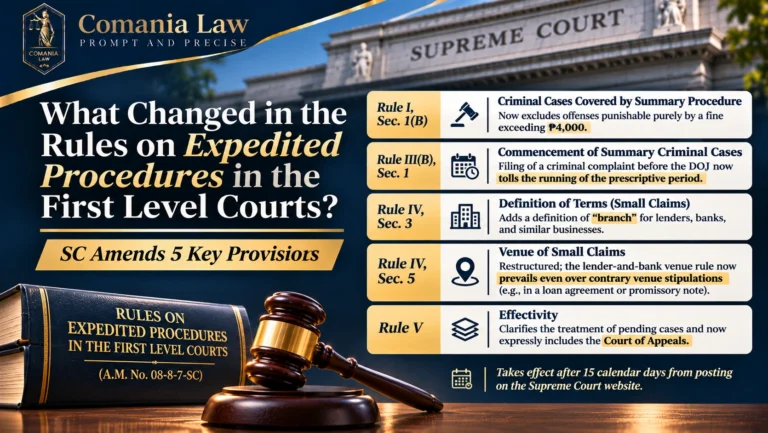
The Supreme Court (SC) En Banc has amended five provisions of the Rules on Expedited Procedures in the First Level Courts (A.M. No. 08-8-7-SC). The changes…